
Synthflow vs PolyAI comes down to how you buy. Synthflow sells only an annual enterprise agreement scoped to your volume, with no trial. PolyAI publishes plans from $49 a month and builds the agent for you on Enterprise. Both are closed and hosted. Teams that want to own the platform can run open-source Dograh, self-hosted or on Dograh Cloud.
Key Takeaways
- Synthflow starts every new deployment on an annual enterprise agreement.
- PolyAI Scale charges $299 per location, with minutes pooled across sites.
- Synthflow's only bring-your-own model key is OpenAI's. PolyAI accepts your endpoint.
Synthflow and PolyAI both sell hosted phone agents to customer-service teams, but one starts with a contract and the other with a sign-up page. We put them in one table, price a multi-site month, compare models and compliance, then say who each fits. The last section covers Dograh.
Synthflow and PolyAI in one table
Synthflow sells a scoped project under contract, while PolyAI sells plans you can start today and a contract for larger teams. Each row uses published plans and documentation.
| Row | Synthflow | PolyAI |
|---|---|---|
| How you buy | Annual enterprise agreement, scoped to your volume | Self-serve plans, Platform pay as you go, or Enterprise |
| Published prices | Priced in the agreement | Essentials $49, Plus $199, Scale $299 per location a month |
| Trial | No free plan or trial | Free trial on the self-serve plans |
| Per-minute rate | No rate by the minute | 30¢, 25¢ or 20¢ after included minutes, Platform from 9.5¢ |
| Who builds | Synthflow's team, with launch support where included | You with Wren, or PolyAI and partners on Enterprise |
| Calls at once | Planned inside the agreement | 5 on Essentials, 10 on Plus, 10 per location pooled on Scale |
| Models | Synthflow LLM and OpenAI GPT models | Raven 3.5 by default, OpenAI and Amazon Bedrock options |
| Your own model | An OpenAI key only | Your own model endpoint |
| HIPAA | Self-attested, BAA tied to its HIPAA Setting | BAA on Enterprise |
| Hosting | Synthflow's cloud in the EU and US | PolyAI's cloud, regional data storage on Enterprise |
| Code | Closed | Closed |
A contract or a sign-up page
The real difference is the first step. Synthflow says its product "is sold as an annual enterprise agreement", scoped to your call volume and phone system, and that every new deployment starts on an Enterprise contract. There is no free plan, no trial and no rate by the minute, so the first number you see comes from a sales call.
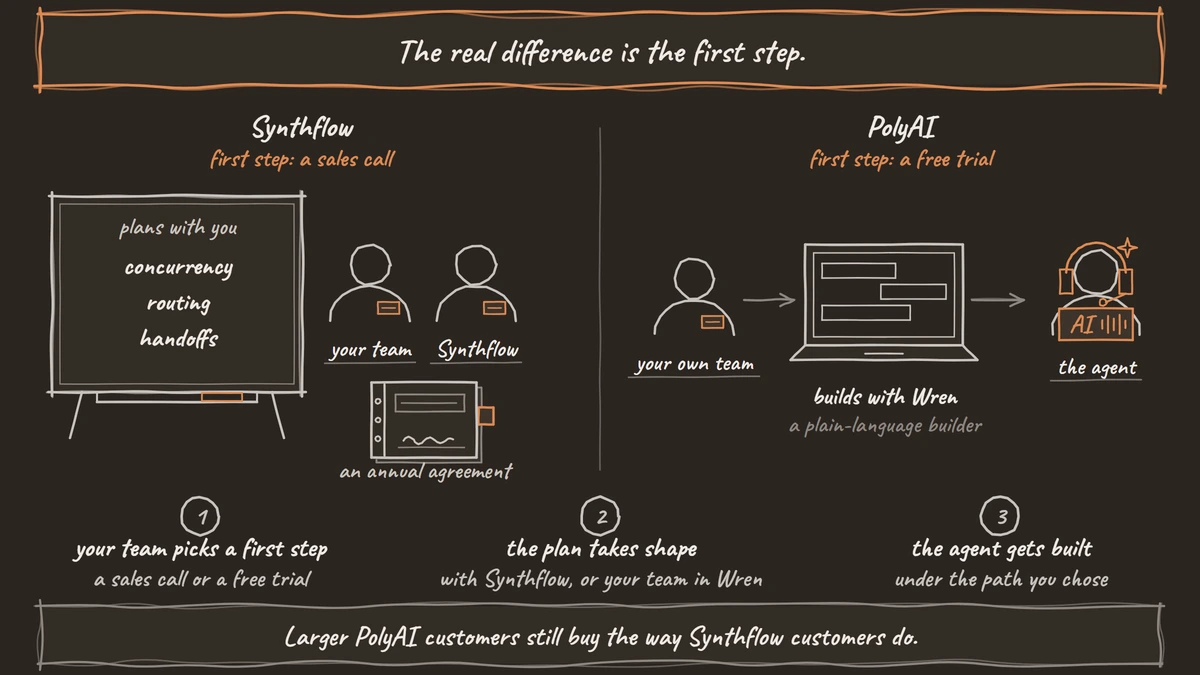
What the agreement covers is substantial. Synthflow plans concurrency, routing, escalation paths, handoffs and fallback logic with you. Its phone options are Synthflow Native Telephony, SIP trunking or approved enterprise telephony. Where launch support is in scope, forward-deployed engineers build alongside your team, and BPOs and platforms can white-label it. Synthflow says deployments go live in weeks, and our post on Synthflow pricing explained walks through what the contract counts.
PolyAI works the other way round. PolyAI prices Essentials at $49 a month with 250 minutes included, Plus at $199 with 1,000 and Scale at $299 per location with 1,500 per location, pooled across one to nine sites. A free trial comes first, and on those three plans your own team builds the agent with Wren, PolyAI's plain-language builder.
Larger PolyAI customers still buy the way Synthflow customers do. Enterprise is custom, and PolyAI or a partner builds the agent. Our PolyAI review weighs each PolyAI plan on its own.
What 8,000 minutes across three sites costs
A worked example shows where the two models diverge. Take a business with three locations and 8,000 call minutes in a month, with the phone line left out because both let you bring a carrier.
| Route | Platform line for 8,000 minutes | Calls at once |
|---|---|---|
| PolyAI Scale, 3 locations | 3 x $299 = $897 for 4,500 pooled minutes, plus 3,500 x $0.20 = $700, total $1,597 | 10 per location, pooled |
| PolyAI Plus, one account | $199 for 1,000 minutes, plus 7,000 x $0.25 = $1,750, total $1,949 | 10 |
| PolyAI Platform pay as you go | 8,000 x $0.095 = $760 and up | 10 |
| Synthflow | Priced in the annual agreement | Planned in the agreement |
| Dograh Cloud | 8,000 x $0.01 = $80 platform fee | 10 included, more on request |
The rows are not like for like. PolyAI's plans already include its models, connectors and review features, while the Platform route is the bare minute with Dograh's line covering only the platform. Your model and carrier bills sit on top of Dograh's $80.
Two things stand out on the PolyAI side. Scale comes in under Plus here because three locations bring 4,500 included minutes, and pooling lets a quiet site cover a busy one. And the Platform route is lowest on paper but leaves out what the plans add. Our breakdown of PolyAI pricing explains that route and the model API.
Synthflow cannot sit in this table as a number. Ask its sales team for the annual figure at your volume, and compare it against the PolyAI row you would really use.

Open Source Alternative to Vapi / Retell
Self-hosted voice agent platform — no per-minute fees
dograh-hq/dograh
Star on GitHub
Models and how much choice you get
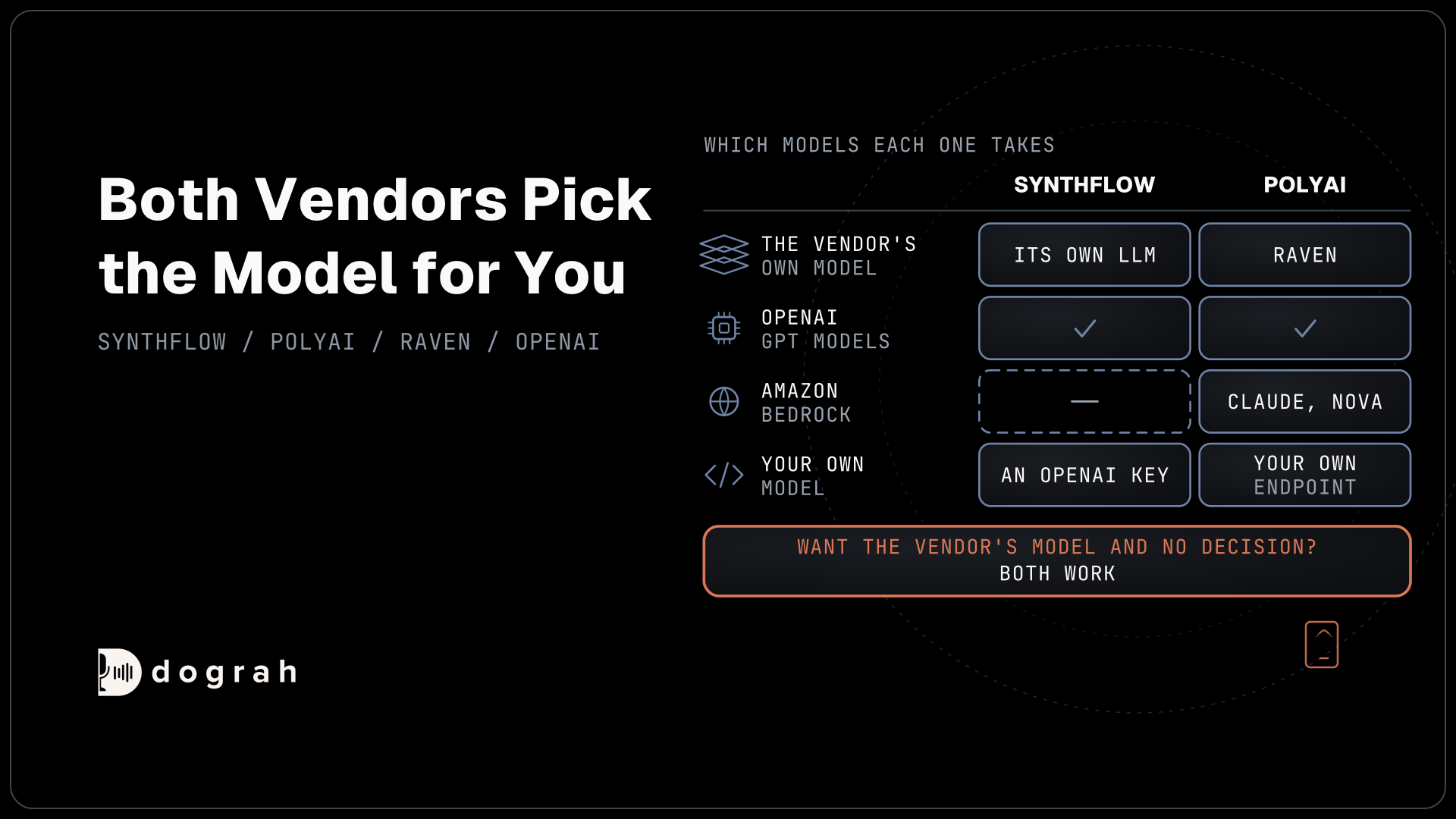
Both vendors pick the model for you by default, but PolyAI leaves more room to change it. Synthflow's model settings say "Synthflow LLM is the only model available to non-enterprise customers". Since every new deployment is now on Enterprise, buyers choose from Synthflow LLM, Advanced Synthflow LLM and OpenAI's GPT models, and the only bring-your-own option is an OpenAI API key.
PolyAI recommends Raven 3.5, its own language model built for customer service, for every deployment. Its list adds OpenAI models and Amazon Bedrock models such as Claude and Nova. Through PolyAI's bring-your-own-model guide you can also connect your own language model endpoint.
So if your team has already settled on a model outside OpenAI, PolyAI can take it and Synthflow cannot. If you want the vendor's model and no decision at all, both work.
Either way, the model choice does not move the call. Bringing your own key or endpoint changes whose model reasons over the conversation, while the audio still runs through the vendor's platform.
Compliance, hosting and HIPAA
Both carry solid certificate lists, and both keep the platform in their own cloud. Synthflow's Trust Center lists SOC 2 Type 2, ISO/IEC 27001, GDPR, PCI DSS v4.0.1 and HIPAA, which Synthflow marks as self-attested. It offers a business associate agreement (BAA) under the Health Insurance Portability and Accountability Act (HIPAA) to customers who use its HIPAA Setting, and it shows EU and US hosting.
PolyAI's plans all run on SOC 2 and ISO 27001 certified infrastructure, and the company also holds SOC 2 Type II, Cyber Essentials Plus and PCI DSS. HIPAA with a BAA, single sign-on, PCI card capture, regional data storage and an uptime SLA are Enterprise items.
For patient calls, then, both roads lead to a contract. On Synthflow every customer is already on one, and the HIPAA Setting decides whether the BAA applies. On PolyAI a clinic starting on Essentials moves to Enterprise before patient calls go through.
Both run as hosted platforms with closed code, so your security team reviews the vendor's certificates rather than the code, and the calls run on the vendor's servers.
Join the Dograh Community
Dograh is an OSS alternative to Vapi. Join our Slack community for queries, releases, best practices & community interactions.
Which one fits your team
Synthflow fits a company that wants a vendor to scope, build and launch the agent under one agreement. It suits contact centers moving an existing phone system onto voice AI with engineers on the project, and BPOs that want each client under their own brand. It fits less well if you want to try the product before you sign, or use a model outside OpenAI.
PolyAI fits a team that wants to start small and grow. A single site can sign up for Essentials, a business with several locations gets pooled minutes on Scale, and a contact center can move to Enterprise when it needs a BAA, SSO or data residency. It fits less well when 5 or 10 calls at once is too few for your busiest minute and you are not ready for Enterprise.
Both fit less well for a team that needs the platform on its own servers or wants to change the code. Whichever you shortlist, run the pilot over a real phone number. Most phone calls still reach the agent as 8 kHz audio, while a browser demo runs at 16 kHz, so an agent tuned in a browser can mishear callers once it takes real calls.
Where Dograh fits
Dograh fits buyers who want neither a contract to start nor a closed platform. Its code is open under BSD 2-Clause, and you can run it on your own servers with Docker, take on-premise or private-cloud deployment on the Enterprise plan, or start on Dograh Cloud with no agreement to sign.
Price works per minute instead of per contract. A self-hosted install has no per-minute platform fee, though servers, model keys and phone minutes still cost money. Dograh Cloud's platform fee is 1¢ per minute, which is the $80 line in the example above.
Running it yourself is real work, and it is worth saying so up front. The server, the database and the upgrades all land with your team. Support on the open-source version comes from the community on Slack and GitHub, and the Enterprise plan carries custom SLAs.
The model layer is where Dograh differs most from both vendors. It is the orchestration layer that runs the call flow, tools and telephony, and you choose the inference providers underneath, from Dograh's own models to any supported provider on your key or open-weight models on your own servers. Only that last route keeps the call audio inside your infrastructure.
For a business with several sites, many phone numbers can point at the same agent, and the number each caller dialed reaches Pre-Call Data Fetch, so the agent can load that site's hours and details before it speaks. Calls at once start at 10 on a self-hosted install, raised with one setting, and Dograh Cloud includes 10, with more on request.
For patient calls, self-hosting means no BAA with Dograh, since the calls never reach us. Your model providers may need their own, and the carrier may need one depending on what it stores.
Agents are built by chatting with the Agent Builder, then checked by the QA step, which scores each step of test and live calls. Our Dograh vs Synthflow comparison covers moving from a Synthflow agreement row by row.
Glossary
- Annual enterprise agreement
- A yearly contract scoped to a buyer's call volume and phone system, priced by the vendor's sales team. Synthflow starts every new deployment on one, with no trial and no per-minute rate.
- Pooled minutes
- Minutes included per business site and shared across every site on one plan. PolyAI's Scale costs $299 per location a month for one to nine locations, with included minutes pooled across them.
- Own model endpoint
- Connecting a language model you host or choose to the vendor's platform through its API address. PolyAI supports it, while Synthflow's only bring-your-own option is an OpenAI key.
- Self-attested
- A vendor's own statement that its platform meets HIPAA, rather than an outside auditor's. Synthflow marks its HIPAA listing this way and ties its BAA to the HIPAA Setting.