
Smith.ai suits small offices that want a person on the line, selling AI, live and hybrid receptionists billed per call. AI starts free for 25 calls, and live plans start at $300 for 30. For teams that want to own the agent and its data, Dograh, the open-source AI voice agent platform, runs self-hosted or on Dograh Cloud.
Key Takeaways
- Smith.ai sells AI, live and hybrid receptionists, each billed per call.
- Buyers praise the live receptionists, while recent complaints target AI errors and refunds.
- Smith.ai's terms make subscriber information jointly owned by Smith.ai and you.
Smith.ai sells a phone answered by AI, by people or by both, and the fit comes down to who answers. We cover what it sells, the AI day to day, price, buyer reviews and data terms, and then we talk about how Dograh fits for teams that own the agent.
The verdict on Smith.ai
Smith.ai is a strong choice for a small office that wants a real person available behind the AI. Its live receptionists have years of practice, its AI line starts free, and its hybrid plans let a business send its most valuable calls to people while AI handles the rest.
The trade is in the bill and the ownership. Every line is billed per call in monthly tiers, add-ons on the live line are charged per call, and a busy month runs at overage rates. The agent runs on Smith.ai's platform, and its terms make the call information jointly owned.
So the real question is what you need to keep. A firm that values a person on the line more than control of the agent will be well served. A team that wants to own the agent, its prompts and its call records, or to pick its own models, will find the limits early.
Three ways Smith.ai answers your phone
The three lines differ in who picks up. The AI Receptionist answers every call with AI, and escalates to a person when the AI decides it should. The Virtual Receptionists line is live people for every call. Hybrid sits between them, with AI-first, Hybrid and Human-first options and presets that decide which calls go to people.
Hybrid is where Smith.ai's own mix shows. Its New Client Priority hybrid preset sends new client calls to live agents and keeps existing clients with AI, and Smith.ai says about 25% of AI-led calls usually need a live agent. Highest Touch sends new and existing clients to people, and After Hours Only puts people on days and AI on nights and weekends. A call that starts with AI and moves to a person counts as one call.
Behind all three sits the Live Agent Network. Smith.ai says it has 500+ North America-based receptionists, handles 400K+ calls a month and has handled 25M+ calls over 10+ years.
What the AI receptionist does day to day
The AI answers around the clock, qualifies leads, takes intake, books appointments, routes calls and transfers with context. Smith.ai's AI Receptionist page lists English and Spanish, 12+ voices, recording, transcription and call summaries on every plan, with spam screening and a dedicated number.
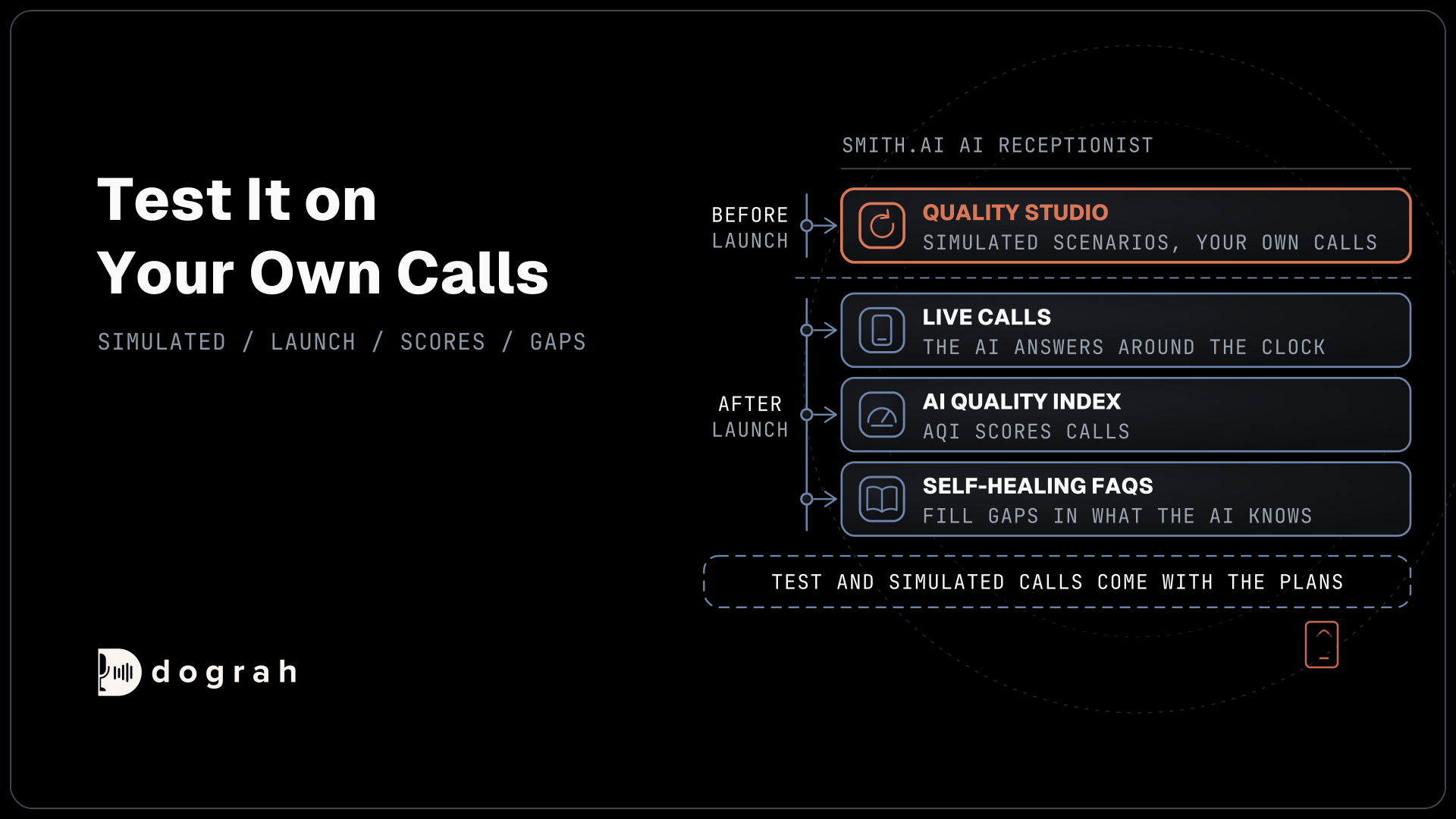
Quality tools are where it stands out. Quality Studio runs simulated scenarios before launch, so a business can hear how the AI handles its own calls before a customer does. After launch, the AI Quality Index (AQI) scores calls, and Self-Healing FAQs fill gaps in what the AI knows. Test and simulated calls come with the plans.
The integrations lean toward law firms and sales teams. Salesforce, HubSpot, Clio Grow and Clio Manage connect natively, and Zapier and Make reach the rest. Smith.ai's AI page is built around legal intake, with case management lookups among its examples, which matches where the service has its deepest roots.
Callers are told they are talking to AI. Smith.ai's own answer to "Will callers know they are speaking to AI?" is "Yes", with greetings a business can customize to introduce the service.

Open Source Alternative to Vapi / Retell
Self-hosted voice agent platform — no per-minute fees
dograh-hq/dograh
Star on GitHub
Pricing in brief
Every Smith.ai line bills per call in monthly tiers. The AI Receptionist starts with a free plan of 25 calls a month, and Pro starts at $150 for 75 calls. The live line starts at $300 for 30 calls, and Hybrid runs from about $1.60 a call AI-first to $7 a call Human-first. Our post on Smith.ai pricing covers every tier, the add-on list and a month at three call volumes.
The add-ons are the part to read closely. On the live line, booking, intake, payments and the rest are charged per call, and a business can stack several. A rival's review of Smith.ai from CallRail, which sells a competing receptionist, makes the same point, and Smith.ai's own list confirms the figures, such as $1.50 for booking and $0.25 for recording and transcription. On the AI line, an escalation the AI starts carries no fee, while live involvement for verification or scheduling is a per-call add-on.
What buyers say
Buyers rate Smith.ai well overall. On Smith.ai's Trustpilot page it holds a TrustScore of 4.2, with most reviews at five stars and a small share at one. The praise centers on the live receptionists, their manners with callers, and cover at nights and weekends.
The recent complaints point at the AI and at refunds. One reviewer says the AI "barely works, consistently making errors and frustrating callers". Another disputes a refund on a six-month term. Smith.ai replied that term plans are non-refundable and that "We do offer month-to-month plans with no long-term contract."
Read the pattern rather than any single review. The live service is where Smith.ai has most of its history, while the AI line is newer. A business choosing the AI line should test it on its own calls in Quality Studio, and read the term before choosing anything longer than month to month.
Join the Dograh Community
Dograh is an OSS alternative to Vapi. Join our Slack community for queries, releases, best practices & community interactions.
Data, contracts and the platform
The data terms are short and worth reading in full. Smith.ai's terms say "All Subscriber Information is jointly owned by Smith and you", kept so that Smith.ai can store it on its servers, relay messages, identify spam callers and improve its services. Smith.ai says it will not sell that information.
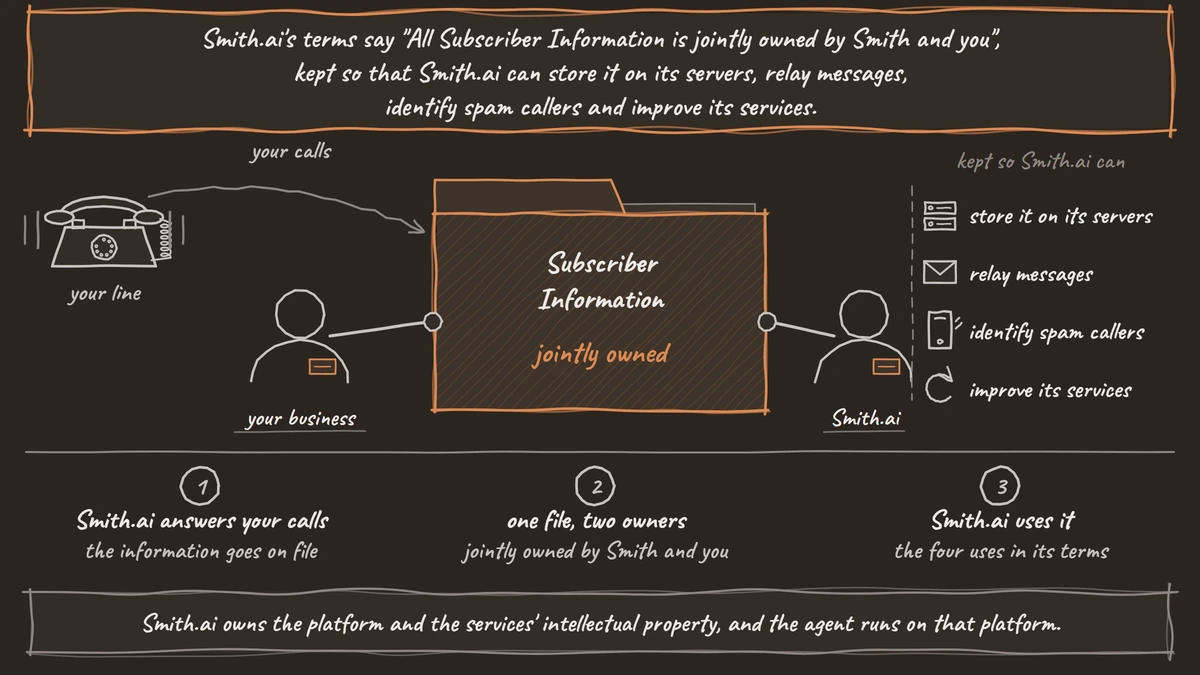
Deletion takes a request. Smith.ai responds to a written request within 3 business days, and deleting the information may require deleting the account and take up to 30 days. For EU data, Smith.ai acts as processor under a data processing agreement. Smith.ai owns the platform and the services' intellectual property, and the agent runs on that platform.
The contract is light on the self-serve plans. They are month to month with no long-term contract, and plan changes are billed from the next month, so a busy month cannot move to a bigger tier halfway through. New live-line clients get a 30-day money-back guarantee up to $1,000, excluding overage. Longer terms, such as the 6-month plan with rollover calls, trade flexibility for a lower rate and, per Smith.ai's reply on Trustpilot, are non-refundable.
A few questions are worth asking before signing. Ask whether add-ons apply to overage calls, what the 6-month plan costs and what leaving it early means, and how call records and recordings are exported if you move. Get the answers in writing, since they decide what the second year looks like.
Who Smith.ai fits and who it does not
Smith.ai fits a small office that wants a person on the line and a steady call volume. Law firms fit best, with Clio integrations and intake built into the AI. A business that cares most about new client calls can send those to people with the New Client Priority preset and let AI take the rest.
It fits less well where ownership or volume drives the decision. A team that wants to change the models, keep call records on its own servers or move the agent elsewhere is buying a service rather than a platform. A business with sharp swings in volume will see overage and per-call add-ons drive the bill more than the tier. Our list of Smith.ai alternatives sorts the other options by type.
Where Dograh fits for teams that own the agent
Dograh, the open-source AI voice agent platform, sells software rather than answered calls, so the people behind the agent are your own staff. Transfer Call sends a caller to the front desk, and Dograh calls the destination first and connects the caller only when someone answers. If the transfer gets no answer, a busy line or an error, the agent hears the result and carries on with the caller. It runs on Twilio, Telnyx, Plivo, Cloudonix and Asterisk ARI.
The agent then does the follow-up itself. When a transfer does not connect, the agent can take a callback request into your system through an HTTP API tool, and the same kind of tool books appointments in the calendar you already use. Callers give their answers by speaking, and any text message goes out through your own SMS provider, called from an HTTP API tool. Our guide to AI receptionist call transfer covers the handover in more depth.
Ownership is the difference that matters most here. When you self-host, the agent definition, its prompts, the recordings and the transcripts sit on your servers, and the speech and language models are chosen per agent. Your own model keys move the contract to you while the call text still reaches the provider you picked, and open models you host keep it inside your walls.
The platform is its own line on the budget. Self-hosting Dograh means paying no per-minute platform fee, though you still cover the servers, the model keys and the phone minutes. Your team handles the database and each upgrade. Support comes through the open-source community, and Enterprise adds custom SLAs. A business without its own servers can use Dograh Cloud, which runs everything for a 1¢-a-minute platform fee and includes 10 concurrent calls on pay as you go, with more on request, while a self-hosted install runs 10 by default and can be raised.
Glossary
- Live Agent Network
- Smith.ai's pool of human receptionists behind its AI and live lines. Smith.ai says it has 500+ North America-based receptionists.
- AI Quality Index (AQI)
- Smith.ai's score for how well its AI handles live calls, read alongside Quality Studio's simulated test calls before launch.
- Hybrid preset
- A Smith.ai setting that decides which calls go to people and which stay with AI, such as New Client Priority or After Hours Only.
- Subscriber Information
- The call and customer information Smith.ai collects for a business. Its terms make it jointly owned by Smith.ai and the business.