
A voice agent takes as many calls at once as the lowest limit in its chain allows, set by the platform plan, the phone carrier and the speech, language and voice accounts. Vapi includes 4, 10 or 30 by package and Retell 20 on pay-as-you-go. Self-hosted Dograh runs 10 at once by default, and you can raise it.
Key Takeaways
- No platform gives one number, because the lowest limit in the chain decides.
- Size for your busiest hour, calls times minutes divided by sixty.
- "Unlimited" usually means metered minutes, so get the real number in writing.
Ask five vendors how many calls their agent takes at once and you get five kinds of answer. We give the direct answer first, then a sizing formula for your busiest hour. Then we talk about what callers hear at the limit and how Dograh's limit works.
The short answer: the lowest limit wins
A voice agent is a chain of systems, and every link has its own cap. The first is the platform plan. Vapi's pricing includes 4 calls at once without a package, 10 on Core and 30 on Pro, with extra lines at $10 a month each. Retell's concurrency docs give Pay-As-You-Go workspaces 20 by default, raised under Settings and Limits.
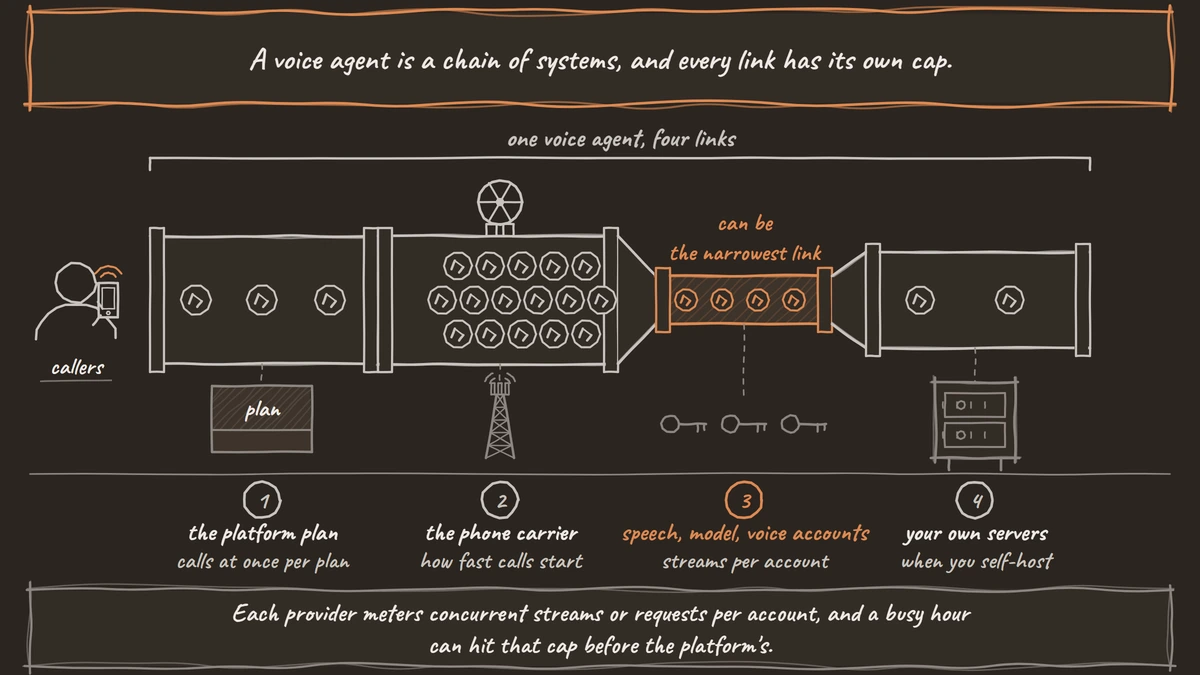
The phone carrier is the second link. Twilio's call docs start each account at one outbound call per second, raised to five with an approved Business Profile, while inbound calls are not limited this way. That caps how fast a campaign can dial, while the number of calls that stay open is untouched.
The third link is the speech-to-text, language model and voice accounts behind the agent. Each provider meters concurrent streams or requests per account, and a busy hour can hit that cap before the platform's. Our post on STT and TTS concurrency limits shows where each vendor counts it. Your own servers are the last link when you self-host, and whichever link is narrowest sets the real answer.
How many calls at once you need
Daily volume does not tell you much. What matters is how many calls overlap in your busiest hour, and the arithmetic is short. Take the calls in that hour, multiply by the average call length in minutes, and divide by 60.
A support line that takes 300 calls between 9 and 10 on a Monday, averaging 4 minutes each, gives 300 x 4 / 60 = 20 calls at once. That is an average for the hour, and calls bunch up inside it, so plan headroom above it. For a firmer number, the Erlang B formula takes the same traffic and tells you how often a caller would find every line busy at a given line count.
Call length matters as much as volume. Halve the average to 2 minutes and the same 300 calls need about 10 lines, while a 10-minute intake call pushes the same hour to 50. Long calls also hold a line until they end, so set a sensible maximum call length rather than letting a stuck call sit for half an hour.
Outbound campaigns are easier to size because you choose the pace. To reach 2,000 people in an 8-hour day, with attempts averaging 3 minutes once unanswered rings are counted, you need 2,000 x 3 / 480, about 13 lines. Run the campaign on fewer lines and it simply takes longer, which is often the better trade when inbound calls share the same limit.

Open Source Alternative to Vapi / Retell
Self-hosted voice agent platform — no per-minute fees
dograh-hq/dograh
Star on GitHub
What callers hear when every line is busy
The limit matters most for what the next caller experiences, and that differs by platform. Retell briefly holds a new inbound call for a free slot, about 40 seconds, before its fallback handling starts. Twilio queues outbound calls over the calls-per-second limit and dials them at that rate, so a campaign slows down rather than failing.
In Dograh, a call over the organization's limit is refused before it starts. An outbound request through the API gets a 429 reply, "Concurrent call limit reached", so your system can retry later. On an inbound Twilio call, the caller hears a short message that the service is temporarily unavailable before the call ends.
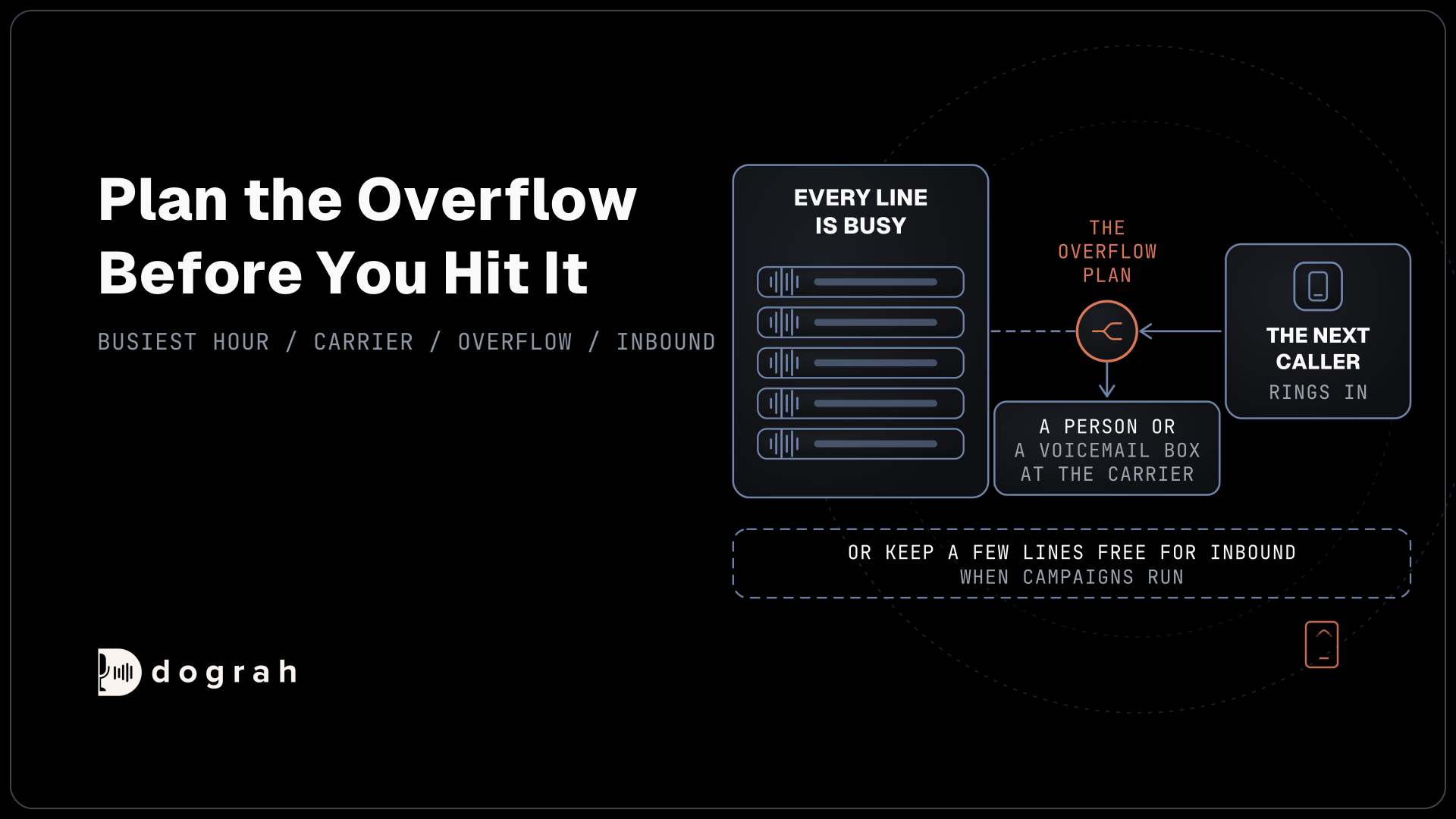
Plan the overflow before you hit it. Point busy calls to a person or a voicemail box at the carrier, or keep a few lines free for inbound when campaigns run. Our list of voice agent platforms for high call volume compares what each platform does when every line is busy.
Why "unlimited" rarely means unlimited
Some AI receptionist services advertise unlimited simultaneous calls. In practice that usually means they bill by the minute or the call and absorb the caps in the chain on their side, which works until a busy hour hits the same carrier and model limits everyone else has.
Before you sign, get the number of calls the account can hold at once in writing, along with what happens to the next caller when it is full. Ask too how fast the vendor raises it. A plan that answers with a number is easier to size than one that answers with a word.
Join the Dograh Community
Dograh is an OSS alternative to Vapi. Join our Slack community for queries, releases, best practices & community interactions.
Dograh's limit and how to raise it
Dograh, the open-source AI voice agent platform we build, counts calls at once per organization. A self-hosted install runs 10 by default, and you raise it with DEFAULT_ORG_CONCURRENCY_LIMIT in the environment variables. The limit covers inbound, outbound, browser and agent stream calls together, and a campaign's Max Concurrent Calls setting can never go above it.
Raising the number only helps if the rest of the chain keeps up. Several API keys per speech, language or voice provider spread calls across accounts, and the platform rotates through them. On your own servers, more FastAPI workers behind nginx handle more calls, as the scaling guide explains. Our post on how to scale to thousands of simultaneous calls covers load tests for each step.
Running Dograh yourself means no per-minute platform fee. It also lets you set the limit yourself. You still pay for servers, model keys and phone minutes, and your team looks after the database and upgrades. Support comes from the open-source community, and Enterprise adds custom SLAs. If you would rather not host it, Dograh Cloud runs it for a 1 cent a minute platform fee, and its Pay as you go plan includes 10 calls at once, with higher concurrency on request.
Glossary
- Concurrency limit
- The number of calls an account can hold open at the same moment. Platforms, carriers and model providers each set their own.
- Calls per second (CPS)
- How fast a carrier lets an account start outbound calls. Twilio starts at one per second, which slows campaigns but does not cap open calls.
- Peak-hour concurrency
- The average number of calls open at once in your busiest hour, worked out as calls times average minutes divided by 60.
- Erlang B
- A telephony formula that gives the chance a caller finds every line busy, from the traffic offered and the number of lines.