
The best voice AI APIs depend on the layer. Deepgram, AssemblyAI and ElevenLabs Scribe are strong speech-to-text picks, ElevenLabs and Cartesia rank near the top for voices, and Gemini, OpenAI and Groq cover the language model. For teams that want those APIs on real phone calls with their own keys, Dograh is the open-source platform, self-hosted or on Dograh Cloud.
Key Takeaways
- An API sells one model layer, while a platform adds the call, tools and telephony.
- Gemini 3.8 Flash rises to $1.50 in and $7.50 out on January 1, 2027.
- In our example, three cascade APIs cost about $0.14 for a 5-minute call.
Most lists of voice AI APIs mix model APIs with full platforms, which makes their prices impossible to compare. We sort the APIs by layer, from speech-to-text to speech-to-speech, price one call across them, then talk about the platform layer, where open-source Dograh runs these APIs on your keys.
What an API gives you and what a platform adds
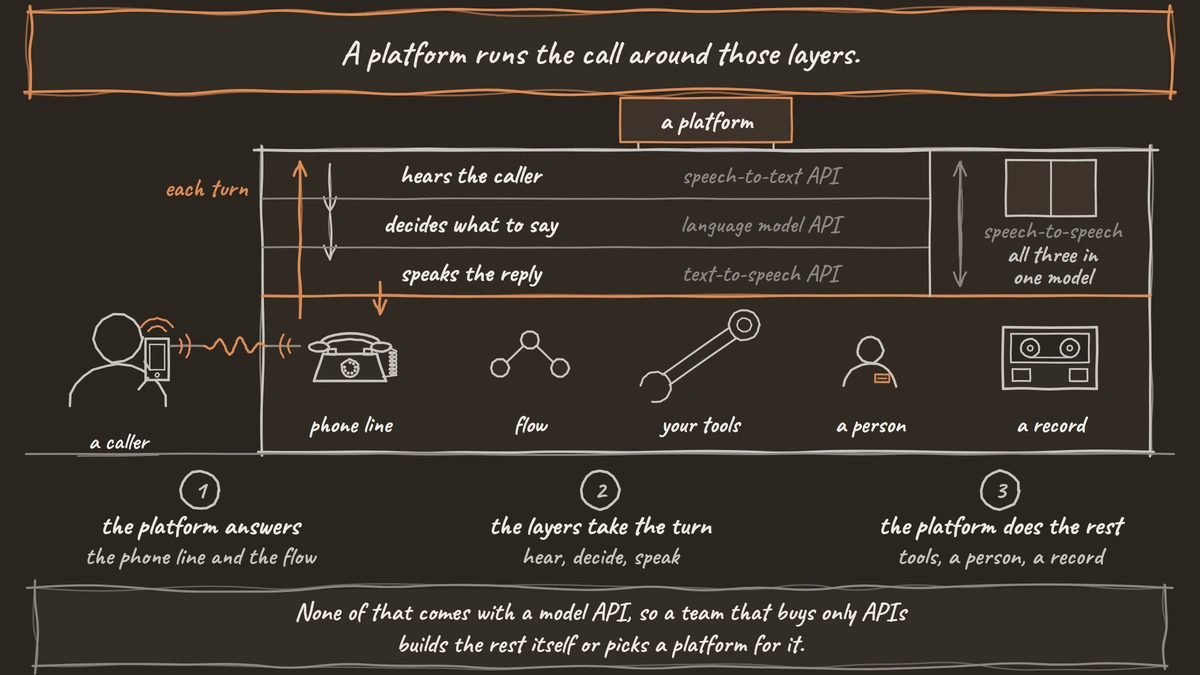
An API sells you one model layer. A speech-to-text API turns the caller's audio into text, a language model API decides what to say, and a text-to-speech API turns the reply into a voice. Chaining those three is called a cascade. A speech-to-speech API does all three in one model, taking audio in and sending audio out.
A platform runs the call around those layers. It answers the phone line, keeps the conversation flow, calls your tools and APIs mid-call, hands the caller to a person and records what happened. None of that comes with a model API, so a team that buys only APIs builds the rest itself or picks a platform for it.
The two are priced differently too. Model APIs charge per minute of audio, per character or per token, and platforms charge per minute of call on top. Keeping the layers apart is the only way to see where the money goes.
Voice AI APIs compared, layer by layer
Each row lists two or three picks with the price on the vendor's own pricing page. Our deeper lists rank more providers in each layer.
| Layer | Picks | Published price |
|---|---|---|
| Speech-to-text | Deepgram Nova-3, AssemblyAI STT-3.7-Realtime-Agent, ElevenLabs Scribe v2 Realtime | $0.0048 a minute (promotional), $0.45 an hour, $0.22 an hour |
| Text-to-speech | ElevenLabs Flash, Cartesia Sonic 3.6, Deepgram Aura-2 | $0.04 per 1,000 characters, credit plans from $5, $0.030 per 1,000 characters |
| Language model | Gemini 3.8 Flash, OpenAI GPT-6 models, openai/gpt-oss-120b on Groq | $0.75 in and $3.75 out per 1M tokens until December 31, OpenAI by model, $0.15 and $0.60 |
| Speech-to-speech | OpenAI gpt-live-1, Gemini 3.8 Live, ElevenLabs Realtime v1 | $0.05 a minute plus the backend model, about $0.005 in and $0.018 out a minute, $0.08 a minute plus the LLM |
| One-vendor bundle | Deepgram Voice Agent API, ElevenLabs Agents | $0.075 a minute, $0.08 a minute |
| Platform | Dograh, Vapi, Retell AI | Your keys with self-hosted or Cloud pricing below, $0.05 a minute hosting, $0.055 a minute voice infrastructure |
Speech-to-text APIs: Deepgram, AssemblyAI, ElevenLabs
Deepgram's pricing page lists Nova-3 streaming at $0.0048 a minute for one language and $0.0058 for many, marked as a promotional rate that was $0.0077, with Flux English at $0.0065 and $200 of free credit. AssemblyAI's STT-3.7-Realtime costs $0.30 an hour, about $0.005 a minute, and its agent version $0.45 an hour. It bills on session duration, so a connection left open while nobody speaks still counts, and new accounts get $50 of credit.
ElevenLabs Scribe v2 Realtime costs $0.22 an hour, about $0.004 a minute. Benchmarks on clean recordings rarely match 8 kHz phone audio, so record a few of your own calls and test each one. Our list of the best speech-to-text APIs for voice agents compares more providers on phone audio, latency and languages.
Text-to-speech APIs: ElevenLabs, Cartesia, Aura-2
ElevenLabs charges $0.04 per 1,000 characters for its Flash and Turbo voices and $0.08 for v3 and v4. On Artificial Analysis's blind-vote board, Eleven v4 Turbo leads, and Cartesia's Sonic 3.6 sits near the top. Cartesia, a Dograh partner, sells credits, from $5 for 100,000 on Pro to $49 for 1.25 million on Startup, with about 750 to 800 credits per minute of audio. Deepgram Aura-2 costs $0.030 per 1,000 characters.
Voice choice is mostly about how the voice sounds to your callers and how fast its first audio arrives. Our list of the best TTS APIs for voice agents compares voices, cloning and latency by provider.
Language model APIs for live calls
A phone call needs a model that answers fast and calls tools reliably, so the largest model is rarely the right one. Google's Gemini pricing puts Gemini 3.8 Flash at $0.75 in and $3.75 out per million tokens through December 31, rising to $1.50 and $7.50 on January 1, 2027. On Groq, openai/gpt-oss-120b costs $0.15 in and $0.60 out per million tokens, and OpenAI's GPT-6 models price by size.
Token counts on a call grow with every turn, since the whole conversation is sent again each time. Our breakdown of LLM API pricing for voice agents prices a 5-minute call on each model family, including caching.
Speech-to-speech APIs: one model for the whole turn
OpenAI's pricing page lists gpt-live-1 at $0.05 a minute, with its backend model billed separately, and gpt-realtime-2.1 audio at $32 in and $64 out per million tokens. Gemini 3.8 Live works out to about $0.005 a minute of audio in and $0.018 out. ElevenLabs Realtime v1 charges $0.08 a minute plus the language model.
Speech-to-speech cuts the handoffs between layers and sounds natural, and it costs more per minute. Realtime models also tend to fail more often on complex tool calls, so a cascade remains the safer pick when the agent books, looks up and updates records mid-call. Our comparison of cascade and speech-to-speech covers the trade in depth.
One-vendor bundles: a voice agent in one API
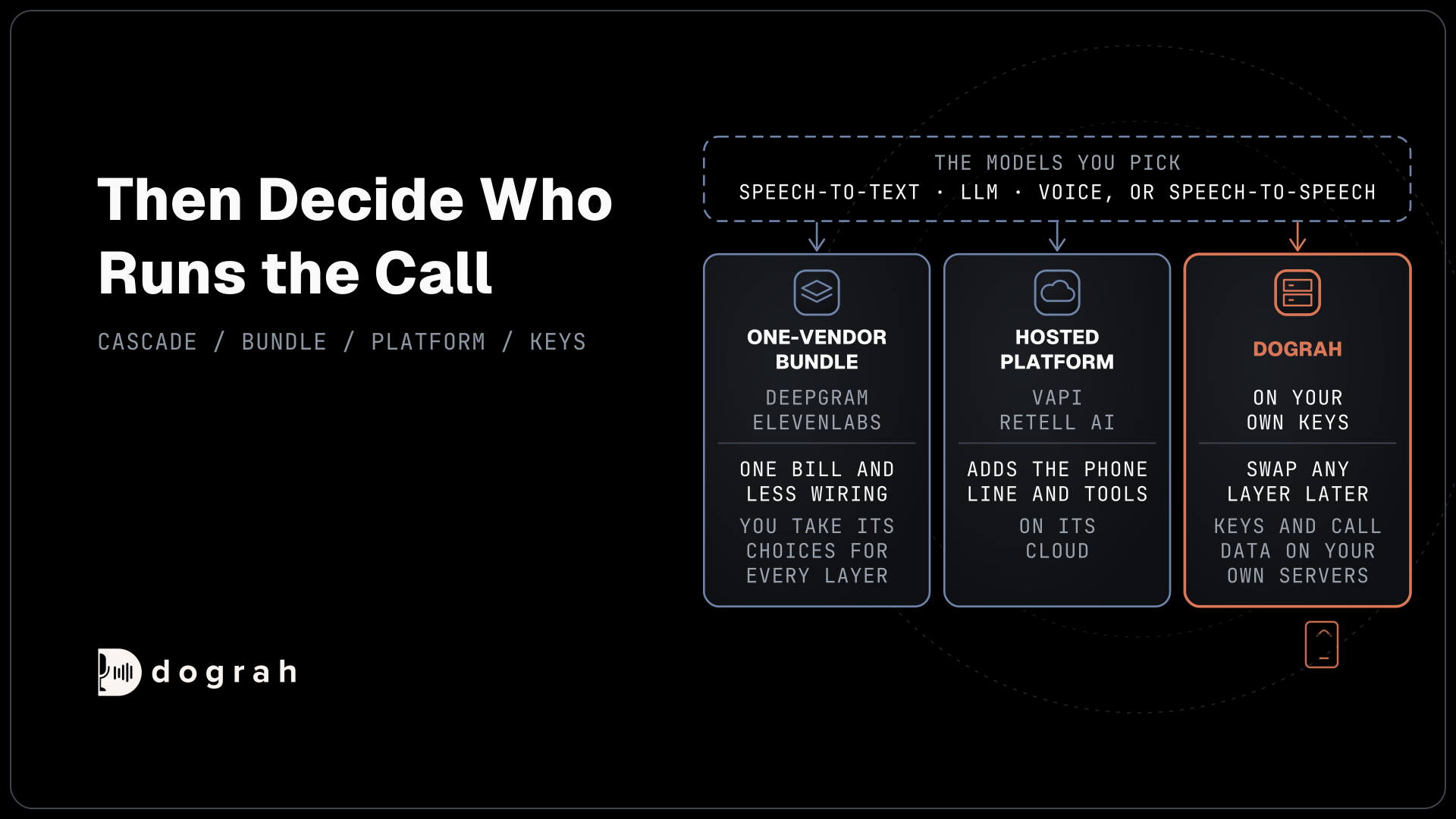
Between single APIs and full platforms sit bundles that run the whole conversation from one vendor. Deepgram's Voice Agent API costs $0.075 a minute on Standard, $0.065 when you bring your own voice or your own LLM, and $0.050 when you bring both. ElevenLabs Agents costs $0.08 a minute. You get one bill and less wiring, and you take that vendor's choices for every layer it supplies.
Hosted platforms go further, adding the phone line, the flow and tools. Vapi charges $0.05 a minute hosting and Retell AI $0.055 a minute for voice infrastructure, with the models billed on top, and our list of the best AI voice agent platforms compares them in full.
Dograh: the platform layer on your own keys
Dograh is the orchestration layer that runs the call flow, tools and telephony, and the speech and language models are a separate layer you choose. For each agent, you pick a speech-to-text, LLM and voice provider, or a speech-to-speech model, on your own keys or on Dograh's own models, in Model Configurations. The lists cover the APIs above, with Deepgram, AssemblyAI, ElevenLabs and Soniox among the speech-to-text options, and ElevenLabs, Cartesia, Deepgram and Rime among the voices.
For the language model, the options include OpenAI, Google, Groq, Azure, AWS Bedrock and OpenRouter, and on Groq the model to pick is openai/gpt-oss-120b. Speech-to-speech runs through OpenAI Realtime, Google's Gemini Live, Azure Realtime, Ultravox and AWS Nova Sonic. A provider can hold several keys, and Dograh spreads calls across them so one rate limit does not stop the agent.
Around the models, Dograh supplies what an API leaves out. The phone line comes from your carrier, such as Twilio, Telnyx, Plivo, Vonage, Exotel, Vobiz, Cloudonix or Asterisk ARI, as the telephony overview lists. The visual workflow keeps the conversation on track, HTTP API tools reach your systems mid-call, and calls get traces and QA scores.
Self-hosted, your API keys and call data stay in your own install. Running Dograh yourself means no per-minute platform fee. You still pay for servers, model keys and phone minutes, and your team looks after the database and upgrades. Support comes from the open-source community, and Enterprise adds custom SLAs. If you would rather not host it, Dograh Cloud runs it for a 1 cent a minute platform fee.

Open Source Alternative to Vapi / Retell
Self-hosted voice agent platform — no per-minute fees
dograh-hq/dograh
Star on GitHub
What one 5-minute call costs across the layers
Here is an example of one 5-minute cascade call at the published rates above. The voice line assumes the agent speaks about 2,400 characters, and the language model figure comes from our LLM pricing breakdown.
| Layer | Pick | Cost for 5 minutes |
|---|---|---|
| Speech-to-text | Deepgram Nova-3, one language | $0.024 |
| Language model | Gemini 3.8 Flash | $0.0242, rising to $0.0484 on January 1, 2027 |
| Voice | ElevenLabs Flash | $0.096 |
| Platform | Dograh | None self-hosted, $0.05 on Dograh Cloud |
| Total before the phone line | About $0.14 self-hosted, about $0.19 on Dograh Cloud |
For contrast, the same five minutes on gpt-live-1 cost $0.25 before its backend model. The voice is the largest line in the cascade, so the voice model is the first place to look when the bill grows.
Join the Dograh Community
Dograh is an OSS alternative to Vapi. Join our Slack community for queries, releases, best practices & community interactions.
Picking your voice AI API stack
Start with the job, then the layer. If the agent books, looks up and updates records, build a cascade and choose each layer on your own calls, a speech-to-text model that hears your callers, a language model that answers fast, and a voice your callers like. If the call is mostly conversation and the budget allows it, a speech-to-speech model gives the most natural turn-taking.
Then decide who runs the call. A one-vendor bundle is the quickest path when one vendor's choices suit every layer. A hosted platform adds the phone line and tools on its cloud. If you want to swap any layer later and keep keys and call data on your own servers, run the APIs through Dograh.
Glossary
- Cascade
- A voice agent built from three separate models, speech-to-text, a language model and text-to-speech, each one swappable on its own.
- Speech-to-speech
- A single model that takes the caller's audio and answers with audio, without a separate transcription or voice step.
- Orchestration layer
- The software that runs the call around the models, the phone line, the conversation flow, tools and transfers.
- Free credit
- A starting balance a vendor gives new accounts, such as Deepgram's $200 or AssemblyAI's $50, enough to test on real calls.