
AI voice agents for win-back in BNPL call shoppers who stopped using a buy now, pay later plan, but only after your system confirms they owe nothing and gave written consent. After verifying the shopper, the agent asks why they stopped, then reads one offer. Any payment problem goes to your hardship team, and no offer is made.
Key Takeaways
- Take anyone behind on any plan off the list before the first call.
- Win-back runs on its own agent and list, apart from collections.
- A shopper who raises a payment problem goes to the hardship team, with no offer.
A lapsed shopper may still owe money on another plan, which makes a win-back offer wrong. We check balances first, keep win-back and collections apart, show why win-back is a sales call, walk through the call and keep spending data in house with Dograh. It sits within our guide to dormant customer reactivation.
Check they owe nothing first
A lapsed BNPL shopper may still owe money on another plan, so the first job is to check every account before anyone is called. In LendingTree's March 2026 surveys, 47% of BNPL users said they had paid late in the past year, up from 41% a year earlier, and 63% have held more than one BNPL loan at the same time.
The Federal Reserve sees the same strain from another angle. In its survey of household finances in 2025, 16% of adults used BNPL, and 11% of those users had a BNPL payment trigger an overdraft or non-sufficient funds fee from their bank.
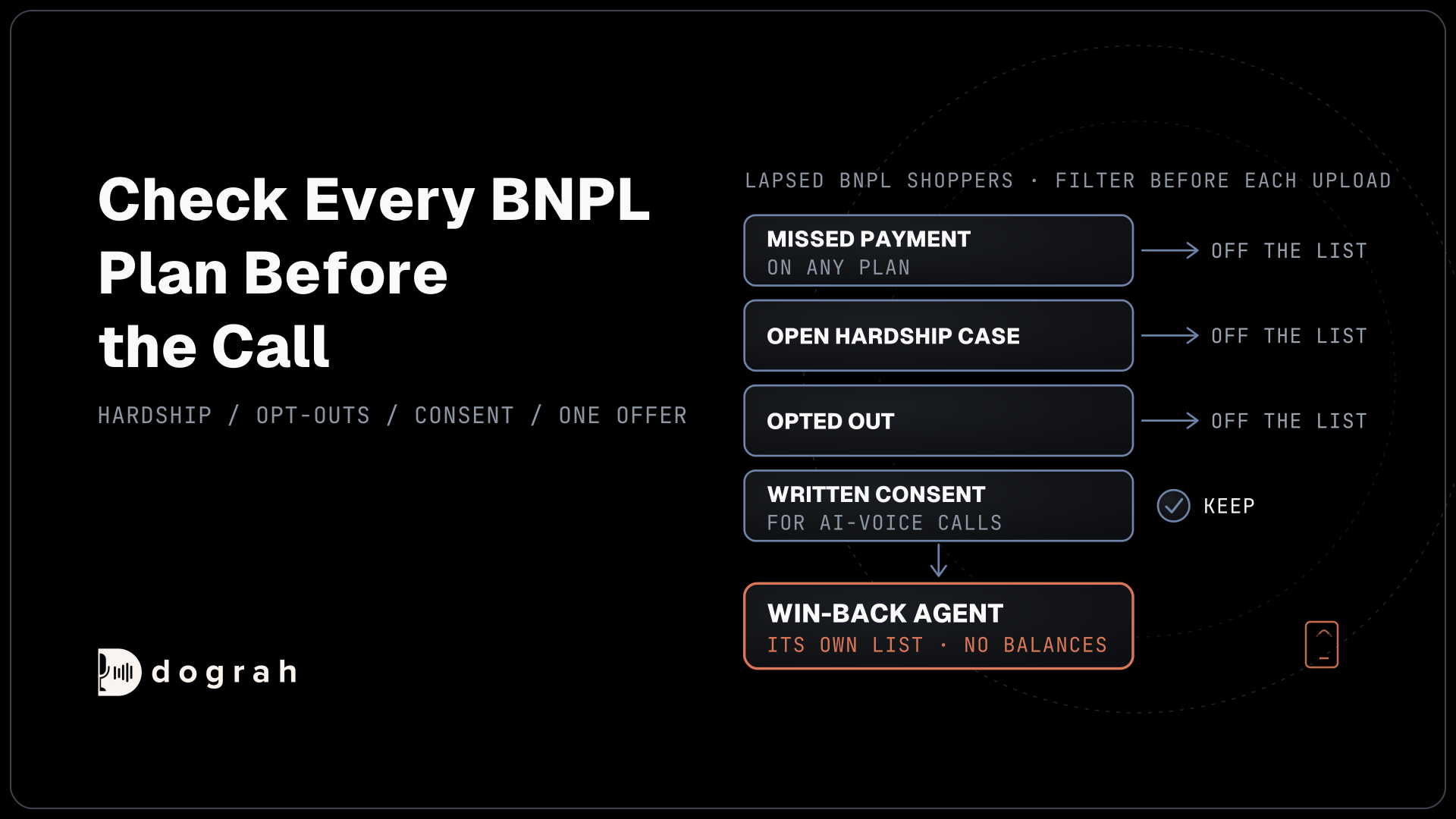
So "lapsed" and "behind" overlap. A shopper who stopped buying may have stopped because they are struggling to pay, and a call inviting them back would land badly. Build the list from your own system and take out anyone with a missed payment on any plan or an open hardship case. Opt-outs come off too. Keep only shoppers with written consent on file for AI-voice calls, and run the filter again before each upload.
Two agents, two lists
Build the win-back call as its own agent with its own campaign, and keep collections on a separate agent. The two calls follow different rules, and an agent built for one should never drift into the other.
The win-back agent never sees a balance. Use Pre-Call Data Fetch on the Start Call node to ask your system for what the call needs, such as the shopper's first name and the one offer they qualify for. Build that endpoint so it returns no amounts and no due dates. It runs once the call connects, so if a payment was missed after the list was built, the endpoint can return no offer and a flag that tells the agent to thank the shopper and end the call.
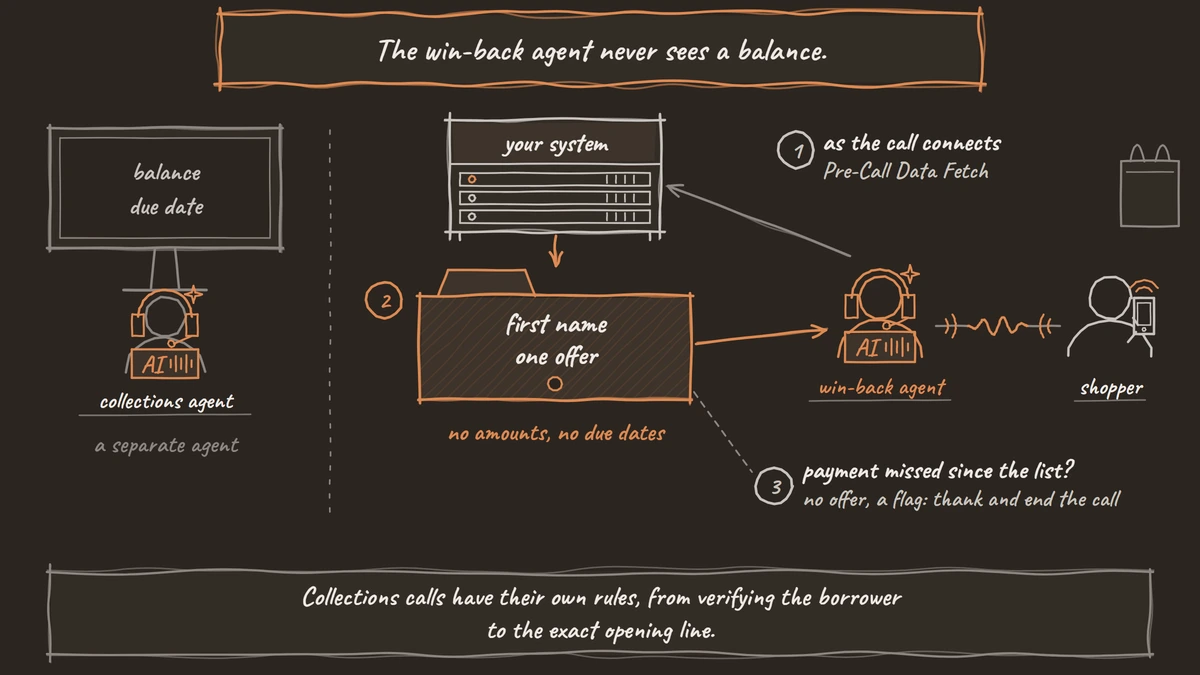
Collections calls have their own rules, from verifying the borrower to the exact opening line. AI voice agents for missed-payment recovery in BNPL covers that call, and nothing from it belongs in a win-back script.
This post speaks to the BNPL provider calling its own customers. A merchant calling its own shoppers about a cart they left is a different caller with its own consent, covered in abandoned-cart recovery.
Win-back here is a sales call
Inviting a shopper back with an offer is telemarketing, so it needs written consent before an AI voice makes the call. A lapsed shopper's phone falls under the Telephone Consumer Protection Act (TCPA) here. The Federal Communications Commission's calling rules require prior express written consent before a sales call uses an artificial voice, and the FCC's 2024 ruling on AI-generated voices places AI voices in that group.
A past purchase does not stand in for that consent. The established business relationship, a purchase within the last 18 months, matters for the do-not-call rules and never replaces written consent for an AI-voice sales call.
Offer wording needs care too. The agent never calls an offer "pre-approved" unless your system returns it that way and your compliance team has approved the words. Read approved terms as fixed text where the wording matters.
UK providers have their own rules now. The Financial Conduct Authority (FCA) regulates BNPL from 15 July 2026 under the Consumer Duty, and lenders must offer support to customers in financial difficulty. A sales call to someone who is struggling sits badly with that duty, which is one more reason the arrears filter comes first. Confirm your consent wording and your UK position with counsel before the first campaign.

Open Source Alternative to Vapi / Retell
Self-hosted voice agent platform — no per-minute fees
dograh-hq/dograh
Star on GitHub
How the win-back call runs
The call names the provider, verifies the shopper, asks why they stopped and makes at most one offer. A payment problem ends the offer at once.
The Greeting Text names the provider, because an unexpected call about a credit product sounds like a scam. Should you want shoppers to know an automated assistant is calling, or a local law says they must, add that line to the greeting as well. Shoppers can interrupt the greeting under the Start Call node's default settings, so turn Allow Greeting Interruption off and the notice plays to the end. The agent asks for the shopper by name, then for an approved check, such as date of birth or the last digits of the account number, before it mentions anything from the account.
Next it asks why they stopped using the plan, and records the answer as the shopper stated it with variable extraction. Then it reads the one offer your system returned, such as a promotion at a store they used, in your system's words. The prompt should say that once a shopper declines, the agent makes no further offers on that call.
If the shopper mentions trouble paying, the agent makes no offer. It has no balance to discuss, so it offers to connect your hardship team. Transfer Call works on Twilio, Telnyx, Plivo, Cloudonix and Asterisk ARI. The hardship team's line is dialled first, and the shopper joins only after someone there answers. Before the handoff, the agent writes the details to your system. If nobody answers within the 30-second default, the shopper stays with the agent, and the prompt tells it to record a callback request.
When a shopper asks by voice to stop the calls, the agent records that in your system mid-call, and your system keeps the number off the next list. A Webhook node sends the reason and the outcome after the call.
Join the Dograh Community
Dograh is an OSS alternative to Vapi. Join our Slack community for queries, releases, best practices & community interactions.
Keep spending data on your servers
BNPL calls touch spending history and credit data, so the safest place for that data is your own infrastructure. You can self-host Dograh or run it on Dograh Cloud, and for BNPL we recommend self-hosting with open-weight models, so the call audio stays in-house.
Here Dograh handles the call flow, the tools and the telephony, while the speech and language models sit in a separate layer that you pick. Using your own keys puts the models under your contract with that provider, though the shopper's audio still reaches it. Self-hosted installs send anonymous usage telemetry until you set ENABLE_TELEMETRY=false and remove POSTHOG_API_KEY.
Running Dograh on your own servers carries no per-minute platform fee, though a BNPL team still pays for servers, model keys and phone minutes. Dograh Cloud charges a separate 1¢-a-minute platform fee. Start with a short list of shoppers who owe nothing. Test the agent on a real phone line, then read the early transcripts for any mention of a balance.
Glossary
- Arrears filter
- The filter that removes anyone with a missed payment or an open hardship case from a win-back list before upload. It keeps a sales call away from someone who owes money.
- Prior express written consent
- A signed agreement, electronic signatures included, that names a phone number and allows sales calls with an artificial or AI voice to it. A BNPL win-back call needs it before the first dial.
- Pre-Call Data Fetch
- A Start Call node setting in Dograh that asks your system for data once the call connects. For win-back, the endpoint returns a name and an eligible offer and never a balance.
- Consumer Duty
- The FCA's rule that firms deliver good outcomes for retail customers. UK BNPL falls under it from 15 July 2026, and it sits badly with selling to a customer in financial difficulty.