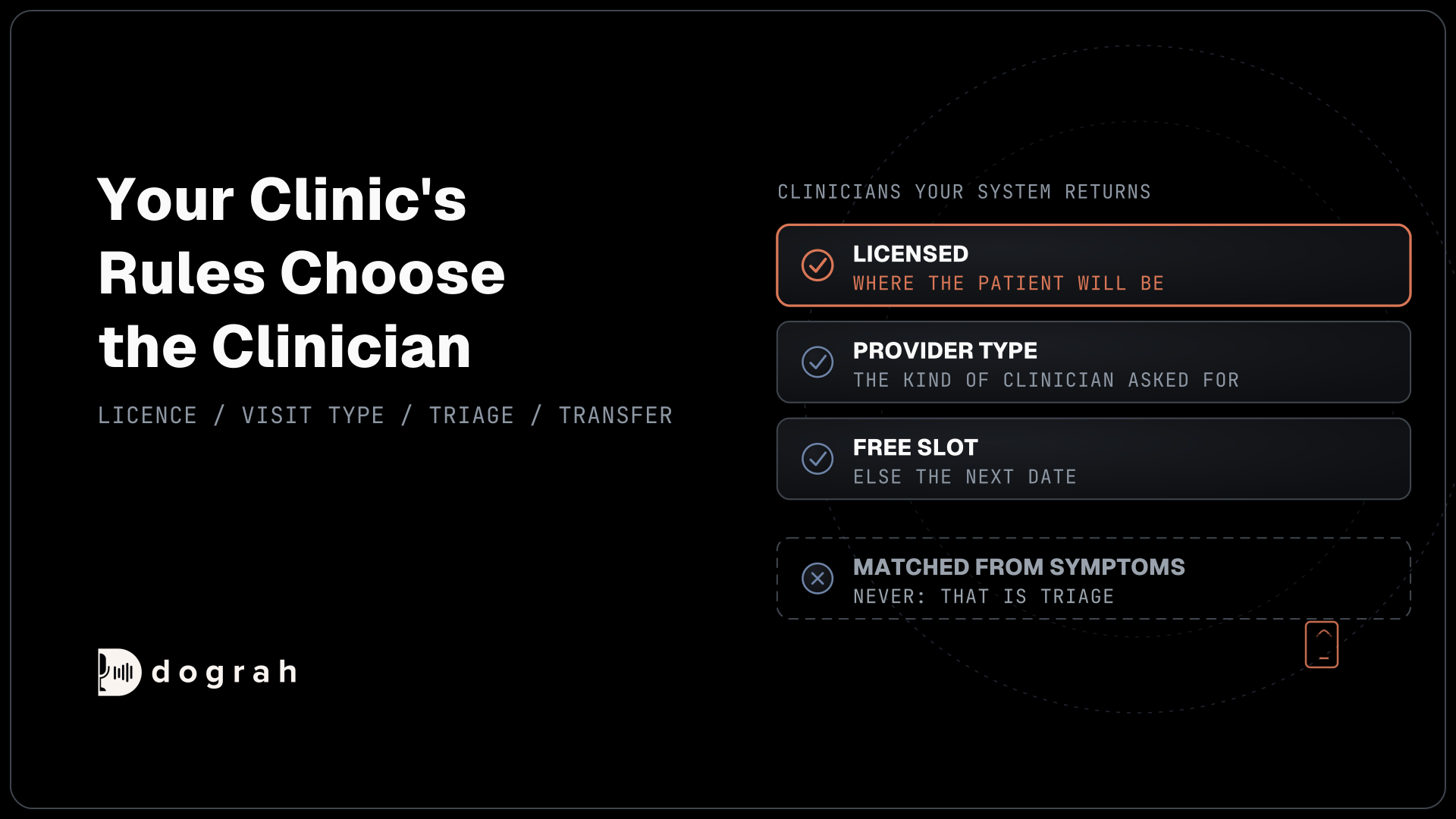

AI voice agents for telehealth appointment booking ask why the patient needs the visit and which state they will be in during it. The clinic's scheduling system then returns only clinicians licensed in that state who take that visit type. Returning patients are verified first, and clinical or prescription questions go to staff.
Key Takeaways
- Provider type and patient state go to the scheduling system, which picks the clinician.
- The agent asks the reason in the patient's words and never sorts by symptoms.
- Emergencies stop the booking with a fixed line telling the caller to call 911.
A telehealth slot only works if the clinician is licensed where the patient will be during the visit. We cover provider type and patient location, new and returning patients, clinical questions and setting up the booking call in Dograh. It is part of our guide to appointment and demo booking.
The right clinician is a booking rule
A telehealth booking reaches the right clinician when the clinic's written rules choose, and the agent only collects what those rules need. Provider type is usually the first question. In FAIR Health's telehealth tracker, 58.5% of patients with a telehealth claim in January 2025 had a mental health diagnosis, rising to 62.3% in February. Many callers want a therapist or a psychiatric clinician, and a general visit is the wrong slot for them.
The agent asks what the visit is for, in the patient's own words, and records the answer as stated. It then asks the questions your rules depend on, such as whether the patient is new and which kind of clinician they want to see. Those answers go to the scheduling system, and the system decides which clinicians and visit types fit.
The agent never matches a patient to a clinician from their symptoms. Choosing care from symptoms is triage, and triage needs clinical judgement. When a reason doesn't map to any visit type, the agent records it and books a callback from intake staff.
Asking too little causes the opposite failure. A new patient booked into a short follow-up slot needs a second call to fix it, so give the agent every question your rules need, and no more.
Ask where the patient will be
The patient's location during the visit decides which state's licence the clinician needs. The Interstate Medical Licensure Compact's FAQ puts it plainly. The place of medical practice is the state where the patient is located, and that state's laws apply. The compact speeds up getting separate state licences. Each licence is still issued by one state.
So the booking call asks where the patient will be at the time of the visit, which is not always their home address. A student at college or a patient visiting family may be in another state that week. The scheduling system holds each clinician's licences and returns only those licensed where the patient will be.
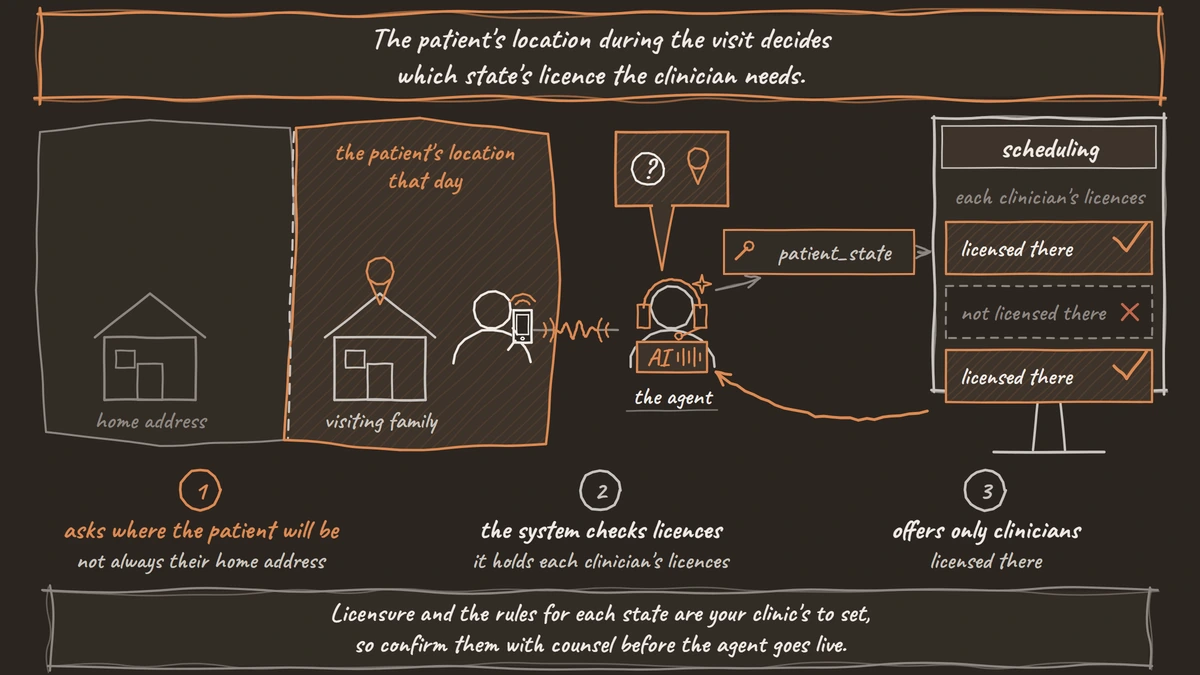
When nobody licensed there has a free slot, the agent says so. It offers the next date with a licensed clinician or records a callback request. If your clinic has an office nearby, an in-person visit is another option. Licensure and the rules for each state are your clinic's to set, so confirm them with counsel before the agent goes live.
New patients, returning patients
A new patient booking a first visit gives details and asks about nothing on file, so the agent can book with a name, a date of birth, a number and the visit type. A returning patient asking about an earlier visit or a test result is different. The Health Insurance Portability and Accountability Act (HIPAA) Privacy Rule requires a provider to verify the identity of someone requesting health information when that person is not known to it.
Pre-Call Data Fetch can load the patient record that matches the calling number as the call connects. The prompt keeps every detail from it unspoken until the clinic's approved check passes, such as date of birth with a second item from the record. Matching a phone number to a chart says nothing about who is actually speaking.
The Greeting Text names the clinic, and never the visit type or the clinician, since a therapist's name alone can reveal why someone is being seen. Any notice that the patient is talking to an automated assistant, added by choice or because a state requires it, goes in the same Greeting Text. Allow Greeting Interruption is on by default on the Start Call node, so switch it off when the greeting carries a notice that must play in full. AI voice agents for telehealth covers the calls that come after the booking.

Open Source Alternative to Vapi / Retell
Self-hosted voice agent platform — no per-minute fees
dograh-hq/dograh
Star on GitHub
Clinical questions leave the booking
A booking call books, and every clinical question goes to a person. If a caller describes an emergency, the agent stops the booking and plays a fixed line: "If this is a medical emergency, please call 911 now." Put that line in the Transition Speech of an emergency pathway so it plays word for word. That pathway is chosen by the model from the condition you wrote, so test it with many phrasings and read the transcripts.
Crisis language gets the 988 Suicide and Crisis Lifeline in the same fixed way. Many telehealth callers are booking mental health care, so plan this route before the booking flow. AI voice agents for behavioral health intake and triage covers it in depth.
Prescription questions go to the clinician. Whether a medication can be prescribed over video depends on federal and state rules your clinic tracks, and the agent never answers it. Which visits can be virtual at all follows your clinic's current rules, held in the scheduling system with everything else.
For anything that needs a person now, Transfer Call works on Twilio, Telnyx, Plivo, Cloudonix and Asterisk ARI. The intake line rings first, and the patient joins once a staff member answers. The agent writes the details to your system first, since no summary travels with the call by default.
Join the Dograh Community
Dograh is an OSS alternative to Vapi. Join our Slack community for queries, releases, best practices & community interactions.
Setting up the booking call in Dograh
The booking runs through an HTTP API tool that sends the patient's answers to your scheduling system as parameters, such as visit_type, provider_type, patient_state and new_patient. Your system returns only slots that pass its rules. If your clinic offers audio-only visits for patients without video, make that a visit type the system can return, and the agent offers it like any other.
A lookup across several clinicians' calendars can take a few seconds. Add a typed line or a recording to the tool's Messages card. It plays when the tool starts, and a later "I'm still checking" can follow if the lookup runs long. Give the booking tool a Preset Parameter named workflow_run_id with the value {{initial_context.workflow_run_id}}, so your system ignores a repeated request. The clinic's telehealth system sends the join link once the booking is written.
Add clinical service names the speech model may mishear, such as "PMHNP" or "psychiatric evaluation", to the Dictionary in the agent's Settings. Then test on a real phone line, because most phone calls reach the agent as 8 kHz audio while a browser test runs at 16 kHz.
Self-hosting keeps patient calls on your servers. Run Dograh on your own servers with open-weight models, and the call audio stays in-house. The clinic signs no BAA with Dograh. A cloud provider hosting those servers does need one, and so may the phone carrier, depending on what it stores. Change one setting before patients call, since a self-hosted install reports anonymous usage telemetry unless you set ENABLE_TELEMETRY=false and remove POSTHOG_API_KEY. HIPAA-compliant voice AI for telehealth covers hosting in full.
Glossary
- Interstate Medical Licensure Compact
- An agreement among member states that speeds up getting separate state medical licences. Under it, the place of practice is the state where the patient is, so a telehealth booking must match the patient's location that day.
- Visit type
- A category in the scheduling system, such as a new-patient therapy intake or a medication follow-up, that sets the length, the clinicians who can take it and whether it can be virtual.
- Audio-only visit
- A telehealth visit held by phone without video. If the clinic offers it, it is set up as its own visit type so the agent offers it only when the scheduling system returns it.
- Emergency pathway
- A separate branch of the call that plays the fixed emergency line word for word. The model picks it by reading a written condition, so it is tested with many phrasings.