
AI voice agents for KYC verification in banking run re-KYC and periodic update calls. The agent reminds a customer that their KYC is due, checks who answered, takes a "nothing has changed" answer or a new address, and sends it to the bank's system. Each call is logged against the customer, and no card numbers or codes are asked.
Key Takeaways
- Calls can fill RBI's notice and reminder slots, but a letter still goes out.
- Every call's outcome reaches the bank's system and is logged against the customer.
- The agent never asks for full card numbers, PINs, passwords or one-time codes.
In India, a bank owes each customer at least three notices and three reminders around a KYC due date. We cover how often KYC is refreshed, the check and update call in Dograh, Indian languages and handovers, and the same call under US rules. Our guide to KYC and identity calls covers the other calls.
How often banks refresh KYC in India
Every bank customer in India has a KYC due date, and the bank's risk rating sets it. Under the Reserve Bank of India's Know Your Customer Directions for commercial banks, the bank refreshes KYC at least once every two years for high-risk customers, every eight years for medium-risk customers and every ten years for low-risk customers. The clock runs from account opening or the last update.
That schedule is the source of your call list. Most due customers are low or medium risk, and for many of them nothing has changed since the last update. A short call that confirms this, after a proper check, saves a branch visit. Customers whose details have changed still need to update them, and the call tells them how.
The bank decides what counts as complete, while the agent reminds the customer and records the answer. Your KYC system marks the update done, or opens a task for staff, based on what the customer said and your own rules.
Three notices, three reminders, one letter each
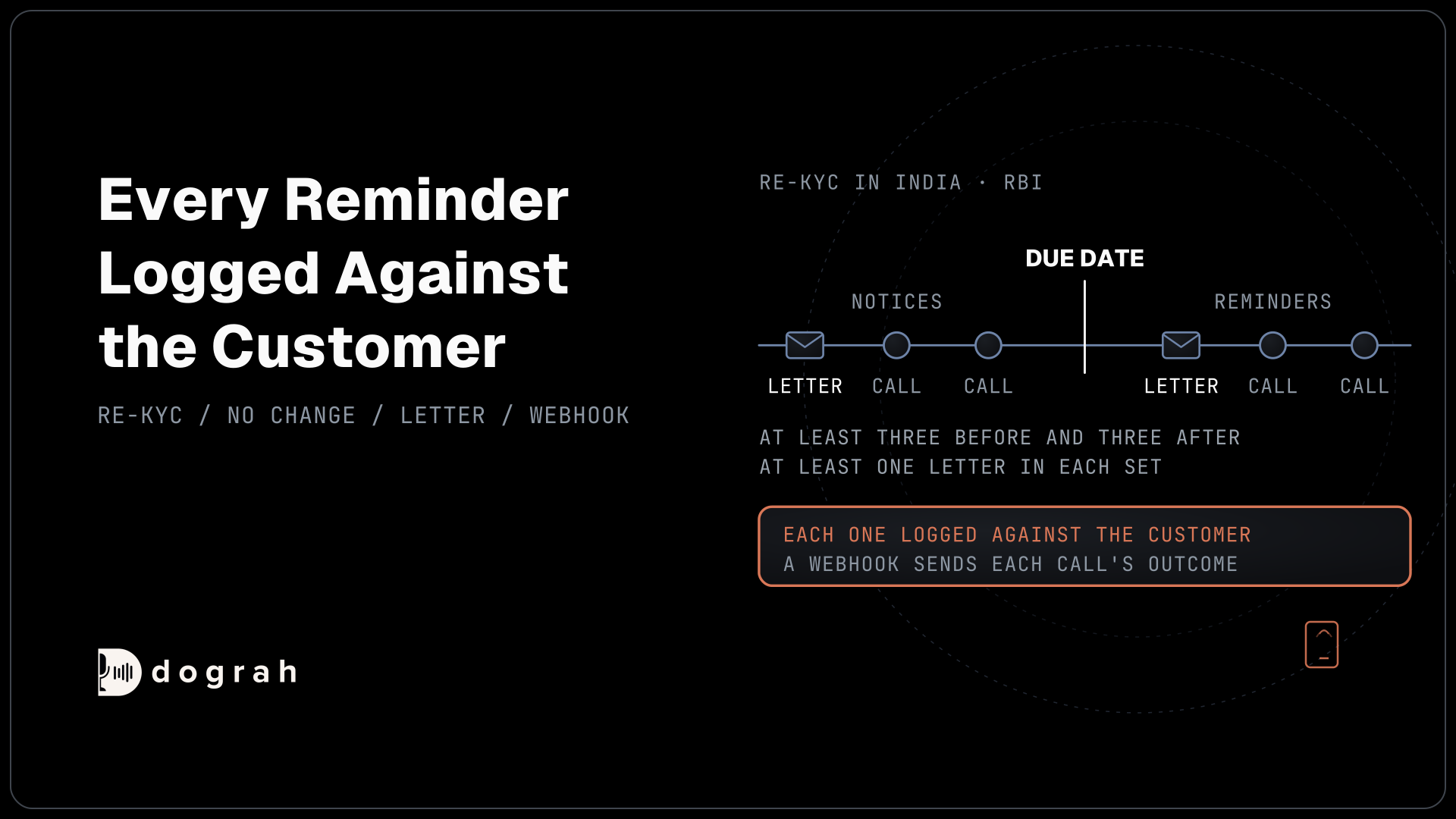
The reminders themselves follow a rule. The RBI's KYC (Amendment) Directions, 2025 ask banks to send at least three advance notices before the due date and at least three reminders after it. At least one notice in each set must be a letter, and each one must be recorded against the customer for the audit trail.
Calls can fill the other slots. Send the letter as usual, and let the agent place the calls in between. What matters is the record. A Webhook node at the end of each call sends your system the outcome, the time and links to the recording and transcript, so every reminder sits against the customer the moment the call ends. A webhook that fails for a moment is retried automatically.
Run the reminder calls as campaigns. Retries go from 0 to 10, with 2 by default, and calling hours are set by weekday. Always set those hours, because a campaign with none set can place calls at any time. Keep the count of notices and reminders in your own system, which already tracks the letters.

Open Source Alternative to Vapi / Retell
Self-hosted voice agent platform — no per-minute fees
dograh-hq/dograh
Star on GitHub
Verify, then take the update
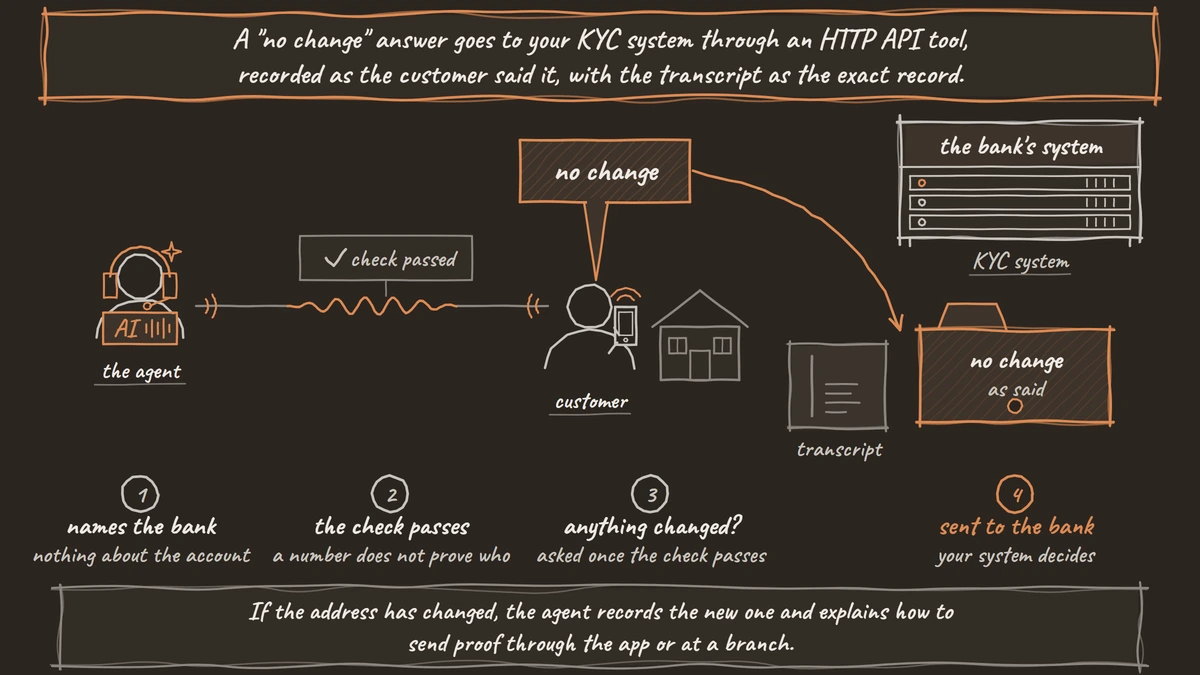
A reminder call opens with the bank's name in the Greeting Text and a check before anything about the account. A phone number finds the customer record, but it does not prove who answered. The agent asks your approved check, such as the date of birth plus the last digits of the account number, and your system replies match or no match.
Once the check passes, the agent asks whether anything in the customer's address or details has changed since the last update. A "no change" answer goes to your KYC system through an HTTP API tool, recorded as the customer said it, with the transcript as the exact record. If the address has changed, the agent records the new one and explains how to send proof through the app or at a branch. It can book that visit too, as covered in branch appointment booking.
The call never asks for a full card number, a PIN, a password or a one-time code. The FTC's advice to consumers is that no real caller from a bank will ask for a verification code, and scammers use KYC updates as a cover story. The FTC logged $15.9 billion in reported fraud losses in 2025. A real re-KYC call earns trust by asking for nothing a scammer would want.
Languages and handovers on Indian lines
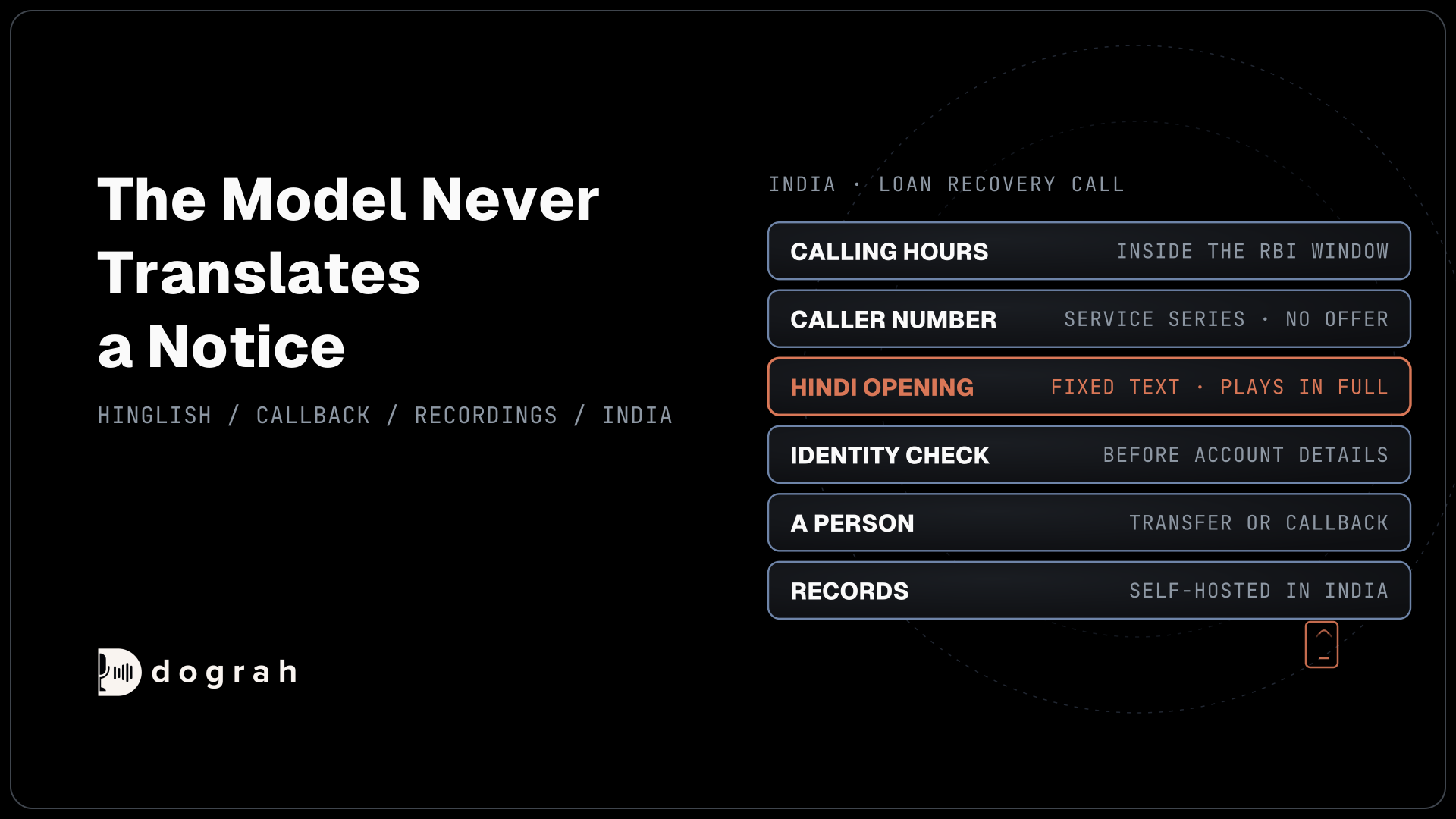
Re-KYC calls reach every kind of customer, so the agent has to speak their language. In the agent's Model tab, set the speech-to-text language to Multilingual (Auto-detect), and tick Language Hints such as Hindi and English, which work with Dograh's own models or Deepgram Flux. The Greeting Text plays before the agent hears the caller, so write it in both languages, such as "Namaste, hello".
For the voice, Sarvam's Bulbul v4 Flash covers Bengali, English (India), Gujarati, Hindi, Kannada, Malayalam, Marathi, Odia, Punjabi, Tamil and Telugu. Add words such as KYC, re-KYC and your bank's product names to the Dictionary in the agent's Settings, so speech-to-text hears them correctly.
Some customers want a person. Transfer Call works on Twilio, Telnyx, Plivo, Cloudonix and Asterisk ARI. The KYC desk's phone rings first, and the customer is put through only after an officer answers. Many Indian banks call from Exotel or Vobiz numbers, and there the agent logs a callback request in your system for the desk to return.
Join the Dograh Community
Dograh is an OSS alternative to Vapi. Join our Slack community for queries, releases, best practices & community interactions.
The same call under US rules
US banks have no fixed re-KYC cycle in the rule text. The customer due diligence rule asks banks to maintain and update customer information on a risk basis, which in practice means when something changes or when a review is due under the bank's own risk model.
The call itself runs the same way. The agent greets the customer, verifies them, asks whether anything has changed and sends the answer to the bank's system. A US bank might trigger it when mail is returned or when an account's activity no longer fits its profile. Our guide to AI voice agents for banking and credit unions covers the wider set of bank calls. Whether a call counts toward your refresh program is your compliance team's decision, so confirm it with counsel before the first campaign.
Glossary
- Re-KYC
- Refreshing a customer's KYC records on a schedule, called periodic updation in RBI's rules. The voice call reminds the customer and takes a no-change answer, and the bank's system marks it done.
- Advance intimation
- A notice sent before a customer's KYC update is due. RBI asks for at least three, including at least one letter, each recorded against the customer.
- Self-declaration
- A customer's own statement that their KYC details have not changed, or that only their address has. On a call, the agent records it as said and sends it to the bank's system.
- Customer due diligence (CDD)
- The US rule that asks banks to keep customer information current on a risk basis. There is no fixed cycle in the rule text, so refresh calls follow the bank's own risk model.