
AI voice agents for UK fintech and lending handle application, document and payment-reminder calls under the FCA's existing rules, since the FCA plans no extra AI rules. The agent reads terms from the lender's system, checks the borrower understood, hands anyone vulnerable to a person and keeps top-up offers off service calls unless PECR consent is in place.
Key Takeaways
- The FCA adds no AI rules, so the Consumer Duty covers every sentence.
- A borrower who sounds vulnerable goes to a person, with notes written first.
- A top-up or refinance offer turns a service call into marketing.
UK lenders get no separate AI rulebook, so their agent answers to every rule they already follow. We cover reading terms and checking understanding, passing vulnerable borrowers to a person, PECR on offers and where borrower data sits with Dograh. See our guide to fintech and lending calls for the wider field.
No AI rulebook, so every duty applies
UK lenders get no separate rulebook for AI calls, which means every rule they already follow applies to the agent. In its approach to AI, the Financial Conduct Authority (FCA) says plainly that it does not plan to introduce extra regulations for AI. It points instead to the Consumer Duty and the Senior Managers and Certification Regime (SM&CR), so a named senior manager answers for what the agent says.
More lenders now sit inside that regime. Under the FCA's policy statement on deferred payment credit, lenders offering Buy Now Pay Later (BNPL) agreements to finance purchases from a merchant have been FCA-regulated since 15 July 2026. Merchants that offer their own agreements directly are not. For a third-party BNPL lender, reminder and support calls now carry the same conduct duties as any other credit.
The volume is real. Bank of England figures show individuals took on £1.9 billion of net consumer credit in September 2026, £0.7 billion of it on credit cards. Each new loan brings application, document and repayment calls.
This post covers those calls up to a missed payment. Arrears and collections follow their own rules, set out in AI voice agents for debt collection in the UK.
Read the terms, then check understanding
On a lending call, the agent reads the borrower's terms from your system and then checks they understood. Verification always comes before disclosure. A phone number finds the account, but before the agent names any amount or date, the borrower passes an approved check, such as date of birth plus the last digits of the loan number.
The Consumer Duty then asks for more than reading figures out. Its rule on customer understanding says that in a one-to-one conversation, including a telephone call, firms should where appropriate tailor the information and ask the customer whether they understand it and have any further questions. Write that step into the prompt: after the repayment amount and date, the agent asks whether it made sense, answers from the same data, and records the reply.
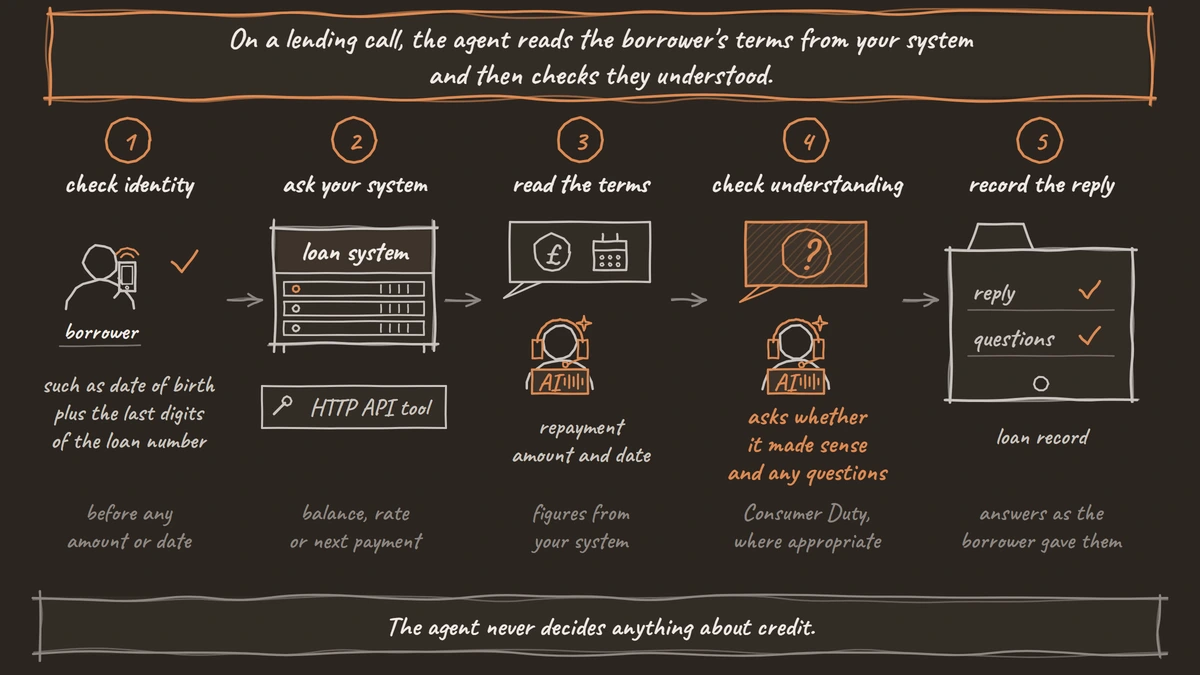
The figures come only from your system. An HTTP API tool asks your loan management system for the balance, rate or next payment during the call. A message (a typed line or a recorded clip) plays when the tool starts, while the request runs, and you can add a later update, such as "I'm still checking", if the lookup takes a few seconds.
The agent never decides anything about credit. It records answers as the borrower gave them, and your lending system or your staff decide, as AI voice agents for loan application screening sets out.

Open Source Alternative to Vapi / Retell
Self-hosted voice agent platform — no per-minute fees
dograh-hq/dograh
Star on GitHub
Vulnerable borrowers go to a person
A borrower who sounds vulnerable leaves the agent for a trained person. The FCA's guidance on vulnerable customers describes a vulnerable customer as someone who, due to their personal circumstances, is especially susceptible to harm, and asks firms to offer more than one channel so those customers have a choice.
On a voice agent, that becomes a pathway with a written condition: the borrower mentions illness, bereavement, a lost job or money trouble, sounds confused, or asks for a person. Choosing that pathway is the language model reading the condition, so it is never a hard rule. Read transcripts of real calls and widen the wording where it missed someone.
Lenders on Twilio, Telnyx, Plivo, Cloudonix or Asterisk ARI make that handover with Transfer Call. Dograh dials your team before anything else, and the borrower is put through only after a person answers. No summary goes with the call by default, so the agent writes the details to your system first. When the team has not picked up after the 30-second default, the borrower is still talking to the agent, which offers a callback and logs the request in your system.
Service calls and offers under PECR
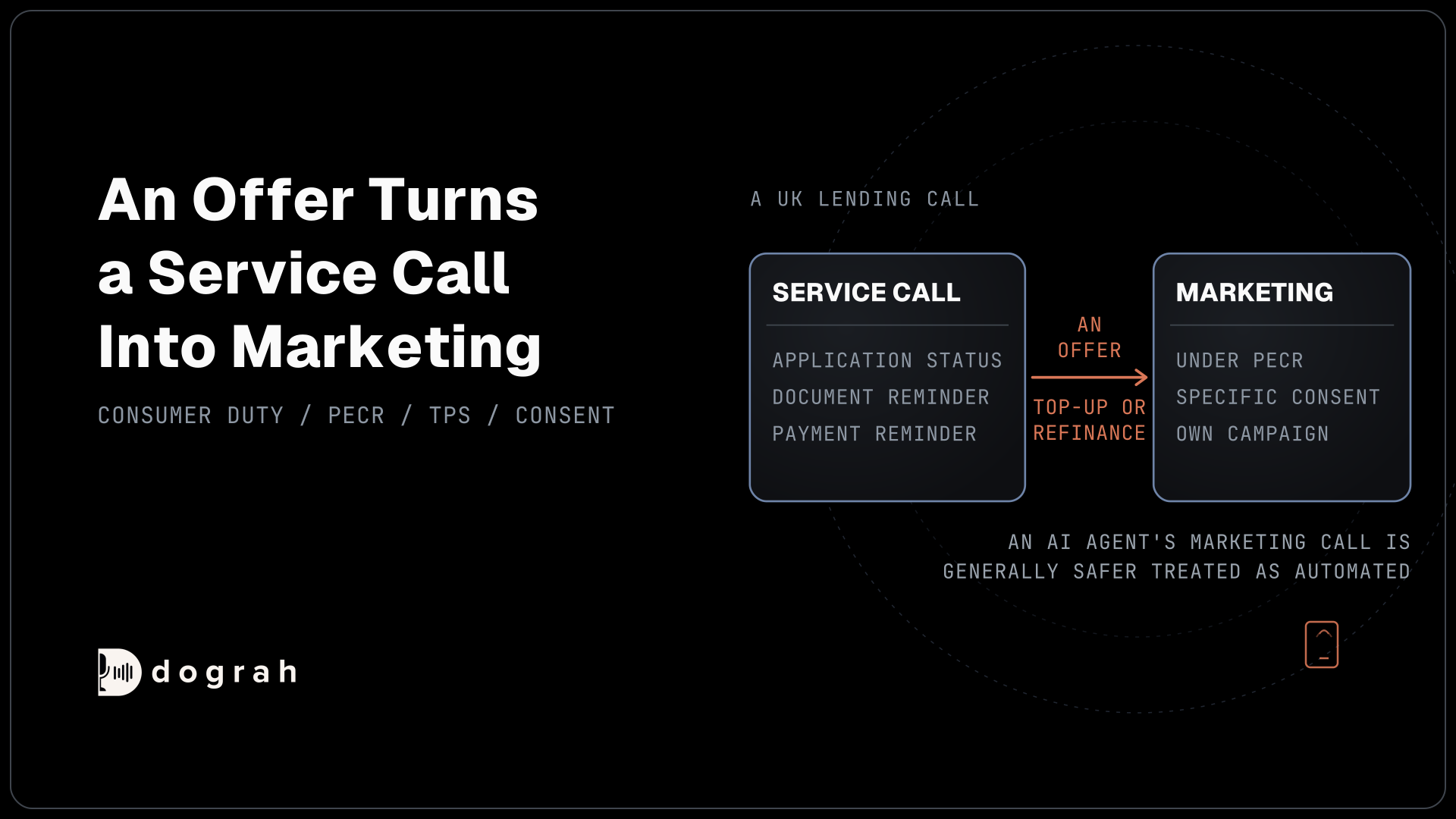
Under UK rules, a call that only deals with the borrower's existing loan is a service call, and an offer turns it into marketing. The ICO's guidance on live marketing calls says service messages are not direct marketing when they are purely administrative, but promotional content inside a service call makes the whole call direct marketing.
So an application status call or a document reminder is a service call. A top-up, a refinance or a "pre-approved" limit is marketing under the Privacy and Electronic Communications Regulations (PECR). Live marketing calls must be screened against the Telephone Preference Service (TPS), and automated marketing calls need the person's specific consent. An AI agent's marketing call is generally safer treated as automated, so offers go only to borrowers with that consent. The ICO can fine up to £17.5 million or 4% of global turnover under PECR.
Opt-outs come by voice. A borrower who says "stop calling me" has opted out, so the agent confirms it and logs it in your system, which keeps that number off the next list. AI voice agents for insurance in the UK walks through the same PECR split for insurers. Treat this post's points on the FCA rules and PECR as general information, and confirm your firm's position with counsel.
Join the Dograh Community
Dograh is an OSS alternative to Vapi. Join our Slack community for queries, releases, best practices & community interactions.
Keep UK borrower data in the UK
Borrower calls hold income, debts and sometimes health details, so decide where they live before the first call. To keep call data in the UK, self-host Dograh in a UK data centre and run the models there too. Azure Speech offers UK South and UK West regions. Those set where that provider processes audio, and the service is still hosted by Azure.
A lending call sits on two layers. Dograh handles the call flow, the tools that reach your loan system and the telephony, while the speech and language models form a separate layer the lender picks. With your own keys, each model contract is between you and that provider, yet the borrower's audio still travels to them. Self-hosted, recordings and transcripts stay on your servers, and recording can be switched off only server-wide.
Before borrower calls go live, turn off the anonymous usage telemetry a self-hosted install sends by default: set ENABLE_TELEMETRY=false and remove POSTHOG_API_KEY. A lender running Dograh on its own servers pays no per-minute platform fee, but the servers, model keys and phone minutes stay on the bill. On Dograh Cloud, there is a 1¢-a-minute platform fee.
For monitoring, QA can sample live calls. Replace its prompt with instructions that flag calls where the agent read terms without the understanding check, mentioned an offer on a service call, or missed a vulnerability cue, and have a person review those calls each week.
Which lending call to start with
Start with inbound application status and document questions, because the agent only reads and records. Add payment reminders before a missed payment next, once the verification check and the vulnerability pathway are tested. Offers come last, on their own campaign, built only from borrowers whose consent is on record.
Last, test from a real phone. Most calls carry 8 kHz audio where a browser test carries 16 kHz, and loan figures read back wrong more often on the phone.
Glossary
- Consumer Duty
- The FCA's rules requiring firms to deliver good outcomes for retail customers, including checking that customers understand what they are told on a call. With no separate AI rules, it covers everything a lender's voice agent says.
- Deferred payment credit
- The FCA's term for Buy Now Pay Later lending. Third-party lenders offering it to finance purchases have been FCA-regulated since 15 July 2026, so their calls carry the same conduct duties as other credit.
- Service message (PECR)
- A purely administrative call or message, such as a document reminder, which is not direct marketing. Add promotional content and the whole call becomes marketing under PECR.
- Vulnerable customer (FG21/1)
- Someone who, due to their personal circumstances, is especially susceptible to harm, in the FCA's guidance. On a voice agent, the cues become a pathway condition that sends the call to a trained person.