
Voice AI agents are now common in customer service. 57% of businesses in G2 and RingCentral's research run them in production, and Pindrop found AI agents or bots on about 1 in 80 calls at one bank. The fastest speech-to-speech models now reach first audio in under a second, and GPT-Live-1 costs $0.05 a minute.
Key Takeaways
- Most surveyed firms run voice AI, yet 87% of customers want a human option.
- Bots already call businesses, and most of them act for genuine customers.
- In our test, the smallest open voice read tricky text best, and dates failed everywhere.
Voice AI figures often lose their source as they travel. We group sourced numbers on adoption, customers, call volumes, bot callers, speed and cost, then add our own reading test of open voices, run by the Dograh team behind the open-source AI voice agent platform you can self-host.
How many businesses run voice AI agents
Most large companies that answer these surveys now run a voice agent in production. In G2 and RingCentral's agentic voice AI research, built on 359 in-depth interviews, 57% of businesses have voice AI agents actively deployed. Among those live deployments, 92% give the agent meaningful autonomy, and 35% of respondents say voice AI can sometimes handle a high-stakes conversation better than a person.
International contact centres tell a similar story. AVOXI and Metrigy's study of international voice surveyed 200 IT, contact centre and customer experience leaders. 55% of their multinational organisations already use AI voice agents, and 92% use them or plan to within two years. Reach still lags, though. These firms serve customers in 37 countries on average but run AI voice agents in production in 17, and 17% have replaced Tier 1 agents entirely with AI voice.
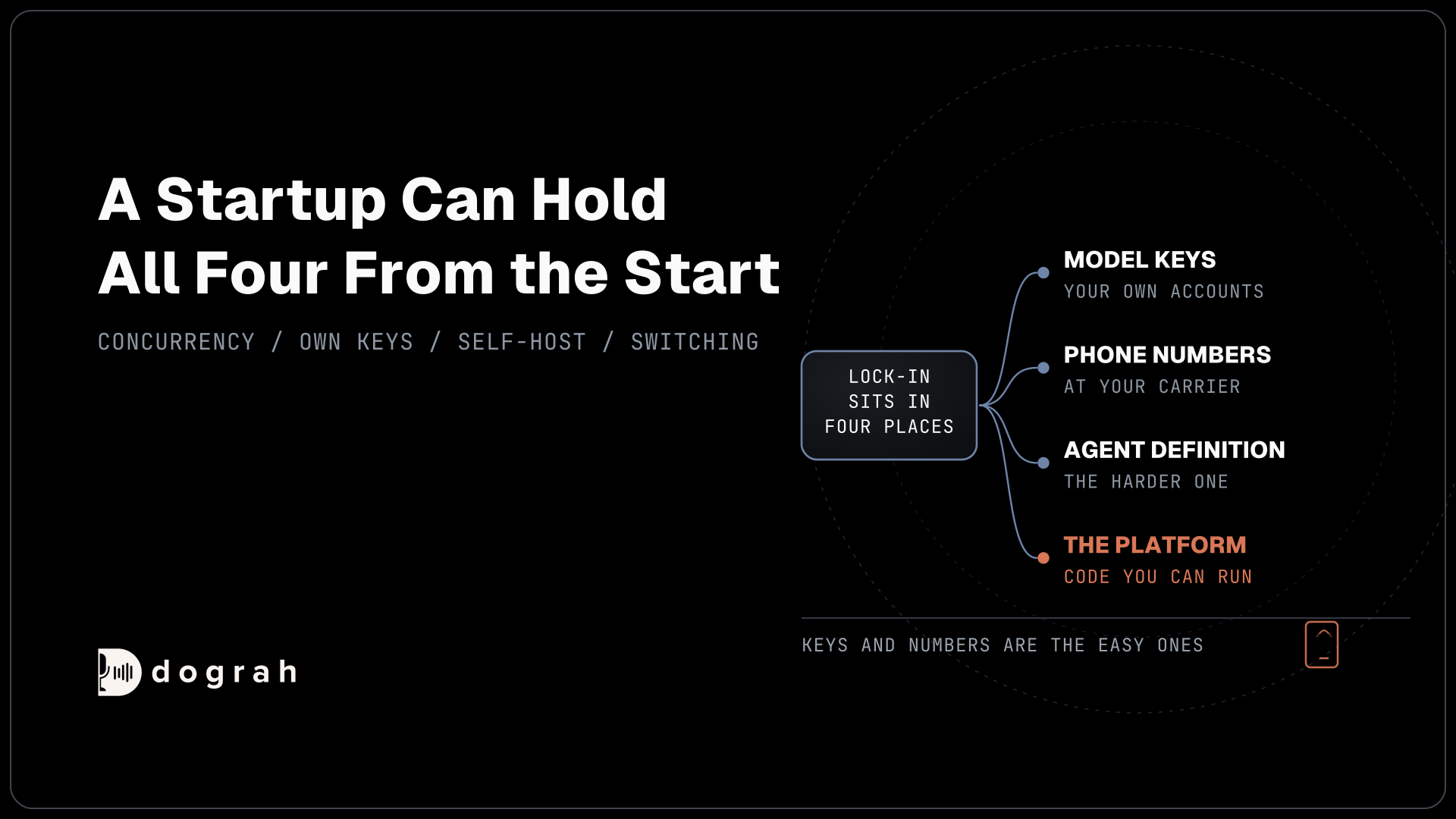
The same study names the brake. 61% call security and compliance the leading obstacle, and 51% name data sovereignty and privacy. Self-hosting Dograh with open-weight speech and language models keeps call audio and transcripts on servers you run, which is the route regulated teams usually take.
What customers say about AI on the phone
Customers use AI agents a lot, and they like them less than businesses think. Twilio's conversational AI report, which asked 457 business leaders and 4,800 consumers in 15 countries, found that 85% of consumers had dealt with an AI agent in the past three months. 90% of the leaders believe customers are satisfied with conversational AI, but only 59% of consumers say they are.
The way out is a clear path to a person. Gartner's survey of 3,566 customers found that 87% say a company using generative AI for service must offer a way to reach a human, while 50% say it makes interactions easier. In Five9's consumer research, 71% say it is very or extremely important to know when they are talking to an AI agent.
Bad AI service shows up in the numbers too. The Qualtrics XM Institute, surveying more than 20,000 consumers in 14 countries, found that nearly one in five who used AI for customer service saw no benefit, almost four times the rate for AI use in general. Among wireless customers who called support, J.D. Power's carrier satisfaction study of 57,339 customers found that 45% of interactions involved an AI assistant, it resolved 48% of them, and satisfaction was 20 points lower when AI was involved.
So build the handoff before the agent goes live. Dograh's Transfer Call tool dials the destination while the caller hears hold music, then connects once the destination answers. When the transfer meets no answer, a busy line, a failure or a timeout, the agent gets transfer_failed back and keeps helping the caller.
Phone calls still carry the hard conversations
The phone remains the costly, human-heavy channel that voice agents are built for. The U.S. Bureau of Labor Statistics counts about 2.7 million customer service representative jobs in the US and projects that number to fall 5% over the next decade.
Each of those calls is expensive. ContactBabel's US contact center guide, based on 207 US organisations, puts the average inbound call at $7.20, 47% more than an email, with an average speed to answer of 74 seconds. AVOXI and Metrigy's respondents expect cloud platforms to handle 64% of their contact centre calls within three years, up from 55% today.
Outbound calls face a different wall. In Hiya's State of the Call report, a survey of more than 12,000 consumers in six countries, 86% do not answer calls from unknown numbers and only 14% answer at once. AVOXI and Metrigy found the business side of the same problem, with 57% naming caller ID flagged as scam or spam as an outbound obstacle.

Open Source Alternative to Vapi / Retell
Self-hosted voice agent platform — no per-minute fees
dograh-hq/dograh
Star on GitHub
AI agents now call businesses too
Voice AI now works on both ends of the line. Pindrop, which sells bot detection, identified 727,000 AI agents or bots in two months of one bank's calls, roughly 1 in 80 calls. Of those, 94% were acting legitimately, mostly for real customers, and 6% were malicious.
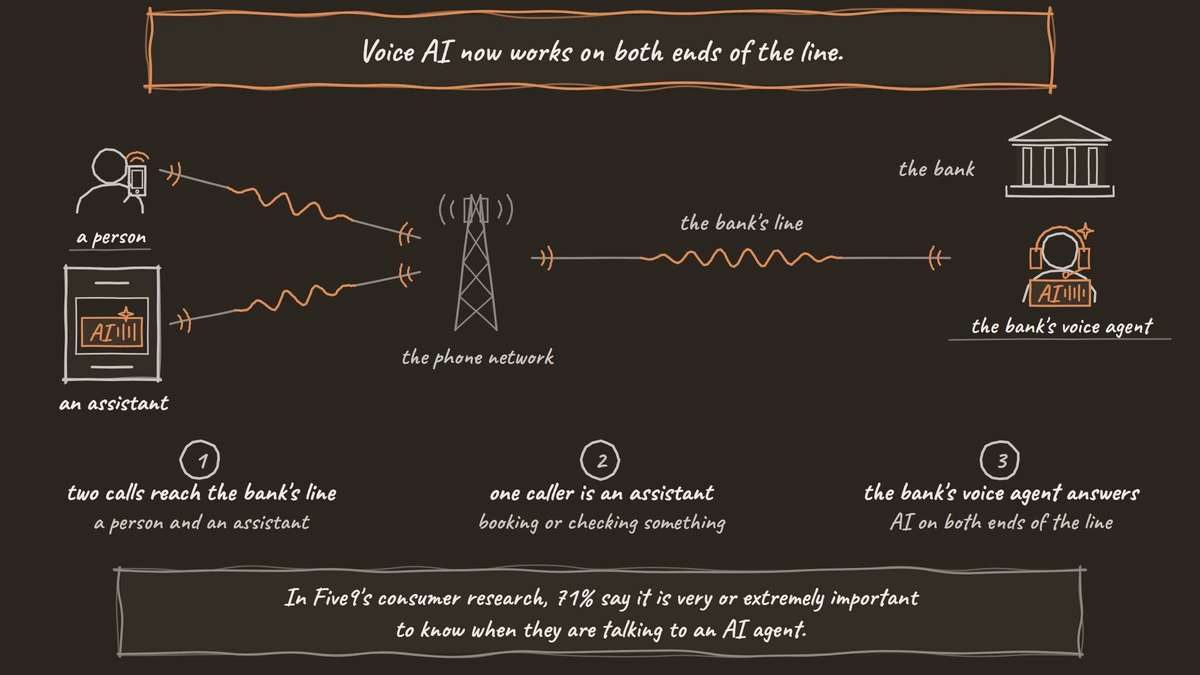
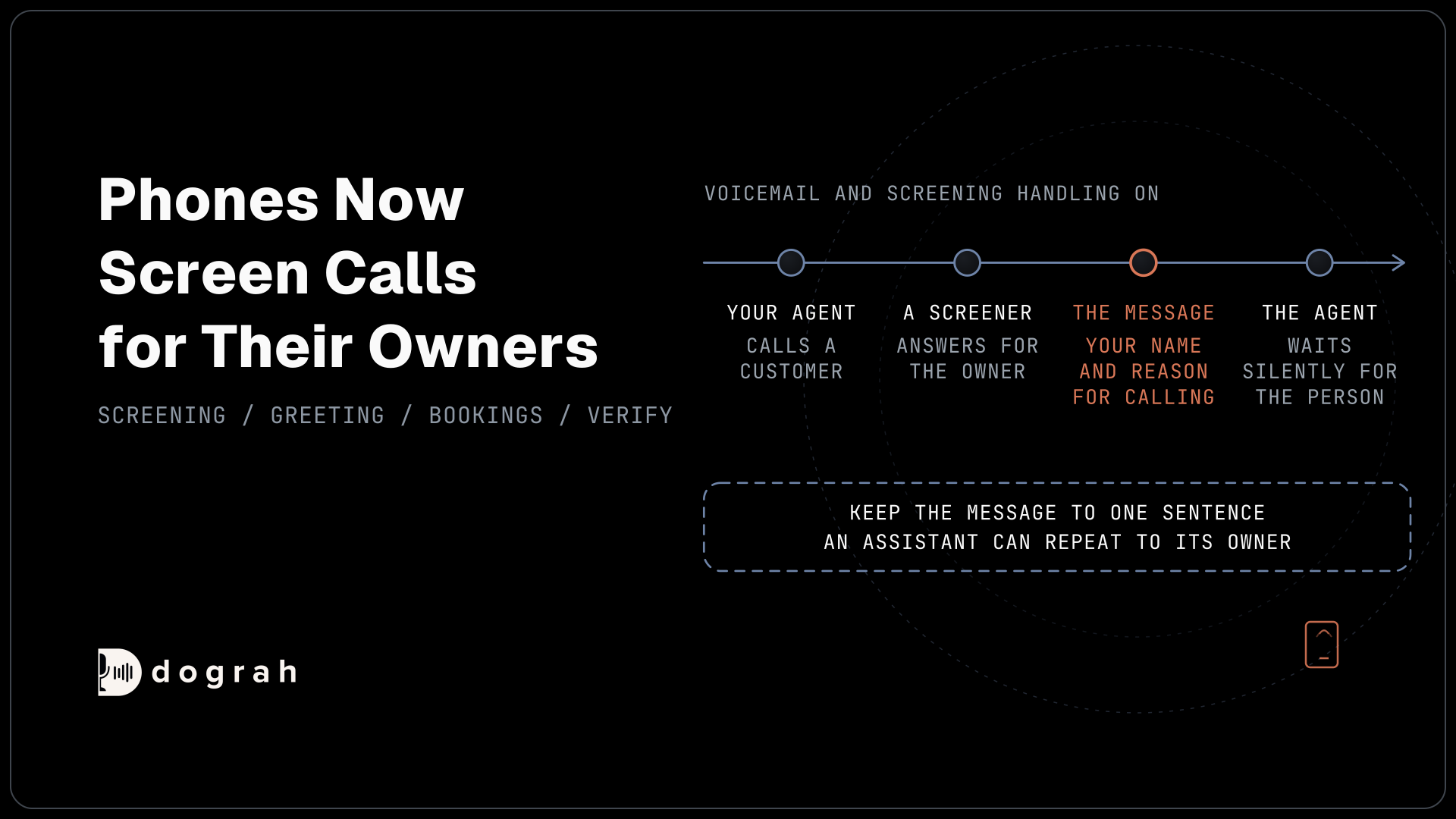
That one bank is a baseline, not the whole market, but it changes how an inbound line should work. A caller may be an assistant booking or checking something for its owner, and the business has to decide what that assistant may do without the customer on the line. Our post on when customers' AI agents call your business covers how to spot one and where to stop it.
How fast voice models answer
Speed is where voice agents win or lose a caller, and the fastest models now answer in under a second. On Artificial Analysis's speech-to-speech leaderboard, measured on its Big Bench Audio dataset, time to first audio is 0.97 seconds for GPT-Realtime-2.1 (Minimal), 1.18 seconds for Gemini 3.8 Live, 1.24 seconds for GPT-Live-1 (Sol, low) and 1.34 seconds for GPT-Live-1 (Astra, medium).
For a cascaded agent, which chains speech-to-text, a language model and text-to-speech, Twilio's guide to core latency sets starting targets of 350 ms for speech-to-text, 375 ms to the language model's first token and 100 ms to the first byte of speech. It puts the mouth-to-ear turn gap at 1,115 ms once the phone network is counted.
Our own bar is tighter. In our experience, end to end under 800 ms is what feels natural on a call, and speech-to-text is usually the slowest part, which our sub-800ms speech latency playbook works through. In Dograh, View Trace shows how long each part of every turn took, so you can see which one is slow on a real call.
What a minute of voice AI costs
A minute of voice AI is several bills, each priced separately. OpenAI's GPT-Live-1 model page prices voice sessions at $0.05 a minute, billed per second, with the backend model and tool use billed separately. Twilio's US voice pricing lists outbound calls at $0.0140 a minute, inbound calls to a local number at $0.0085, Media Streams at $0.0044 a minute and a local number at $1.15 a month.
Here is a worked example for one 5-minute outbound call on GPT-Live-1, carried by Twilio and run on Dograh Cloud:
| Line | Sum | Cost |
|---|---|---|
| GPT-Live-1 voice session | 5 x $0.05 | $0.25 |
| Twilio outbound minutes | 5 x $0.0140 | $0.07 |
| Twilio Media Streams | 5 x $0.0044 | $0.022 |
| Dograh Cloud platform fee | 5 x $0.01 | $0.05 |
| Total, before backend model and tool use | $0.392 |
That comes to about 7.8 cents a minute. The platform line is the one you choose most freely. Self-hosted Dograh has no per-minute platform fee, but servers, model keys and phone minutes still cost money. Dograh Cloud charges a 1¢-a-minute platform fee.
The model line moves the most. Bring your own keys for each model provider, or run open models on your own GPUs and turn that line into a server bill. Our breakdown of what an AI voice agent costs per minute prices each part of a cascaded call.
Join the Dograh Community
Dograh is an OSS alternative to Vapi. Join our Slack community for queries, releases, best practices & community interactions.
Our test of seven open-source voices
We ran our own test of open text-to-speech models, because a phone agent reads prices and dates out loud all day. In our TTS verbalization benchmark, seven open models read 1,080 sentences across 27 types of tricky text, and two independent speech recognisers wrote down what each one actually said.
The smallest model won. kokoro-82m read 61% of tricky items correctly, a score of 0.61, and used about 18x less compute per clip than the runner-up, orpheus-3b, at 0.54. It read prices almost perfectly, at 0.97 on currency. Dates were the weak spot for every model, with a best date score of 0.23, and no model read a hashtag correctly, 0 of 279. The full results are in our guide to the best open-source TTS models for phone agents.
Keep the test's limits in mind. It covered English only, with each model as hosted on Replicate, and it measures reading accuracy, not how pleasant a voice sounds.
The fix for dates starts in the prompt, which should have the language model write them as spoken words. For lines the agent says on every call, Dograh can play pre-recorded clips of a real person and fall back to a cloned voice for everything else.
How to read voice AI statistics
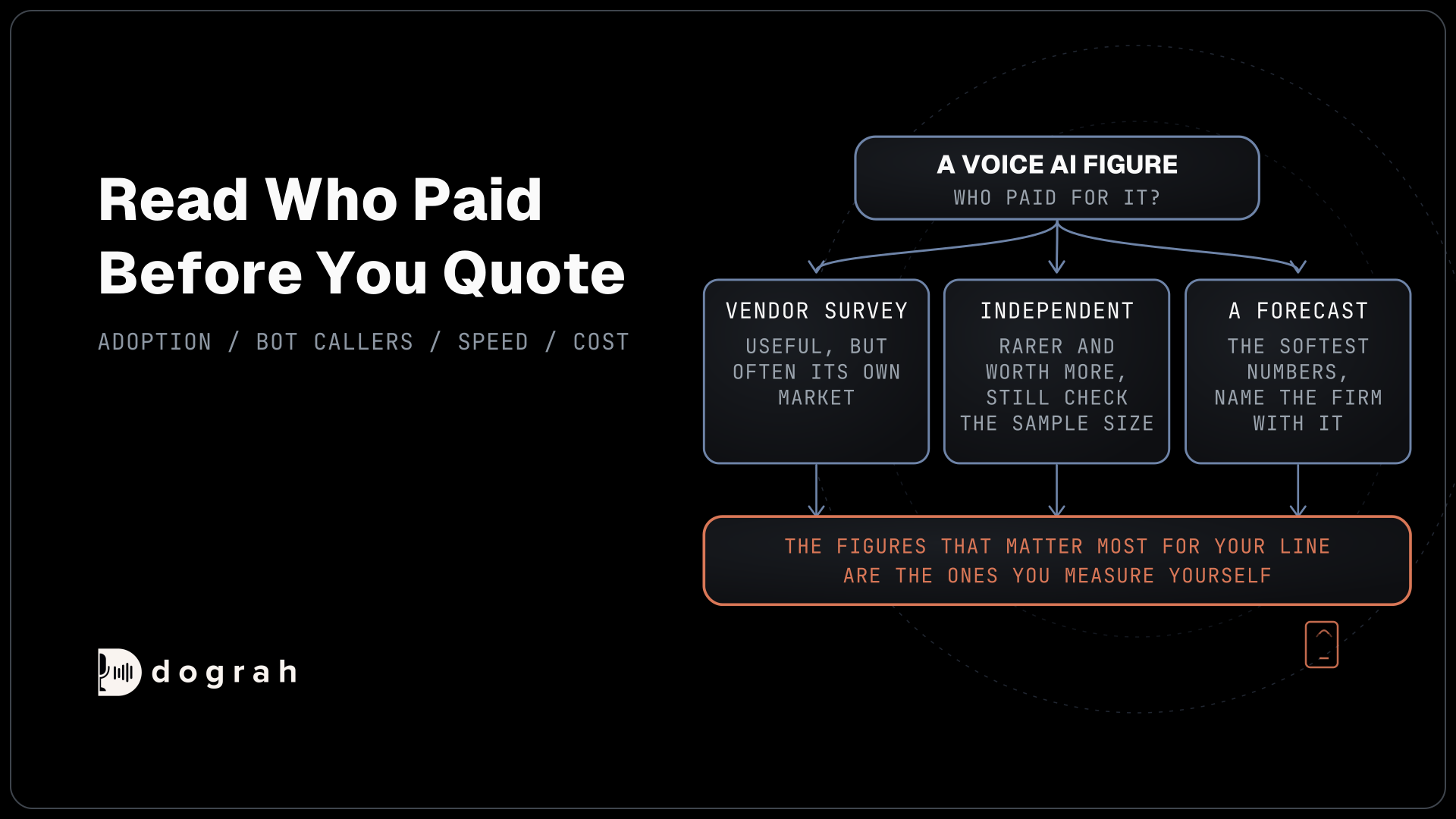
Most voice AI numbers come from companies that sell something near the result, so read who paid before you quote a figure. RingCentral sells phone systems, AVOXI sells international voice, Pindrop sells bot detection, Hiya sells caller ID and Twilio sells communications APIs. Their surveys are useful, but the sample is often their own market.
Independent sources are rarer and worth more. The Bureau of Labor Statistics, Gartner, J.D. Power, ContactBabel and Artificial Analysis have no voice agent to sell. Even then, check the sample size and whether a number was measured or forecast.
Forecasts are the softest numbers of all. Grand View Research estimates the AI voice agents market at $3.5 billion in 2026 and forecasts $35.2 billion by 2033. Other research firms publish very different totals, so always name the firm with the figure. Gartner predicts that agentic AI will resolve 80% of common customer service issues on its own by 2029, cutting operational costs by 30%. That is a prediction, so quote it as one.
The figures that matter most for your line are the ones you measure yourself. Test on real phone calls, read the traces, and keep your own numbers next to the published ones.
Glossary
- Time to first audio
- The time from the end of a caller's turn to the first sound of the agent's reply. Artificial Analysis measures it per model on its Big Bench Audio dataset, where the fastest models come in under one second.
- Mouth-to-ear turn gap
- The whole silence a caller hears between finishing a sentence and hearing the reply, phone network included. Twilio's starting target for a cascaded agent is 1,115 ms.
- Tier 1 agents
- The staff on the first line of a contact centre, who take routine requests such as order status or password resets. In AVOXI and Metrigy's study, 17% of respondents have replaced their Tier 1 agents entirely with AI voice.
- Verbalization
- Turning written forms such as prices, dates, phone numbers and codes into the words a person would say aloud. In our benchmark the best date score of any open voice was 0.23, so the prompt should write dates as words first.