
Smallest AI suits teams that want its Lightning voices and Pulse speech-to-text on one bill, at $0.09 to $0.21 a minute on Pay as you go. Its limits are 20 calls at once, paid zero data retention and closed code. Dograh, the open-source AI voice agent platform we build, runs Smallest's voices on your key, self-hosted or on Dograh Cloud.
Key Takeaways
- Lightning and Pulse are Smallest's own work. The language model is passed through at cost.
- Pay as you go stops at 20 calls at once, with no add-on.
- Zero data retention costs $1,000 a month unless you are on Enterprise.
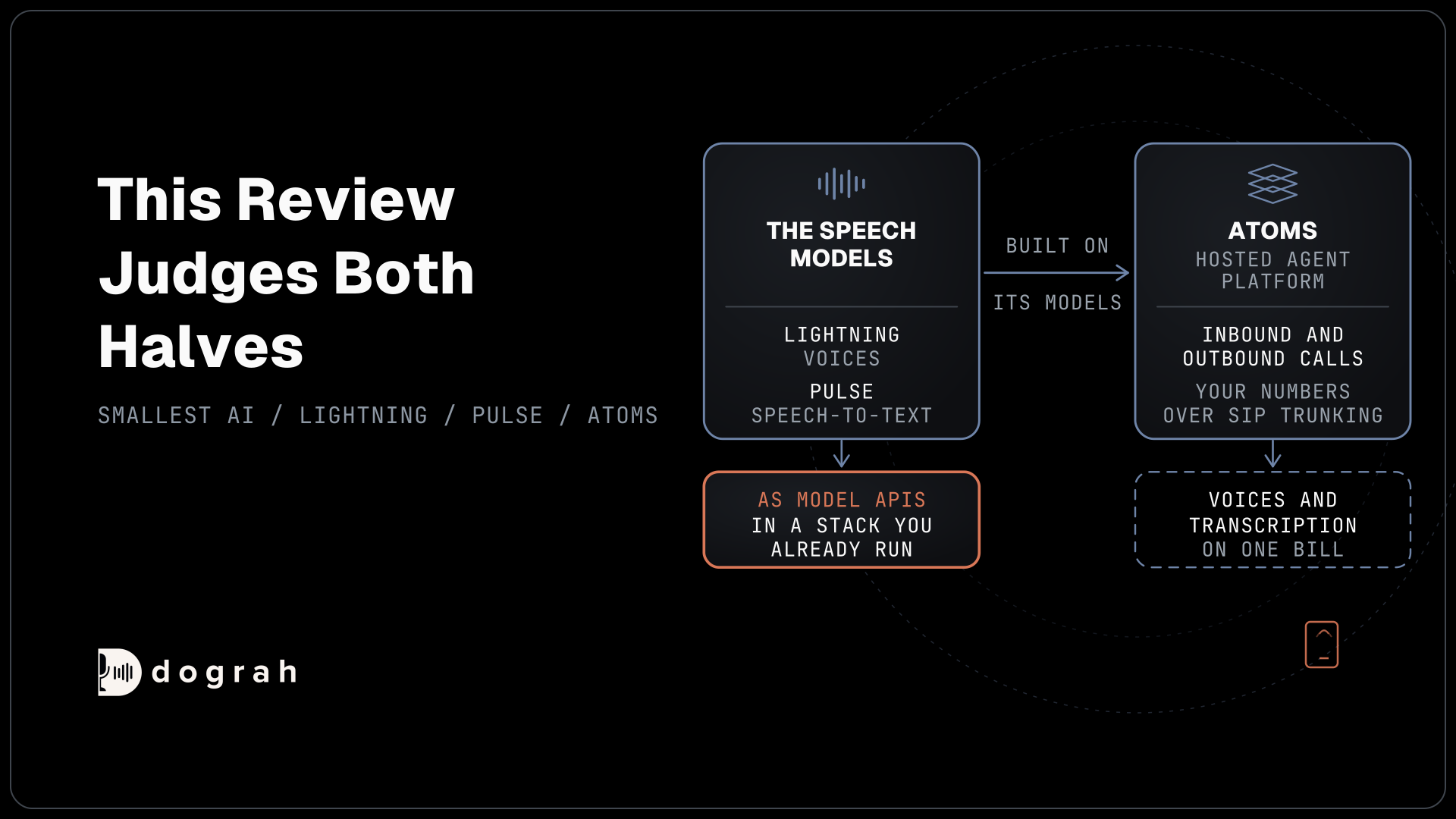
Smallest AI is a speech model company that also rents out a hosted agent builder, so this review judges both halves. We cover the voices, building on Atoms, the plan limits and the data question, then who it fits. The last section covers Dograh for teams that want the code.
Smallest AI pros and cons at a glance
Smallest is strongest in its own speech models and weakest where a growing team needs more room or more control. Every row in this table comes from Smallest's own plan and product pages.
| Area | Strength | Limit |
|---|---|---|
| Voices | Lightning V3.1 and V3.1 Pro, sold per 10,000 characters | The sub-100 ms figure is Smallest's own claim |
| Speech-to-text | Pulse realtime at about $0.004 a minute, 100 streams | Test your callers' languages before you commit |
| Language model | GPT models passed through at cost | Electron, Smallest's own model, is Enterprise only |
| Price | $0.09 to $0.21 a minute on Pay as you go, $10 in free credits | The Enterprise rate from $0.05 needs a sales call |
| Calls at once | 20 included on Pay as you go | No add-on for more short of Enterprise |
| Data retention | Zero data retention is on offer | $1,000 a month as an add-on on Pay as you go |
| SSO and SOC 2 | SOC 2 Type 2 and ISO 27001 badges on the product page | The plan table marks SSO and SOC 2 as No on Pay as you go |
| Where it runs | Smallest's cloud, with SIP trunking for your own numbers | On-premise deployment on Enterprise only |
| Code | Public APIs for the models and the agents | Closed platform and closed model weights |
Lightning voices and Pulse speech-to-text
The speech models are the reason to look at Smallest, and they are priced to be tried. Smallest sells Lightning V3.1 at about $0.175 per 10,000 characters and Lightning V3.1 Pro at about $0.195, and describes both with "Sub 100ms time-to-first-audio". Pulse, the speech-to-text model, costs about $0.004 a minute in realtime and about $0.003 in batch.
Treat the latency figure as what it is. Time-to-first-audio measures how fast the voice starts once it has text, which is one slice of a turn. In our experience speech-to-text is usually the slowest part, and a whole turn has to land under about 800 ms to feel natural. A fast voice helps, but measure the full turn on your own calls before you count on it.
If you call the models directly, outside Atoms, the pay-as-you-go caps are worth knowing. Lightning allows 15 concurrent streams, 100 requests a minute and 450 million characters a month, while Pulse allows 100 concurrent streams. Running either model on your own hardware is an Enterprise option.
Smallest also lists Hydra, its own speech-to-speech model, and Electron, a small language model. Both matter less to most buyers than Lightning and Pulse, which are the products other platforms already plug in. Test your callers' languages on a real call before you choose a voice.
What building on Atoms gets you
Atoms is the hosted agent platform Smallest builds on top of its models. Smallest's voice agents page pitches inbound and outbound calls, and you can keep your existing numbers through SIP trunking. Inside an Atoms agent, transcription and the voice come from Pulse and Lightning, so the speech side is Smallest's from end to end.
The reasoning side is not. The language model is billed at cost, with ChatGPT 4.0, 4.1 and 5.2 among the options at about $0.045 to $0.056 a minute. Electron is listed on Enterprise only, and speech-to-speech on Pay as you go runs on ChatGPT Realtime, also at cost. So on most plans the part that decides what the agent says, and which tool it calls, is another vendor's model.
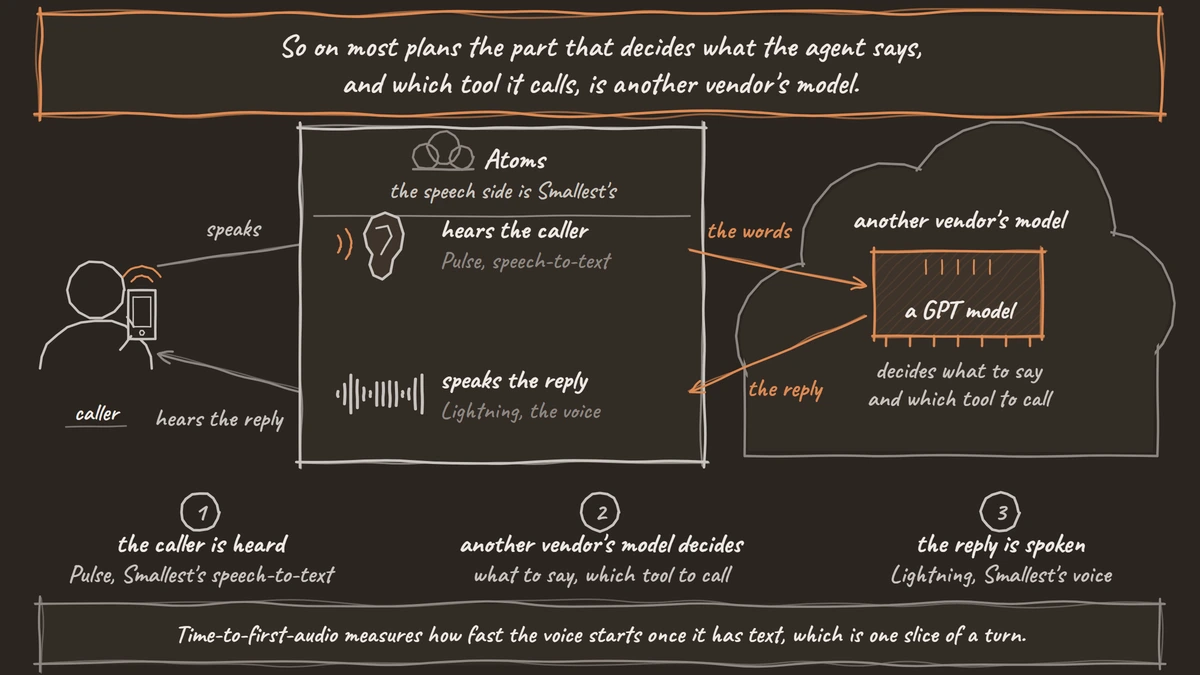
That makes Atoms a speech-led product. On a Pay as you go minute the voice, at about $0.09, is the largest line, larger than any language model on the list. Hosting adds a flat $0.01 and transcription about $0.009. Most of what you pay Smallest buys sound quality and speed.
For a team that has already settled on a GPT model, this is a sensible split. For a team that wanted one vendor's model behind the whole call, Electron means an Enterprise conversation.

Open Source Alternative to Vapi / Retell
Self-hosted voice agent platform — no per-minute fees
dograh-hq/dograh
Star on GitHub
The plan limits that shape a rollout
Smallest's price is simple to start with, and the limits matter more than the rate. Pay as you go costs $0.09 to $0.21 a minute depending on the models, after $10 in free credits. Enterprise is listed "As low as $0.05/minute", and our Smallest AI pricing breakdown prices each layer of the minute.
The first limit is calls at once. Pay as you go includes 20, and there is no option to buy more. Take an example of a clinic line where 25 people call in the same Monday-morning minute. The first 20 reach the agent, and handling the other five at the same moment means moving to Enterprise with custom concurrency.
The rest of the plan table follows the same pattern. Phone numbers rented from Smallest cost $10 a month each, or you bring your own through SIP. The 99.99% uptime SLA, on-premise deployment and Electron all sit on Enterprise.
None of this is unusual for a hosted platform. It does mean the jump from pilot to production runs through a sales conversation instead of a settings screen.
Where your call data goes
On Pay as you go, call audio and transcripts live in Smallest's cloud, and both the platform code and the model weights are closed. The product page shows ISO 27001, SOC 2 Type 2, GDPR and HIPAA badges. The plan table is more specific, marking SSO and SOC 2 as No on Pay as you go and on-premise deployment as No.
Zero data retention is the setting most buyers ask about first. Smallest sells HIPAA zero data retention as a $1,000-a-month add-on on Pay as you go, so it is off unless you buy it. Smallest's privacy policy says uploaded audio and text are collected to provide the service and kept as long as needed or permitted.
For most sales and support lines that is a normal hosted arrangement. In healthcare and finance it often is not, because teams there cannot send call data to a third-party platform at all, and self-hosting becomes a compliance requirement. On Smallest that route means an Enterprise contract for on-premise Lightning and Pulse, with the code still closed.
Join the Dograh Community
Dograh is an OSS alternative to Vapi. Join our Slack community for queries, releases, best practices & community interactions.
Who Smallest AI fits, and who it does not
Smallest fits a team that wants fast voices and transcription from one vendor on one bill, stays under 20 calls at once, and is happy with the GPT models on offer. The $10 in credits and no monthly fee make a pilot easy. It also suits developers who only want Lightning or Pulse as model APIs inside a stack they already run.
It fits less well in four cases. A line with steady peaks above 20 calls at once needs Enterprise. A buyer who needs SSO or a SOC 2 report on the plan itself needs Enterprise too. A team whose call data must stay in-house finds on-premise only on a sales contract. And a team that wants to choose the platform and the language model separately from the voice is paying for an agent builder it may not want.
Whichever way you lean, test on a real phone number. Most phone calls still reach the agent as 8 kHz audio, while a browser demo runs at 16 kHz, so a voice that sounds perfect in the console can sound flatter, and transcription can slip, once the call is on a phone line.
Where Dograh fits
Dograh fits teams that like Smallest's models but want their own platform around them. Smallest AI is a built-in voice provider in Dograh, with lightning_v3.1 and lightning_v3.1_pro, and Pulse is built in as a transcriber. Both run on your own Smallest key, and Smallest bills you for them directly. Dograh is the orchestration layer for the call flow, tools and telephony, and you choose the speech and language models separately, so you can keep Lightning for the voice and pick the language model yourself, from any supported provider on your key or an open-weight model on your own servers. Our Dograh vs Smallest AI comparison goes through the setup and every other row.
Running it yourself removes the per-minute platform fee entirely, though servers, model keys and phone minutes still cost money. Dograh Cloud adds a 1¢-a-minute platform fee. Because the voice is the biggest line on a Smallest-style minute, pre-recorded clips help here, since the agent can play its most common lines from recordings and use Lightning only for the rest. Calls at once are yours to set. Self-hosted Dograh runs 10 by default, raised with one environment setting, and your servers and carrier set the real ceiling, while Dograh Cloud's pay as you go includes 10, with more on request.
Be clear about the data, though. With your own key the audio still reaches Smallest, so bringing your key changes who holds the contract and leaves the audio path as it was. Full control comes only when open-weight speech and language models run on your own servers too, and self-hosting also hands you the running of it. You deploy it with Docker, and the server, the database and every upgrade are your team's job. Help on the open-source version comes from the community on Slack and GitHub, while Enterprise adds custom SLAs.
Agents are built by chatting. On the "Create an agent" page you describe what you need, approve the requirements card with "Approve & build", and "Test agent" publishes version 1. The QA step then scores each step of test and live calls, and each call's trace shows the speech-to-text, AI and voice time for every turn. For the wider field, see our guide to Smallest AI alternatives.
Glossary
- Time-to-first-audio
- How long a text-to-speech model takes to start playing sound once it receives text. Smallest gives Lightning a sub-100 ms figure. It is one slice of a turn, after speech-to-text and the language model.
- Zero data retention
- A setting under which a vendor does not keep call audio or transcripts after processing. On Smallest's Pay as you go it is a $1,000-a-month HIPAA add-on, so it is off unless bought.
- Passed through at cost
- Billing a third-party model at the provider's own rate inside the platform's minute. Smallest bills GPT language models and ChatGPT Realtime this way on Pay as you go.
- Calls at once
- The number of calls a plan can run at the same moment. Smallest's Pay as you go includes 20 agent calls with no add-on, and its model APIs have their own stream limits.