
Retell AI is a hosted voice platform for teams that build their own call flows and pay $0.07 to $0.31 a minute. Thoughtly is a lead follow-up platform that calls, texts and emails new leads on plans quoted by sales. For teams that want to own the platform, Dograh is the open-source option, self-hosted or on Dograh Cloud.
Key Takeaways
- Retell bills each minute from $0.07 to $0.31, with 20 calls at once included.
- Thoughtly quotes plans with unlimited minutes and caps calls at once instead.
- Thoughtly follows up by call, text and email from one agent.
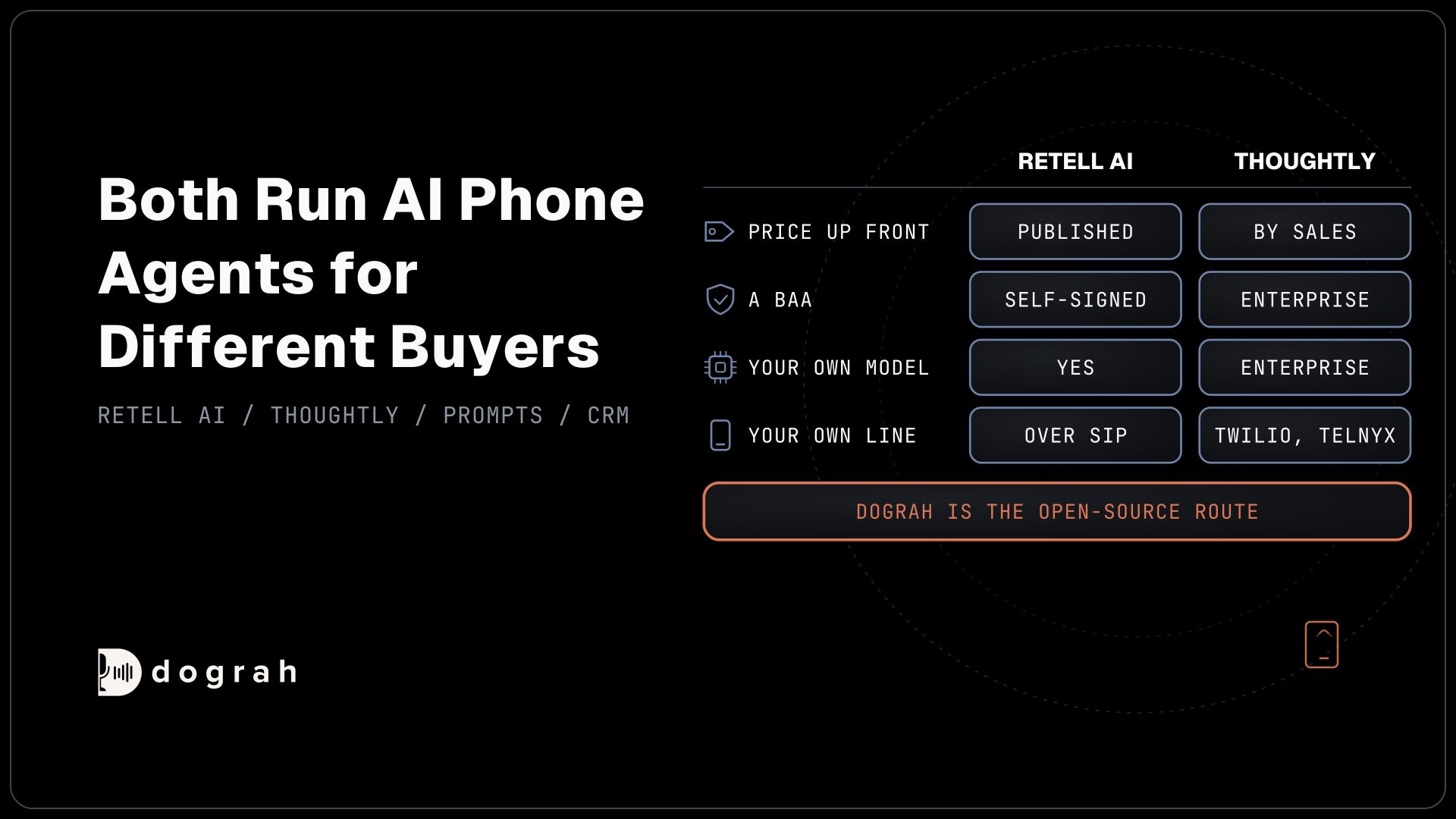
Retell and Thoughtly both run AI phone agents for different buyers. We put them in one table, then compare how you build on each, how each charges, compliance and data, and who each fits. If you want open source or on-prem hosting, the last section covers Dograh.
Retell AI vs Thoughtly in one table
Retell sells a platform you build on and pay for by the minute, while Thoughtly sells lead follow-up on a quoted plan. Each row uses the published Retell rates and Thoughtly plans.
| Row | Retell AI | Thoughtly |
|---|---|---|
| Built for | Teams that design their own call flows | Revenue teams that follow up every new lead |
| How you build | Single-prompt, multi-prompt or Conversation Flow canvas | No-code builder |
| Price | $0.07 to $0.31 a minute on pay as you go | Flex, Scale and Enterprise, each quoted by sales |
| Minutes | Billed to the second | Unlimited on every plan, overage billed in arrears |
| Calls at once | 20 included, then $8 per extra call a month | 10 on Flex, 100 or more on Scale, custom on Enterprise |
| Language models | Your pick, including your own, plus speech-to-speech | GPT, Claude or Gemini, your own model on Enterprise |
| Follow-up channels | Phone, with texts at $0.01 a message | Calls, SMS or iMessage and email on every plan |
| Phone line | Retell numbers at $2 a month, or your own carrier over SIP | Thoughtly numbers, or your own Twilio or Telnyx |
| HIPAA BAA | Self-signed, no extra fee | Enterprise only |
| Code and hosting | Closed, hosted by Retell | Closed, hosted by Thoughtly |
Building call flows or switching on lead follow-up
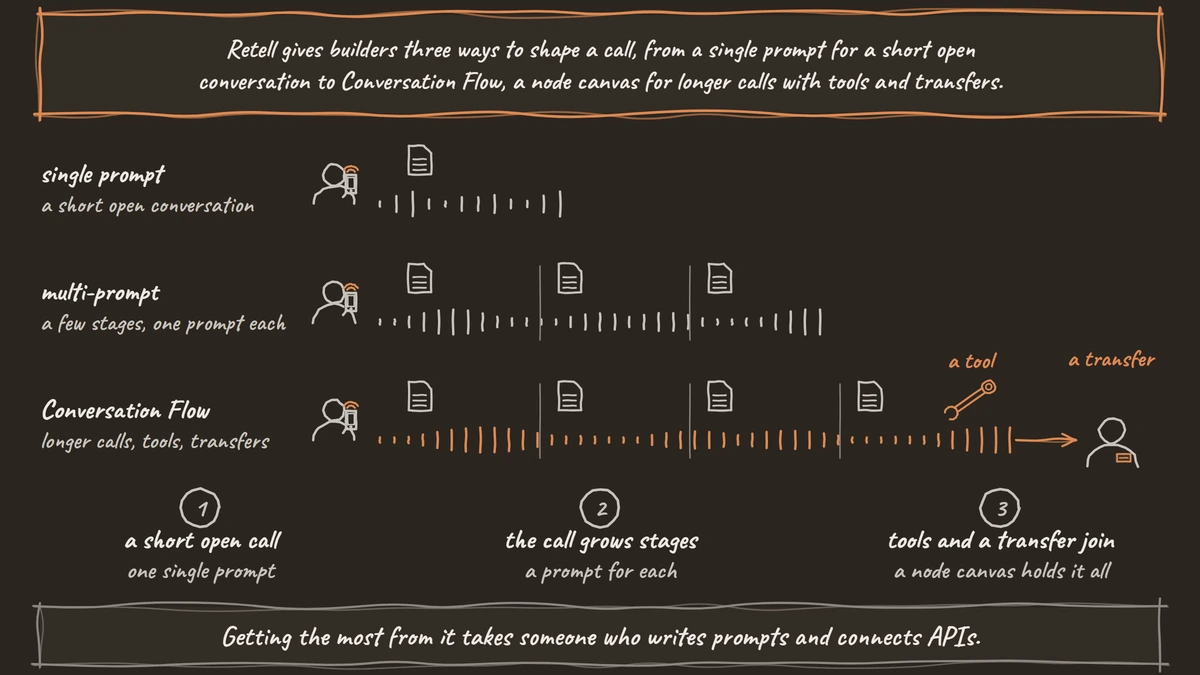
The two products start from different jobs. Retell gives builders three ways to shape a call, from a single prompt for a short open conversation to Conversation Flow, a node canvas for longer calls with tools and transfers. You choose the language model, your own included, and Retell also sells speech-to-speech models. Getting the most from it takes someone who writes prompts and connects APIs.
Thoughtly starts from the lead. Its pitch is that every inquiry gets an immediate response, and one agent can call, text and email a new lead until it is ready to talk, then log the result to the CRM. The builder is no-code, so a revenue or operations team can run it without engineers, and Thoughtly lists more than 200 native integrations with two-way CRM sync on every plan.
Voices follow the same split. Retell lists more than 100 voices and voice cloning, with most voices at $0.015 a minute and ElevenLabs voices at $0.040 to $0.10. Thoughtly offers the Cartesia and ElevenLabs catalogs, custom voice cloning on every plan and more than 34 languages, with your own ElevenLabs key limited on Flex.
That follow-up sequence is Thoughtly's clearest strength. Retell can send texts at $0.01 a message, but Thoughtly builds the whole product around a lead going cold. Retell's strength is control over each call, so it suits teams whose main workload is the conversation itself, such as a support line or a contact center.
A per-minute stack or a plan with unlimited minutes
Retell charges for each part of each minute. There is a $0.055 voice infrastructure fee, then the language model from $0.0016 a minute for GPT 5 nano, $0.015 for most voices and $0.015 for the phone line. Bring your own carrier over SIP and Retell charges nothing for the line. Calls are billed to the second, new accounts get $10 in free credits, and each call above 20 at once costs $8 a month.
Here is a worked example of 5,000 minutes in one month on Retell, with GPT 5 nano, a standard voice and Retell's phone line:
| Line | 5,000 minutes in one month |
|---|---|
| Retell voice infrastructure | 5,000 x $0.055 = $275 |
| Language model, GPT 5 nano | 5,000 x $0.0016 = $8 |
| Voice | 5,000 x $0.015 = $75 |
| Phone line | 5,000 x $0.015 = $75 |
| One Retell number | $2 |
| Retell total | $435 |
| Thoughtly | Your quoted plan, minutes unlimited |
| Dograh Cloud platform fee | 5,000 x $0.01 = $50, with your model keys and carrier on top |
Thoughtly prices each plan through its sales team, so its line is the quote. Minutes are unlimited on every plan, and usage above the plan's allowances is billed in arrears at the end of each cycle. What sets the plan is concurrency, 10 calls at once on Flex and 100 or more on Scale, so measure your busiest hour before the sales call.
The two bills reward different traffic. Retell's grows with every minute, which suits steady, measurable volume. Thoughtly's stays fixed until a launch week pushes calls at once past the plan's cap. For the full detail, see Retell AI pricing and Thoughtly pricing.

Open Source Alternative to Vapi / Retell
Self-hosted voice agent platform — no per-minute fees
dograh-hq/dograh
Star on GitHub
Compliance, data and where each runs
Retell is the quicker buy for a healthcare pilot. Retell offers its business associate agreement (BAA) under the Health Insurance Portability and Accountability Act (HIPAA) for self-signing at no additional fee, and it lists SOC 2 Type 1 and Type 2. Retention is set per agent, from 1 day up to 2 years. Retell does not currently operate services within the European Union, which matters for a team with an EU data residency rule.
Thoughtly puts HIPAA with a BAA, data residency and dedicated infrastructure on Enterprise. Scale adds a SOC 2 Type II report on request and a 99.9% uptime SLA. Both products are closed source and hosted, so the platform code stays with the vendor whichever plan you buy.
Who each one fits
Retell fits an engineering-led team that wants to design each call and see the price before signing. Support lines and contact-center calls with tools mid-call suit it, and so does a US healthcare pilot that wants a self-signed BAA quickly. It fits less well a European team with a residency rule, or a sales team with no one to write prompts.
Thoughtly fits a revenue or growth team that wants every new lead answered fast across calls, texts and email, with results written back to the CRM and no engineers involved. It fits less well a team that wants a price before a sales call, or one that needs its own model or a BAA without an Enterprise contract.
Join the Dograh Community
Dograh is an OSS alternative to Vapi. Join our Slack community for queries, releases, best practices & community interactions.
Where Dograh fits
For open-source and on-prem buyers, Dograh is the third route. It is released under the BSD 2-Clause license, so your team can read the code, self-host it with Docker or run it on Dograh Cloud. Any language model, speech-to-text or voice provider works on your own keys, or open models run on your own servers.
Building needs no code, which matters to Thoughtly's kind of buyer. On the "Create an agent" page you describe the agent in plain words, the Agent Builder asks a few questions, and you approve "Your agent requirements" before it builds. "Test agent" publishes version 1, and later changes in the editor's Builder tab save as a draft until you publish. On Cloud the builder is billed in credits, and a self-hosted install needs a Dograh Service Key for it, otherwise you build on the canvas.
For lead calls, campaigns work through a list within calling hours set in one time zone. A busy line or an unanswered call is retried automatically, and leads that reached voicemail get another attempt through Redial Campaign after the campaign finishes. CRM updates and follow-up texts or emails go through HTTP API tools that call your CRM or messaging provider during the call, and a Webhook node sends the results once it ends.
When a lead asks for a person, Transfer Call rings your sales rep first and connects the lead only once the rep picks up. If the rep is busy or does not answer, the lead stays with the agent and the call goes on.
Self-hosted, Dograh adds no per-minute platform fee, though servers, model keys and phone minutes still cost money. Dograh Cloud charges a 1¢-a-minute platform fee, the $50 line in the example above. A self-hosted install runs 10 calls at once by default, raised with one setting, and Cloud pay as you go includes 10, with more on request.
Self-hosting puts the upkeep on your side. The server, the database and the upgrades become your team's work. The open-source version is supported by the community on Slack and GitHub, and Enterprise plans come with custom SLAs. If neither hosted product suits you, our guides to Retell AI alternatives and Thoughtly alternatives cover the wider field.
Glossary
- Conversation Flow
- Retell's node canvas for building a call as connected steps, each with its own prompt, tools and transfers. It sits beside single-prompt and multi-prompt agents for longer, more structured calls.
- Two-way CRM sync
- An integration that reads lead details from the CRM before a call and writes the outcome back after it. Thoughtly lists it on every plan, and on Dograh the same job runs through HTTP API tools and a Webhook node.
- Calls at once
- The number of calls running at the same moment. Retell includes 20 and charges $8 a month for each extra, while Thoughtly's plans cap them at 10 on Flex and 100 or more on Scale.
- Self-signed BAA
- A business associate agreement under HIPAA that a customer signs online without a sales contract. Retell offers one at no additional fee, while Thoughtly puts its BAA on Enterprise.