
At $0.15 per million input tokens and $0.47 per million output on Alibaba's Model Studio, qwen3.8-flash runs our 5-minute example call for about half a cent, and open-weight qwen3.8-27b for 1.6 cents. Dograh, the open-source AI voice agent platform we build, connects to hosted Qwen or Qwen on your own GPU, self-hosted or on Dograh Cloud.
Key Takeaways
- qwen3.8-flash runs our example call for under half a cent.
- One rented RTX 4090 matches hosted qwen3.8-27b at about 1,300 calls a day.
- Self-hosting Qwen buys control over data and a flat daily cost.
This post is part of our guide to LLM API pricing for voice agents, which works out what the language model costs on one ordinary phone call. Below, we price it on Qwen models and weigh the hosted API against your own GPU, with both running in Dograh.
Alibaba's prices for each Qwen model
Alibaba sells Qwen through Model Studio, priced per million tokens and by region. These are the International (Singapore) rates for the smallest request tier in Alibaba Cloud Model Studio, which covers a phone call's short prompts.
| Model | Input | Output | Note |
|---|---|---|---|
| qwen3.8-max | $2.00 | $6.00 | |
| qwen3.7-max | $2.50 | $7.50 | |
| qwen3.7-plus | $0.40 | $1.60 | List price, with a limited-time 20% discount shown |
| qwen3.6-plus | $0.50 | $3.00 | |
| qwen3.5-plus | $0.40 | $2.40 | |
| qwen3.8-flash | $0.15 | $0.47 | |
| qwen3.7-flash | $0.03 | $0.13 | Prompts up to 32,000 tokens |
| qwen3.5-flash | $0.10 | $0.40 | |
| qwen3.8-27b (open weights) | $0.50 | $3.00 | |
| qwen3.6-35b-a3b (open weights) | $0.375 | $2.25 |
Some of these models come with a free quota of 1 million tokens for 90 days in the Singapore region. Other regions and deployment scopes carry different rates.
One 5-minute call on each Qwen model
We use the guide's example call: 12 turns in five minutes, a 2,000-token system prompt that travels with every request, and short turns of roughly 25 caller tokens and 50 agent tokens. Summed over the call, the model reads 29,250 tokens and writes 600.
On qwen3.8-flash, input costs 29,250 x $0.15 / 1,000,000 = $0.0044 and output 600 x $0.47 / 1,000,000 = $0.0003, so the call costs $0.0047, under a tenth of a cent a minute.
| Model | 5-minute call | Per minute |
|---|---|---|
| qwen3.8-max | $0.0621 | $0.0124 |
| qwen3.7-plus (list price) | $0.0127 | $0.0025 |
| qwen3.8-flash | $0.0047 | $0.0009 |
| qwen3.7-flash | $0.0010 | $0.0002 |
| qwen3.5-flash | $0.0032 | $0.0006 |
| qwen3.8-27b, hosted | $0.0164 | $0.0033 |
| qwen3.6-35b-a3b, hosted | $0.0123 | $0.0025 |
Caching can lower some of these. On Alibaba's context cache rules, implicit caching starts at 1,024 tokens, which every request in this call clears, and a hit typically bills at 20% of the input price. qwen3.8-27b supports it in Singapore, so in the best case its call drops from $0.0164 to $0.0059. qwen3.8-max and qwen3.8-flash have their own cache rates, shown in the Model Studio console.

Open Source Alternative to Vapi / Retell
Self-hosted voice agent platform — no per-minute fees
dograh-hq/dograh
Star on GitHub
Hosted API or open weights on your own GPU
qwen3.8-27b is the model where the choice is real, because its weights are open and a 4-bit version fits on one 24GB card. Hosted, you pay per token and someone else runs the GPU. Self-hosted, you pay for the GPU by the hour and nothing per token, so the question becomes how many calls the GPU has to carry to cost the same.
Here is that sum as an example. On RunPod, an RTX 4090 with 24GB rents for $0.89 an hour on its Secure Cloud. Running all day, that is $0.89 x 24 = $21.36. At $0.0164 per hosted call, $21.36 buys about 1,300 calls. So the rented GPU costs the same as the hosted API only if it carries about 1,300 of our five-minute calls a day. Other hosts sell the same open model at their own rates, and a lower hosted price moves that line higher.
That is about 6,500 minutes of calls a day, an average of four or five calls running at once around the clock, with busier hours above that. Whether one card holds that load at phone speed, together with speech-to-text, is something only a load test on your own setup can tell you, and the answer decides the break-even.
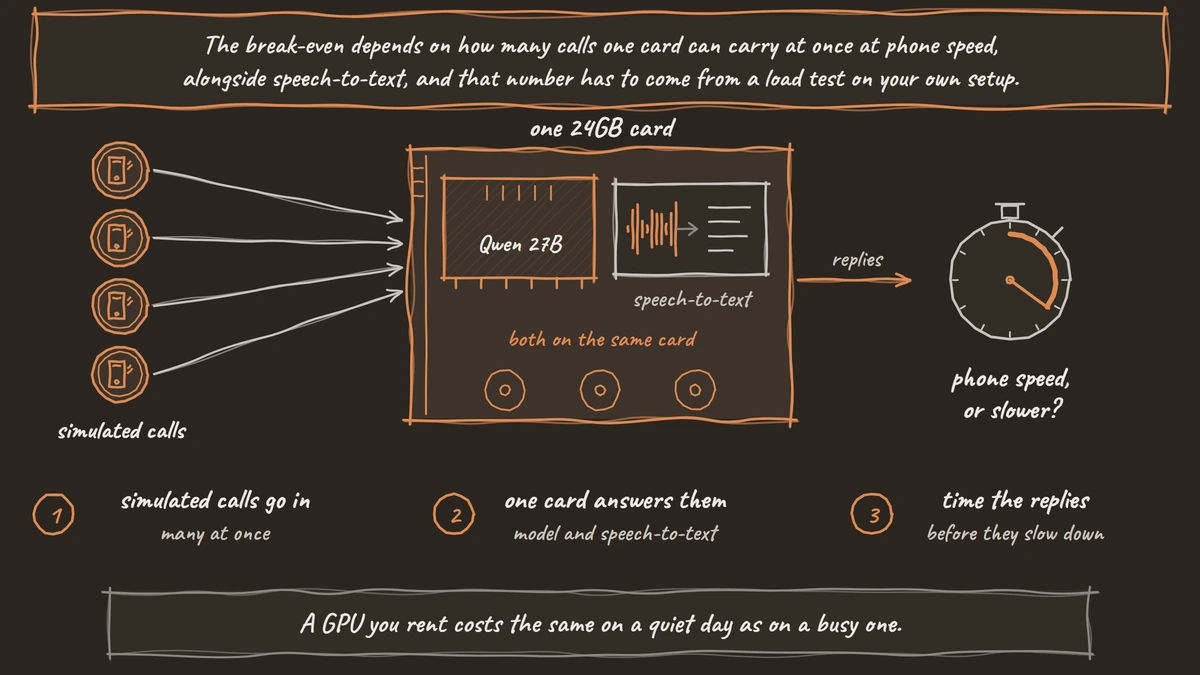
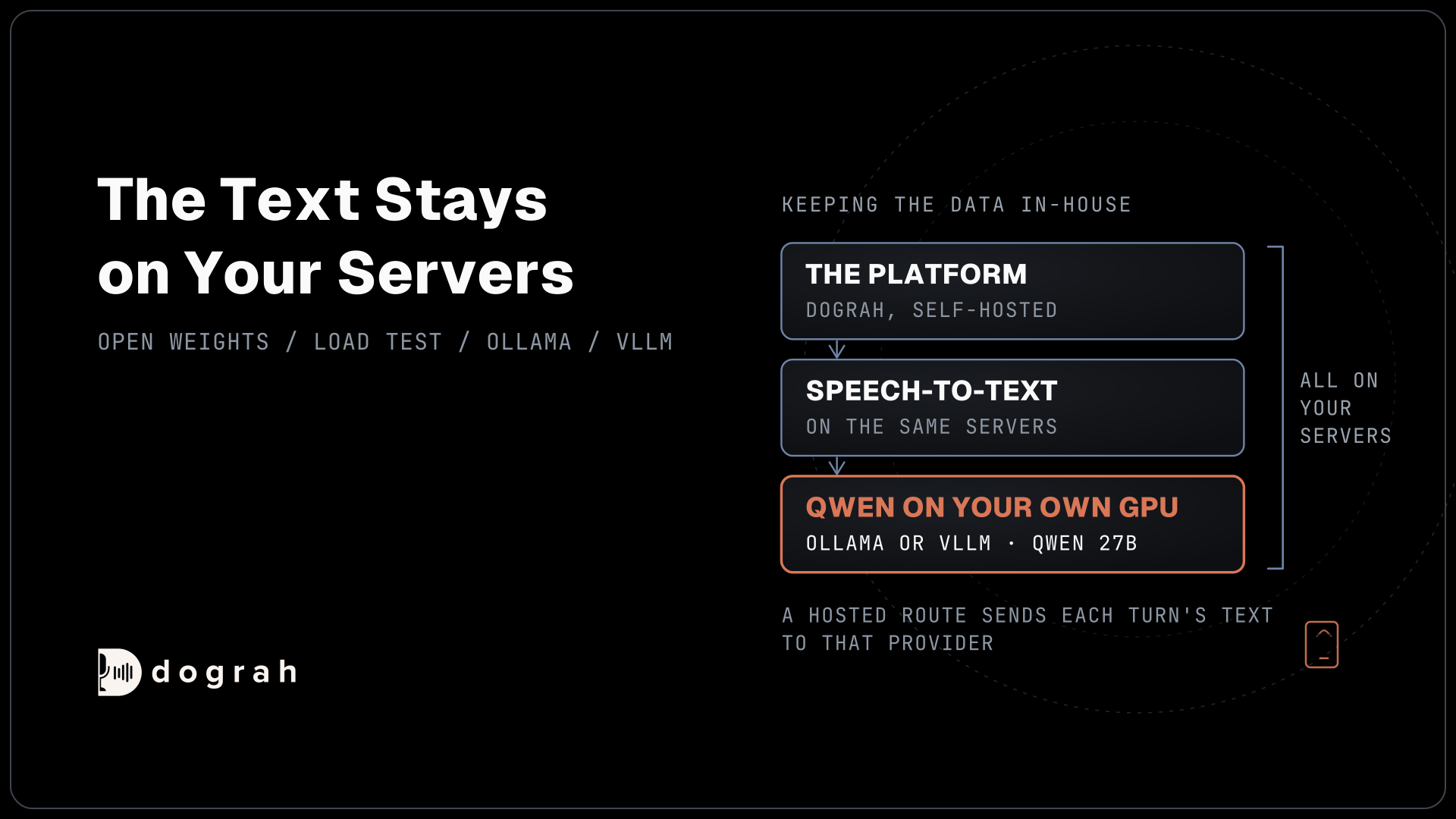
The stronger case for self-hosting is control. A GPU you rent costs the same on a quiet day as on a busy one, and with Qwen on your own servers, the text the model reads stays on your servers. Our guide to running voice AI on local, self-hosted models covers the VRAM sizing and the rest of the open stack.
Running Qwen in Dograh, hosted or local
Dograh is the orchestration layer, running the call flow, the tools and the phone side, while the language model underneath is a separate choice, hosted or on your own card. For hosted Qwen, Dograh connects through Atlas Cloud, where its default model is qwen/qwen3.5-flash, or through Hugging Face or OpenRouter, each with your own key. Those routes set their own prices, so Alibaba's list is a reference point rather than the exact bill.
For your own GPU, the Local Models (Speaches) provider connects any OpenAI-compatible server, such as Ollama or vLLM, by its address and model name. You save each setup as a named model configuration, so one agent can run hosted qwen3.8-flash while another runs Qwen 27B on your own card. Our tutorial on building a voice agent on fully local open-source models walks through that setup.
A hosted route with your own key still sends each turn's text to that provider. Keeping the data in-house needs the platform and every model on your own servers. Self-hosted Dograh has no per-minute platform fee, but servers, model keys and phone minutes still cost money. Dograh Cloud charges a 1¢-a-minute platform fee. Either way, the Qwen line on the bill is yours to choose.
Join the Dograh Community
Dograh is an OSS alternative to Vapi. Join our Slack community for queries, releases, best practices & community interactions.
Glossary
- Open weights
- A model whose trained weights are published, so you can run it on your own hardware. qwen3.8-27b is open-weight, which is why it can be priced two ways: per token on Alibaba Cloud or per GPU hour on your own server.
- Implicit caching
- Alibaba's automatic discount for a request that repeats the start of a recent one. It starts at 1,024 tokens and typically bills hits at 20% of the input price, though some qwen3.8 models carry their own cache rates.
- Break-even
- The daily call count at which a rented GPU costs the same as the hosted API. For qwen3.8-27b on one RTX 4090 in our example it is about 1,300 five-minute calls, valid only if the card can carry them.
- Load test
- Running many simulated calls at once to see how much traffic a server handles before replies slow down. For a self-hosted model it is the only way to know how many calls one GPU can carry at phone speed.