
Leaping AI alternatives are divided into hosted platforms with published per-minute prices, sales-led vendors and open-source options. Dograh, the open-source AI voice agent platform we build, fits buyers who want to read the code and price every line, and you can self-host it or run it on Dograh Cloud. Vapi, Retell AI and Bland are the hosted platforms.
Key Takeaways
- Leaping AI prices each deal by quote, so the budget waits for a sales call.
- Vapi, Retell AI and Bland print per-minute rates you can check at your volume.
- Dograh is open source and self-hostable, with on-prem deployment on Enterprise.
Leaping AI builds finished voice agents for home-improvement firms and multilingual call centers, and prices each one by quote. Below we compare the options in one table, start with open-source Dograh, then cover hosted and sales-led vendors, a priced month, when staying is right and what a move takes.
Leaping AI alternatives in one table
Leaping AI is the baseline row, and every other option answers the same questions. Leaping prices each deal through a quote form in place of plans, provides the phone system or works with your own phone company, and hosts European data inside the EU.
| Option | Open source | Where it runs | How it bills | What you get |
|---|---|---|---|---|
| Leaping AI (baseline) | No | Leaping's cloud, with numbers it provides or your own phone company. European data hosted in the EU | By quote | Done-for-you voice and SMS agents for inbound, after-hours and outbound lead calls, with HubSpot and Lead Perfection connections |
| Dograh | Yes, BSD 2-Clause | Your own servers with Docker Compose, on-prem on Enterprise, or Dograh Cloud | Self-hosted, no per-minute platform fee. Dograh Cloud, 1¢/min platform fee. Models and phone extra | A full platform with the Agent Builder, a visual call-flow canvas, Campaigns, call transfer, QA and call traces |
| Vapi | No | Vapi's cloud | $0.05/min hosting plus models and phone. Core $29/mo for 10 calls at once. HIPAA add-on $2,000/mo | A developer platform set up in code or the dashboard |
| Retell AI | No | Retell's cloud, with on-prem through Enterprise sales | $0.055/min voice infrastructure, the language model per minute and $0.015/min telephony. $0.07 to $0.31/min all-in | Hosted agents with 20 calls at once included, then $8 a month for each extra |
| Bland | No | Bland's cloud, with on-prem or VPC on Enterprise | Start $0.14/min. Build $0.12/min plus $299/mo | One rate with Bland's own models, 10 calls at once on Start and 50 on Build |
| PolyAI | No | PolyAI's cloud | Essentials $49/mo for 250 minutes, then 30¢/min. Enterprise through sales | Self-serve plans you build with its Wren builder, or an Enterprise agent built for you |
| Synthflow | No | Synthflow's cloud | Annual enterprise agreement, no per-minute rate | A hosted platform scoped and launched with the vendor |
| LiveKit Agents and Pipecat | Yes, Apache-2.0 and BSD-2-Clause | Your own servers | Free to self-host | Frameworks. Your team builds the phone wiring, call history and QA |
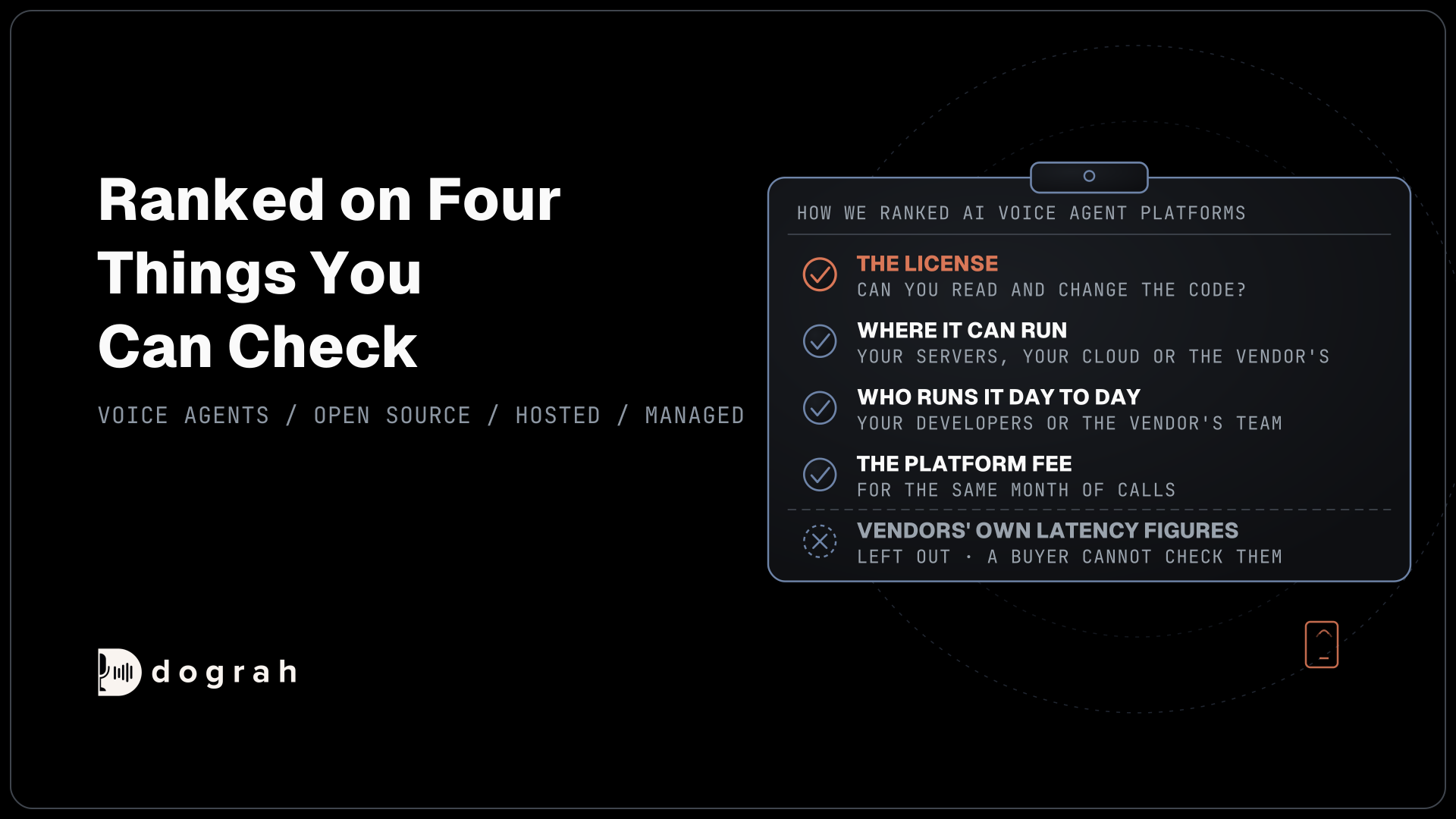
The hosted rows print a price you can multiply by your own minutes. Leaping, Synthflow and PolyAI's Enterprise tier use quote-only pricing and want a conversation first. Only three rows let you run the code yourself, and of those, Dograh alone arrives as a working product with the builder, phone connections and QA already in place.
Dograh: open code and a price for every line
Dograh's whole platform sits in its GitHub repository under the BSD 2-Clause license, so your team can read every line that touches a call. You can self-host it with Docker Compose on a server with at least 8 GB of RAM and 4 vCPUs, or run it on Dograh Cloud. The Enterprise plan adds on-prem deployment inside your own data perimeter.
Dograh runs the call flow, the tools and the telephony as the orchestration layer, while you choose the speech and language models as a separate layer. Use Dograh's own models, your keys with a provider you already pay, or open-weight models served on your own machines through an OpenAI-compatible server. Bring your own key (BYOK) moves the contract to you, while the call audio still reaches that provider. Audio stays inside your network only when the models run there too.
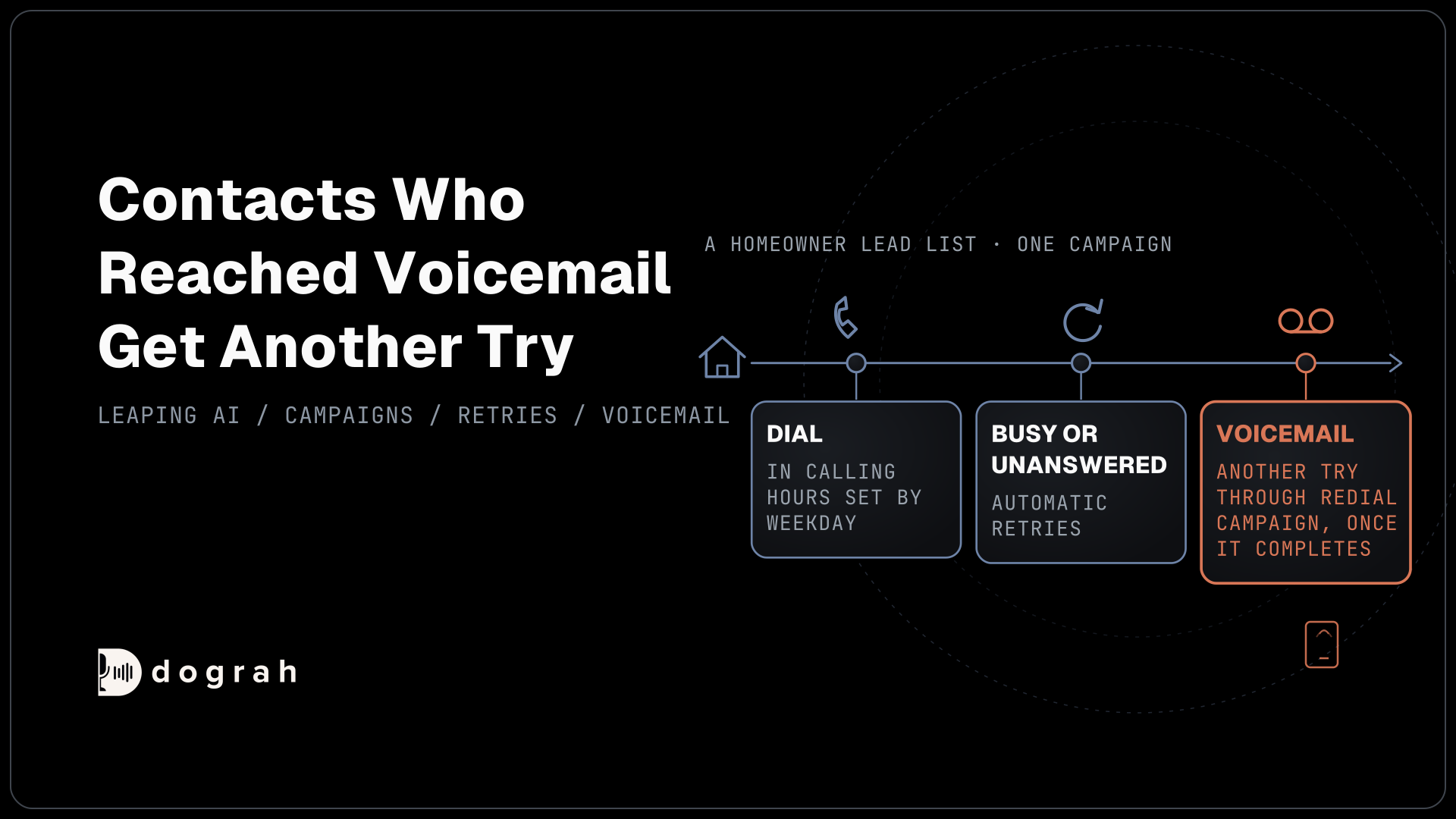
For outbound lead lists, Campaigns dial a contact file with calling hours set by weekday, in one time zone per campaign. Automatic retries cover busy and unanswered calls, and contacts who reached voicemail get another try through Redial Campaign once the campaign completes. Texts go out through your own SMS provider, which an HTTP API tool asks to send the message during the call.
The fixed opening of a lead call can be a pre-recorded clip in a real person's voice, with text-to-speech covering the lines that change. When a homeowner wants a person, Transfer Call works on Twilio, Telnyx, Plivo, Cloudonix and Asterisk ARI. Dograh dials that person first and connects the homeowner only once someone answers. If nobody picks up, the line is busy or the call fails, the agent hears that and carries on with the caller.
On your own servers there is no per-minute platform fee, though the servers, model keys and phone minutes still cost money. Dograh Cloud adds a 1¢-a-minute platform fee on top of the models and phone line you choose. Self-hosted installs run 10 calls at once by default, a setting you can raise, and the Cloud pay as you go plan includes 10, with more on request.
Self-hosting is real work, and it helps to name it before you choose. The server, the database and every upgrade belong to your team. The open-source edition is supported by the community in Dograh's Slack, and custom SLAs come with the Enterprise plan. Our post on the open-source alternative to Leaping AI prices that route line by line.
Once a call ends, the QA step gives each of its steps a score, on test calls and live ones, and View Trace breaks every turn into speech-to-text, AI and voice time.

Open Source Alternative to Vapi / Retell
Self-hosted voice agent platform — no per-minute fees
dograh-hq/dograh
Star on GitHub
Hosted platforms that publish a per-minute rate
Each of these runs on its vendor's cloud and bills for as long as you use it, but you can price it before anyone books a demo. Vapi charges $0.05 a minute for hosting, with speech, the language model, the voice and the phone line billed on top. Without a package you get 4 calls at once, Core gives 10 for $29 a month, and HIPAA handling is a $2,000-a-month add-on.
Retell AI charges $0.055 a minute for voice infrastructure, a separate per-minute price for the language model and $0.015 a minute for telephony, with no charge when you bring your own SIP trunk. Its own all-in range runs from $0.07 to $0.31 a minute, and on-prem is available through Enterprise sales.
Bland's Start plan costs $0.14 a minute with Bland's own models included, 10 calls at once and 100 calls a day. Build costs $0.12 a minute plus $299 a month, with 50 calls at once and 2,000 a day. On-prem or VPC deployment sits on Enterprise.
PolyAI now sells self-serve plans from $49 a month. PolyAI's Essentials plan includes 250 minutes, then 30 cents a minute, with 5 calls at once, and you build the agent yourself in its Wren builder. All four are closed source. Our guide to Vapi alternatives covers Vapi, Retell AI and Bland in full.
Sales-led vendors like Leaping AI
Some buyers want what Leaping offers, a vendor that scopes the project and builds the agent, and two others sell the same way. Synthflow sells an annual enterprise agreement with no per-minute rate, scoped around call volume, concurrency, telephony and integrations. PolyAI's Enterprise tier is sales-led too, with PolyAI or a partner building the agent and a named account manager available around the clock. The trade is the same in each case, since a team builds the agent for you and you give up a rate you can check against your own volume before you sign.
Open-source frameworks: LiveKit Agents and Pipecat
LiveKit Agents and Pipecat give developers strong building blocks and leave the product to them. LiveKit Agents is Apache-2.0, with its turn-detection models under a separate LiveKit Model License, and Pipecat is a BSD-2-Clause Python framework that Dograh itself is built on. With either one, your team writes the phone wiring, call history and live-call checks before the first lead gets a callback.
What 5,000 minutes a month costs
A worked example makes the published rates concrete. Take 5,000 call minutes in one month and price only the line each vendor bills for them.
| Option | Platform line for 5,000 minutes | Still to add |
|---|---|---|
| Leaping AI | By quote | Set in the quote |
| Vapi | 5,000 x $0.05 = $250 | Speech, language model, voice and phone |
| Retell AI | 5,000 x $0.055 = $275, plus 5,000 x $0.015 = $75 telephony, so $350 | The language model. Retell's own all-in range gives $350 to $1,550 |
| Bland Start | 5,000 x $0.14 = $700 | Phone time |
| Bland Build | 5,000 x $0.12 + $299 = $899 | Phone time |
| Dograh Cloud | 5,000 x $0.01 = $50 | Your models and carrier |
| Dograh self-hosted | No platform fee | Servers, model keys and phone minutes |
The rows count different things. Bland's rate already pays for its language model and voices, while the Vapi, Retell AI and Dograh rows still need models added at each provider's price. What the table does show is that every row except Leaping's can be worked out tonight, before a sales call, and checked again whenever your volume changes.
Join the Dograh Community
Dograh is an OSS alternative to Vapi. Join our Slack community for queries, releases, best practices & community interactions.
When staying on Leaping AI makes sense
Leaping is a sound choice for a team that wants the agent built and run for it. Its focus on home improvement runs through the product, with pages for roofing, windows, siding, HVAC and bathroom remodeling, and it connects to HubSpot and Lead Perfection, which many of those firms already use. Number provisioning, call routing and human handoff come included, and SMS agents work beside the voice ones.
Speed of launch is the other draw, and Leaping says Eurowings rolled multilingual voice AI out to its call centers in under two months. If nobody on your team wants to own servers or tune prompts, a done-for-you vendor saves real effort. The case for moving starts when you need to see the price before you sign or keep call data on your own machines.
What moving off Leaping AI takes
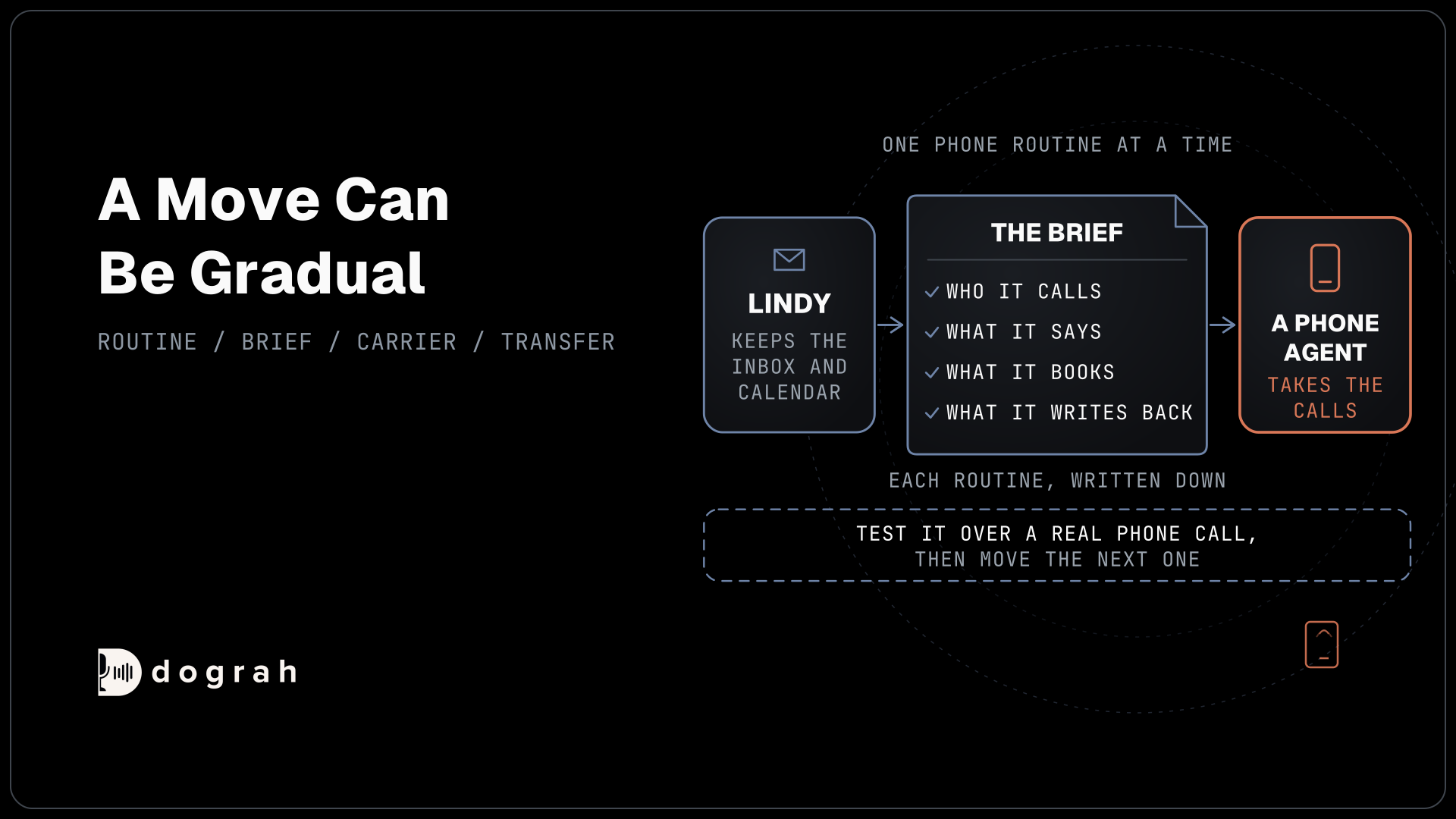
A move is mostly a rebuild, because Leaping built the agent for you. Start by asking Leaping what it can hand over, such as the call scripts, routing rules, recordings and transcripts, and keep that material as the spec for the new agent.
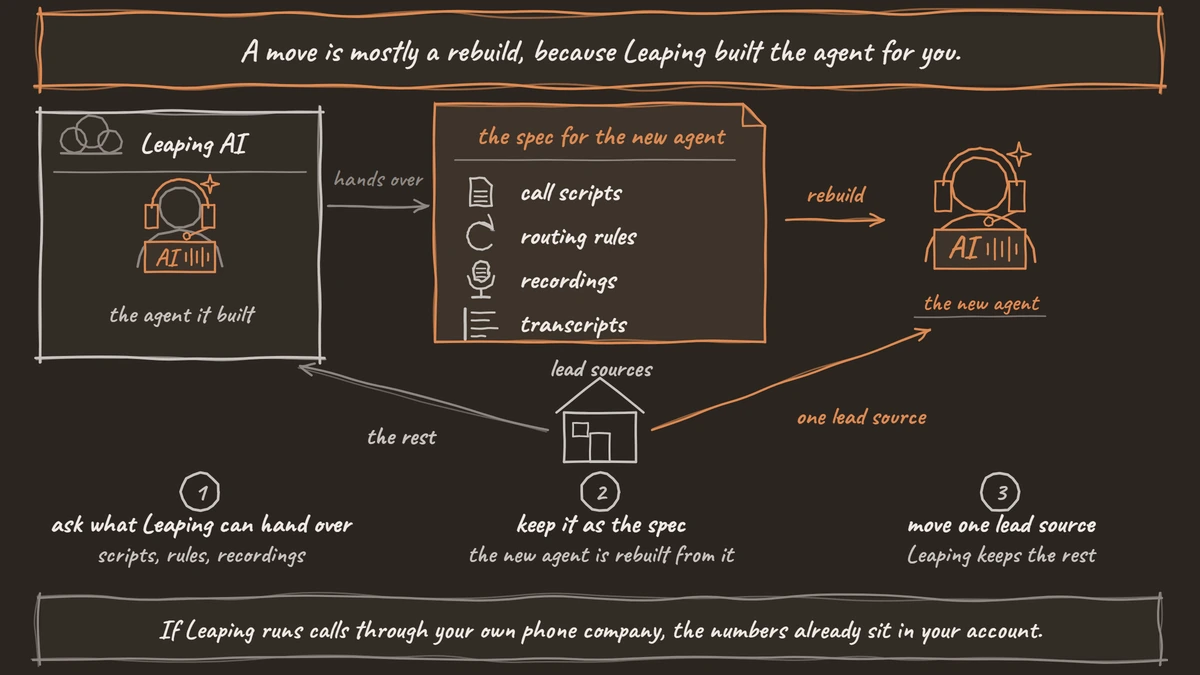
Phone numbers come next. If Leaping runs calls through your own phone company, the numbers already sit in your account. If Leaping provided them, ask how a port works before you set dates. On Dograh Cloud you describe the agent on the Agent Builder's "Create an agent" page, approve the "Your agent requirements" card and let it build. A self-hosted install uses the builder with a Dograh Service Key, or you build the flow on the canvas.
CRM links need the most care. Dograh reaches a CRM such as HubSpot through HTTP API tools during the call and a Webhook node after it, so plan those requests before cutover. Our walkthrough on connecting a voice agent to HubSpot shows them in order.
Then run both for a while. Send one lead source or one after-hours line to the new agent, keep Leaping on the rest, and test every transfer over a real phone call, because a browser test call cannot run a transfer.
Picking your Leaping AI alternative
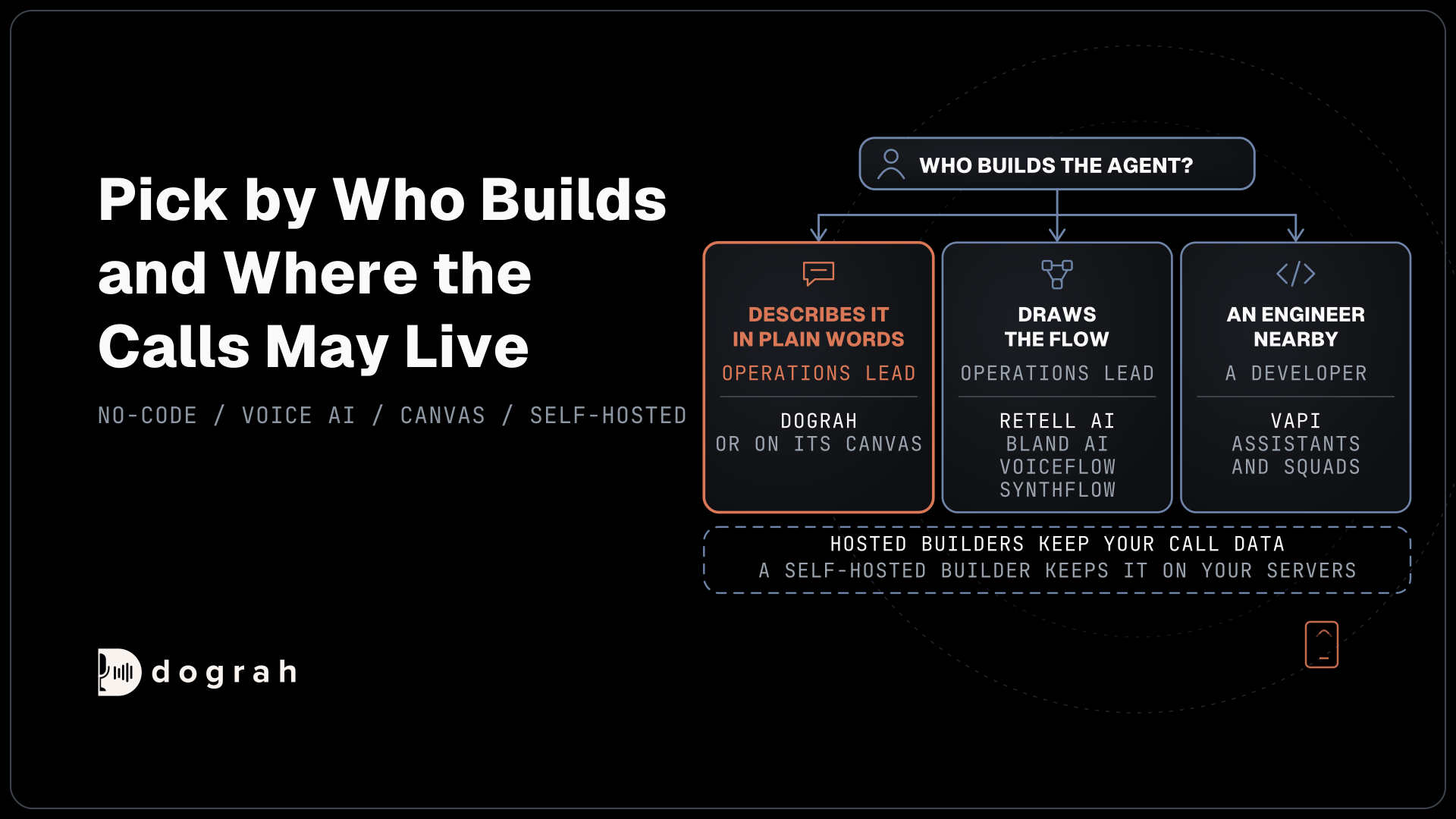
Start from where your calls must run and who will keep the agent working. If you want open source, your own servers or on-prem inside your network, start with Dograh, with an Enterprise contract behind it when you need on-prem. If you would rather build the product yourself, LiveKit Agents and Pipecat are good bases. If a hosted rate suits you, price Vapi, Retell AI, Bland and PolyAI at your own minutes with models and phone added. And if you want a vendor to build it, Synthflow works the way Leaping does. Whichever way you lean, run one real lead flow on the new option before you move a phone number.
Glossary
- Quote-only pricing
- A vendor prices each customer through a sales conversation instead of a public rate. Leaping AI sells this way, so the cost of a month is known once the quote arrives.
- Platform fee
- What a voice agent platform charges for running the call, apart from the models and the phone line. Vapi's is $0.05 a minute for hosting, and Dograh Cloud's is $0.01 a minute.
- Orchestration layer
- The part of a voice agent that runs the call flow, turn-taking, tool calls and the phone connection. The speech and language models sit in a separate layer you can swap.
- Bring your own key (BYOK)
- Using your own account with a model provider inside the platform. You hold the contract and the bill, while the call audio still goes to that provider.