
Cresta sells through contracts, and its one public price is on AWS Marketplace, at $150,000 a year for up to 100,000 Agent Assist voice calls, then $1.50 for each extra call. That price covers agent assist only. Dograh, the open-source AI voice agent platform we build, can be self-hosted or run on Dograh Cloud.
Key Takeaways
- Cresta's one public price is $150,000 a year for 100,000 Agent Assist calls.
- Inside the contract that is $1.50 a call, the same as the overage rate.
- Ask which products, units and subprocessors your quote covers before you sign.
Cresta prices by contract, so most of the real work happens in the quote. We read the one listing Cresta publishes, turn it into per-call and per-minute figures, set out the questions to ask before signing, and then price a self-hosted or Dograh Cloud voice agent the same way.
How Cresta sells and prices its products
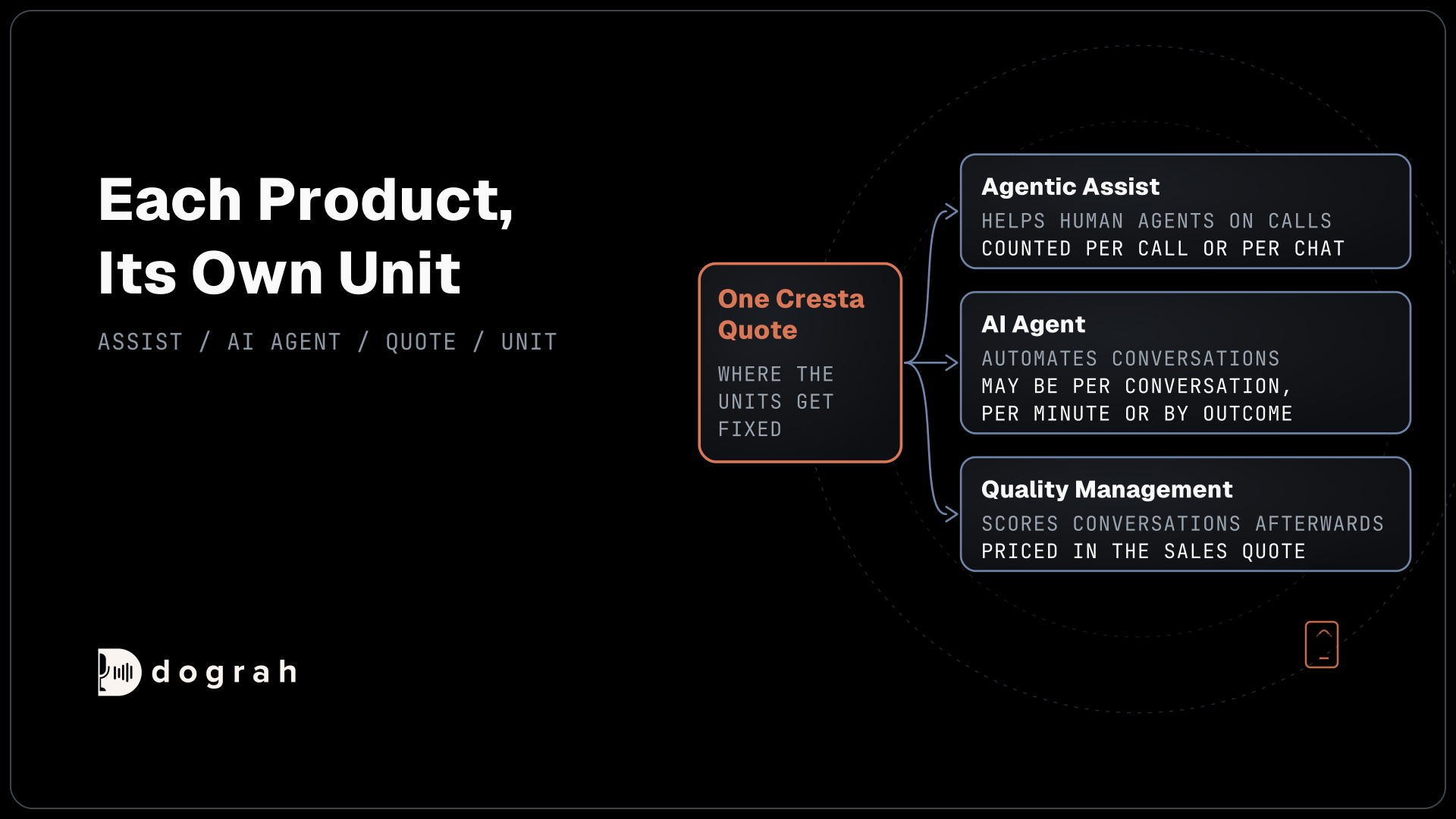
Cresta sells through its sales team, and a quote can cover several products at once. Its homepage leads with "Book a demo" and lists AI Agent, Deputy Agent, Agentic Assist, Knowledge Agent, Conversation Intelligence and Quality Management. Some help human agents during live calls, and others automate conversations or score them afterwards.
Each product can be priced on its own unit, which is why two Cresta quotes can look very different. Helping a human agent is naturally counted per call or per chat. An AI agent that finishes conversations may be counted per conversation, per minute or by outcome. The quote is where those units get fixed.
Everything runs as a hosted service on Amazon Web Services, which Cresta lists as its infrastructure, so a Cresta bill has no server line. Your costs are the contract, the contact center platform it sits on, the phone minutes and the people on the floor.
The one public price, on AWS Marketplace
The only price list Cresta publishes is its AWS Marketplace listing, and it covers agent assist rather than the AI Agent. Cresta's AWS Marketplace listing, sold by Cresta Intelligence as "Contact Center AI Platform", offers two 12-month contracts. Real-Time Agent Assist for Voice covers up to 100,000 calls for $150,000. Real-Time Agent Assist for Chat covers up to 125,000 chats for $150,000.
Usage above the contract is billed at $1.50 for each extra call and $1.20 for each extra chat. The listing says price depends on the duration and terms of your contract plus additional usage, and that subscriptions are non-cancellable and non-refundable for the period you sign up for. If you don't renew, your entitlements end on the contract end date.
So the public figures tell you what real-time help for human agents costs at one volume. AI Agent, Quality Management and Conversation Intelligence come through the sales quote.
What that price means per call and per minute
Here is a worked example built only on the listing, and the arithmetic is ours. A contact center buys the voice contract and handles exactly 100,000 calls in the year. $150,000 divided by 100,000 calls is $1.50 a call, the same as the overage rate, so there is no volume discount inside the listing.
If the average call lasts 5 minutes, $1.50 is $0.30 a minute for agent assist alone. That sits on top of the phone minutes and the wages of the agent who still takes the call.
Under-use costs more per call. If the team handles only 60,000 calls, it still pays $150,000, which works out to $2.50 a call, and the contract cannot be cancelled or refunded. Over-use is simple. At 120,000 calls the bill is $150,000 plus 20,000 extra calls at $1.50, so $180,000.
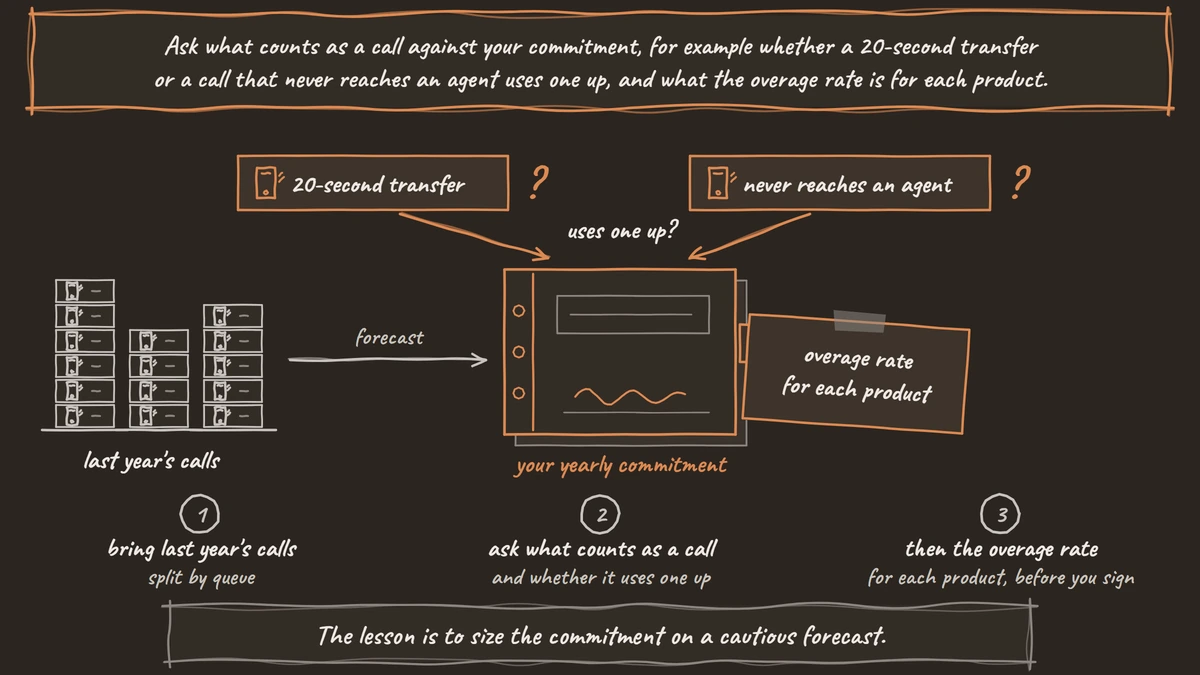
The lesson is to size the commitment on a cautious forecast. Overage at $1.50 costs the same per call as the contract itself, while unused calls in a non-refundable year cost you the full price.

Open Source Alternative to Vapi / Retell
Self-hosted voice agent platform — no per-minute fees
dograh-hq/dograh
Star on GitHub
Questions to ask before you sign
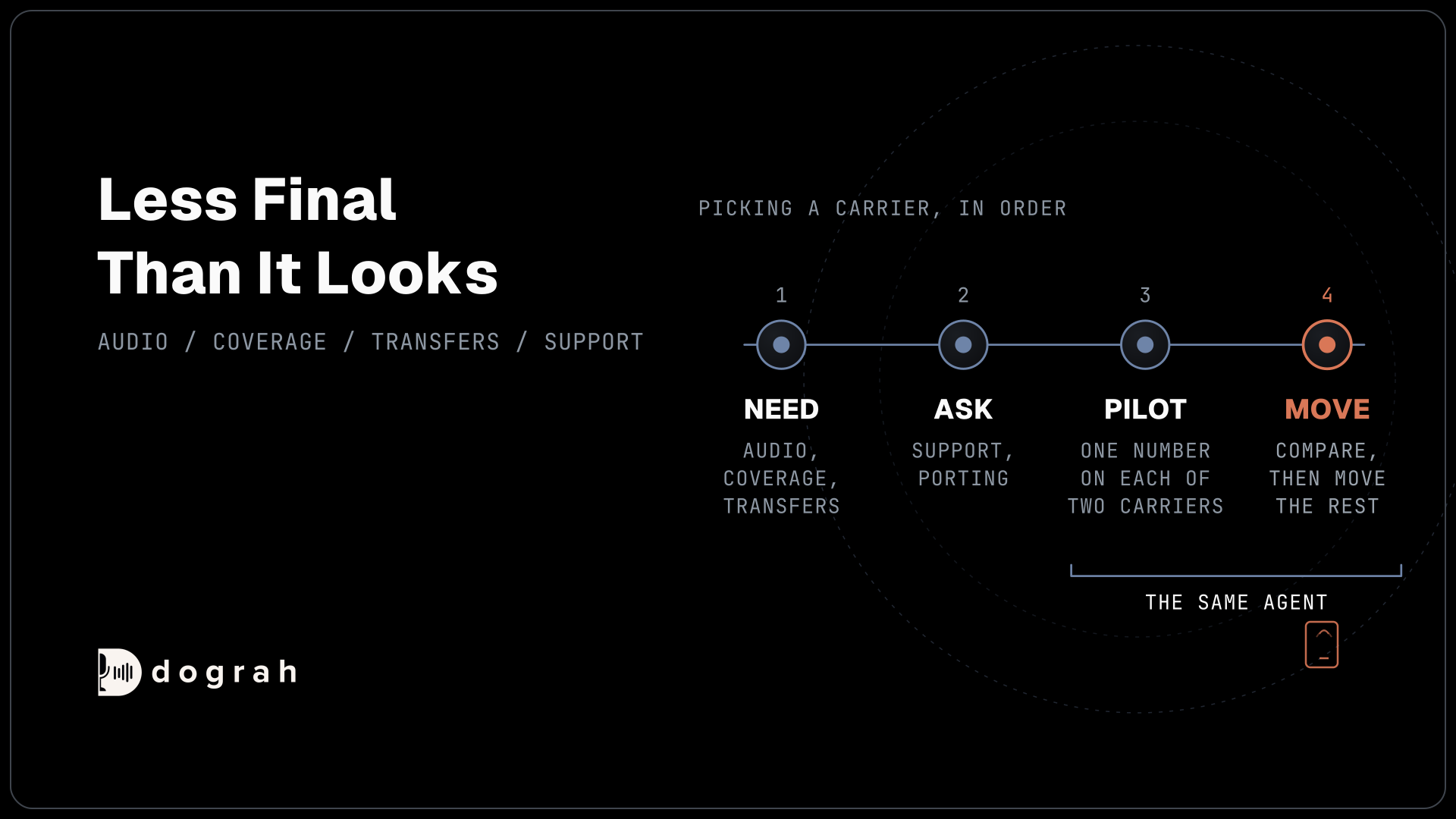
Bring last year's call and chat volumes to the first meeting, split by queue. Then use the questions below to pin down what the quote really covers.
Start with products and units. Ask which products the quote includes, and whether each is priced per seat, per call, per chat, per conversation or per minute. Ask what counts as a call against your commitment, for example whether a 20-second transfer or a call that never reaches an agent uses one up, and what the overage rate is for each product.
Then ask about the term and the exit. The Marketplace contract runs 12 months and can't be cancelled or refunded, so ask whether unused calls roll over, what happens to the price at renewal, and how you get your data back if you leave. Ask what implementation, integration and support cost, and how much of your own team's time the rollout needs.
Finally, ask where the audio goes. Cresta's trust center lists model and speech providers among its subprocessors, including OpenAI, Anthropic, Fireworks.ai, Deepgram, Cartesia AI and ElevenLabs. Ask which of them process your calls, in which region, and whether a business associate agreement (BAA) under the Health Insurance Portability and Accountability Act (HIPAA), or a PCI DSS scope review, is part of your contract. Cresta lists both HIPAA and PCI DSS among its certifications.
If you are weighing the features rather than the price, our Dograh vs Cresta comparison covers what each product does, and where Cresta is stronger.
Pricing an open-source voice agent instead
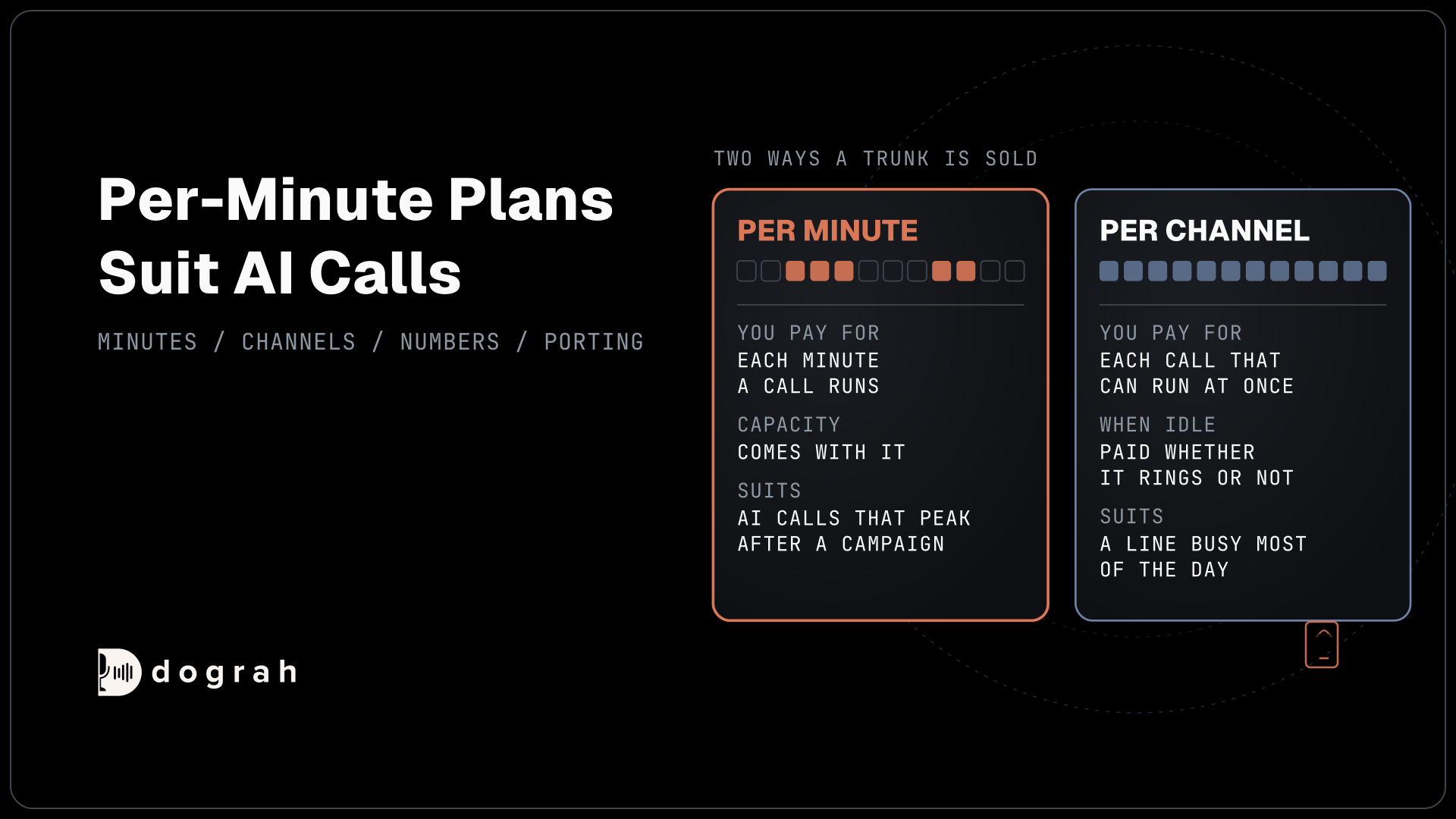
An open-source voice agent can be priced line by line before any sales call, because each part has a public rate. Self-hosted Dograh has no per-minute platform fee, but servers, model keys and phone minutes still cost money. Dograh Cloud charges a 1¢-a-minute platform fee. Its pay-as-you-go plan includes 10 concurrent calls, with more on request.
Here is one example 5-minute inbound call on Dograh Cloud, with your own keys and a US Twilio number. The platform fee is 5 x $0.01, so $0.05. Speech-to-text on Deepgram Nova-3 streaming, at $0.0077 a minute, adds $0.0385. The voice on ElevenLabs Flash, at $0.04 per 1,000 characters and about 400 characters a minute, adds $0.08.
For the phone line, Twilio charges $0.0085 a minute to receive the call plus $0.0044 a minute for the media stream, so $0.0645 for 5 minutes. That brings the call to about $0.23 before the language model, and our guide to LLM API pricing for voice agents prices that last line by model.
Keep the jobs apart when you read these numbers. Cresta's $1.50 helps a human agent who is still on the call and still paid. The $0.23 is an AI agent handling the whole call. They answer different questions, so compare Cresta's AI Agent quote, when you have it, with the AI call above. Our breakdown of what an AI voice agent costs per minute shows how each part moves with your choices.
The lines can also shrink. Pre-recorded clips play a real recording for the lines your agent says most, with TTS only as a fallback, which cuts the voice line.
Call scoring is already in the price. QA comes with the platform and scores each step of test and live calls, so call scoring is not a separate product to buy.
Join the Dograh Community
Dograh is an OSS alternative to Vapi. Join our Slack community for queries, releases, best practices & community interactions.
Which cost model fits your contact center
Cresta's contract model fits a large contact center that keeps human agents at the center and wants one vendor to help and score them, with an AI agent on top. The price is a yearly commitment, so it rewards teams that can forecast volume with confidence.
A per-minute or self-hosted model fits a team that wants to automate whole calls and see every cost line before it commits. On Dograh Cloud you pay as you go, and self-hosting with Docker swaps the platform fee for servers you run. Either way the model and phone providers bill you at their own rates.
Many contact centers end up with both. They keep an assist and coaching contract for the human floor, and run an open-source agent for reminders, after-hours calls and other calls that never needed a person. Price each against the job it does, and the two bills stop competing.
Glossary
- Commitment
- The number of calls or chats a contract pays for upfront, used or not. Cresta's Marketplace voice contract commits to 100,000 calls a year, so using fewer raises the real price per call.
- Overage rate
- The price for each unit above the committed volume. On Cresta's Marketplace listing it is $1.50 per extra call and $1.20 per extra chat.
- Subprocessor
- A third party that processes customer data for a vendor, such as a model or speech provider. Cresta's trust center lists several, so ask which ones handle your calls.
- Platform fee
- What a voice agent platform charges for running calls, separate from the models and the phone line. Self-hosted Dograh has none, and Dograh Cloud charges it per minute.