
AI voice agents for win-back in fintech call users your own records show have gone inactive, such as people who stopped using a wallet or a neobank app. After verifying the person, the agent asks why they stopped, then reads one offer your system returns, with written consent on file. Reopening the account happens in the app.
Key Takeaways
- A status call and an offer call are separate calls with separate consent.
- Name the company in a fixed greeting, and never ask for codes or card numbers.
- The agent reads one offer from your system, and reopening happens in the app.
A surprise call about a money app sounds like a scam to many. We cover who to call, keeping status and offer calls apart, an opening that proves who is calling, one offer after the reason, reopening in the app and where Dograh keeps the data. It builds on our guide to dormant customer reactivation.
Which inactive users to call
The list starts with your own rule for inactive, written as a field in your system, such as no login for 90 days or no transaction in six months. A wallet, a neobank and an investing app will each draw that line differently, and that is fine as long as the rule stays the same from one campaign to the next.
Then take people out. Anyone without written consent on file for AI-voice calls comes off, and so does anyone who has opted out. Anyone in collections or a hardship plan comes off too, because a call about coming back means nothing to someone who is behind on a payment.
Current customers belong on a different call. Offering a second product to someone who still uses the app is cross-sell, covered in AI voice agents for banking cross-sell. This post is about users who have gone quiet. Upload the filtered list to Campaigns, where each extra column, such as a first name or the last feature used, reaches the agent as a variable.
A status call and an offer call
A call that only tells a user something about their account is a service call, and a call with any offer in it is a sales call. The two need different consent, so keep them apart.
Telling a user that their account has gone inactive, or that a feature they used has changed, with nothing offered, is a service call. It generally needs prior express consent, such as the number they gave when they signed up. Add a fee waiver or a cashback bonus and it becomes a sales call. Under the Telephone Consumer Protection Act (TCPA), the Federal Communications Commission's calling rules then require prior express written consent for an artificial voice, and the FCC's 2024 ruling on AI-generated voices treats an AI voice as one.
The user's old relationship with you does not fill the gap. The established business relationship covers the do-not-call rules and never replaces written consent for an AI-voice sales call. A user inactive for a long time is often past it anyway.
So run two agents if you need both calls: one that gives the status and offers nothing, and one that runs only on users with written consent on file. Lenders and insurers face the same split, which our post on win-back and drop-off recovery lays out. Confirm your consent wording with counsel before the first campaign.
Open like your company, not like a scam
An unexpected call about a money app sounds like a scam to many people, so the opening has to prove who is calling. In 2025, 20% of adults experienced financial fraud or scams, according to the Federal Reserve's survey of household finances. Consumers reported losing $15.9 billion to fraud in 2025, as the FTC told Congress.
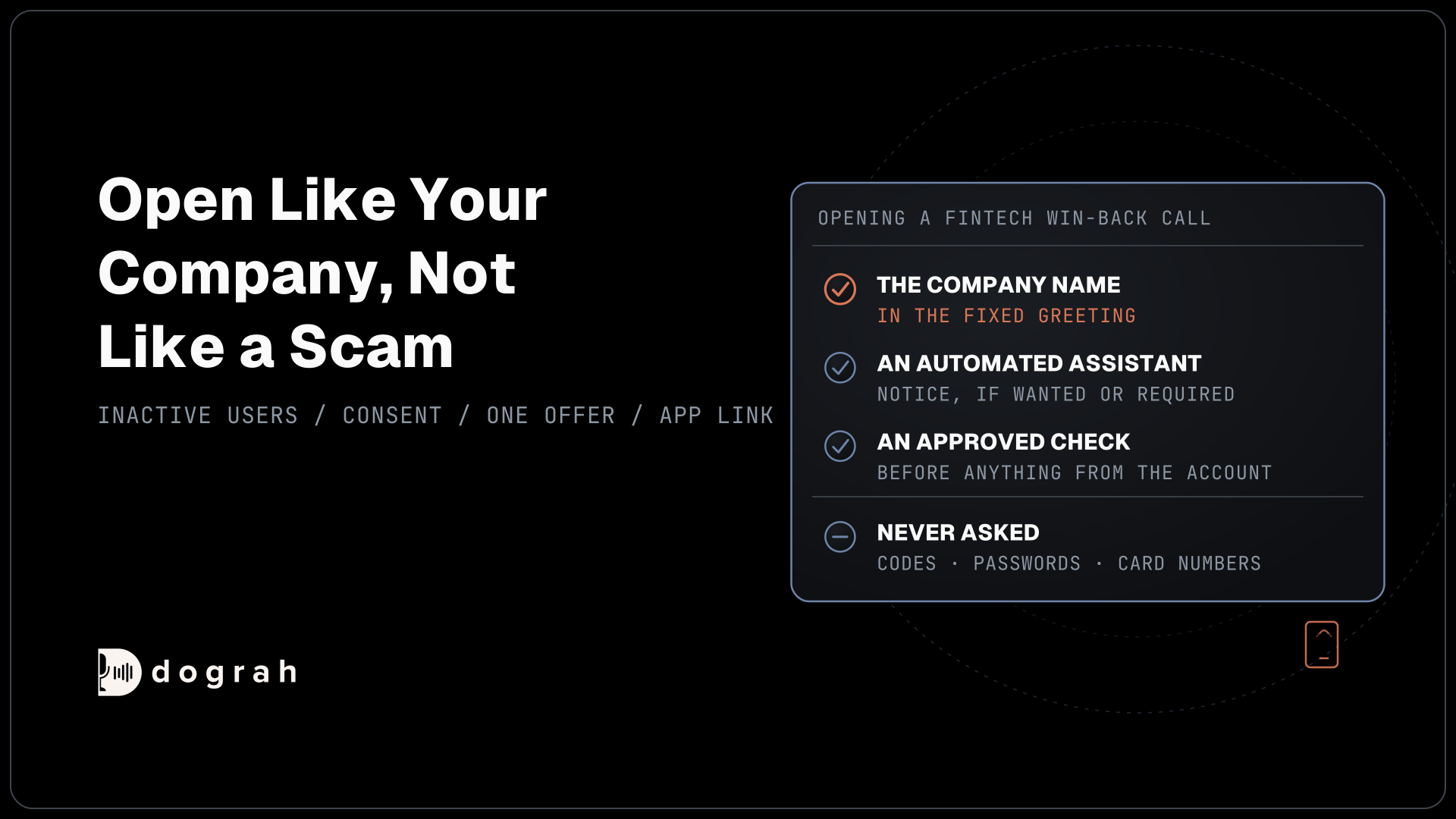
Put the company name in the Greeting Text, the fixed line Dograh speaks word for word as the call connects. Users who should hear that an automated assistant is on the line, because your team wants them told or a local law requires it, hear that in the same opening. With a notice in that opening, set Allow Greeting Interruption on the Start Call node to off, since the default lets a user's first couple of words end the greeting early. Then the agent asks for the user by name, which only finds the right person.
Before it mentions anything from the account, the agent asks for an approved check, such as date of birth or the last digits of the account number. It never asks for a password or a one-time code, and card numbers stay off the call as well. Tell users that in the greeting or the first answer, so the call sounds different from the scams it resembles. AI voice agents for fraud-alert callbacks covers the same problem from the bank's side.

Open Source Alternative to Vapi / Retell
Self-hosted voice agent platform — no per-minute fees
dograh-hq/dograh
Star on GitHub
Ask why they stopped, then one offer
Once the user is verified, the agent asks why they stopped using the service, and only then makes an offer. Users leave a money app for reasons you can act on, such as fees or a missing feature, and the reason decides whether any offer fits.
Record the answer with variable extraction, in a field such as reason_for_stopping, as the user stated it. Because a model fills that field, the transcript and recording stay the record of what the user really said.
Next, an HTTP API tool sends the reason and the user reference to your offer service and gets back what that user can have, such as a fee waiver or a guide to a feature they never tried. While your offer service looks the user up, a short typed or recorded message set to play as the tool starts fills the pause. The agent reads the offer the way your system words it and never makes up a rate or a deadline.
Some terms need approved wording, such as a fee or an interest rate. Play those as fixed text, such as a pathway's Transition Speech, with one pathway per offer, because Transition Speech takes no per-user values. Add a line to the prompt saying that once a user turns the offer down, the agent makes no other offer on that call.
The account reopens in the app
A yes on the call ends with a link, and the user reopens the account in the app with their own login. The agent never takes a password or login details on the phone.
When the user wants to come back, an HTTP API tool asks your own system to send the app link by text or email. Your system sends it, and the user logs in as usual. If they ask to stop hearing from you, the agent writes that opt-out to your system during the call, and your system leaves the number off the next list.
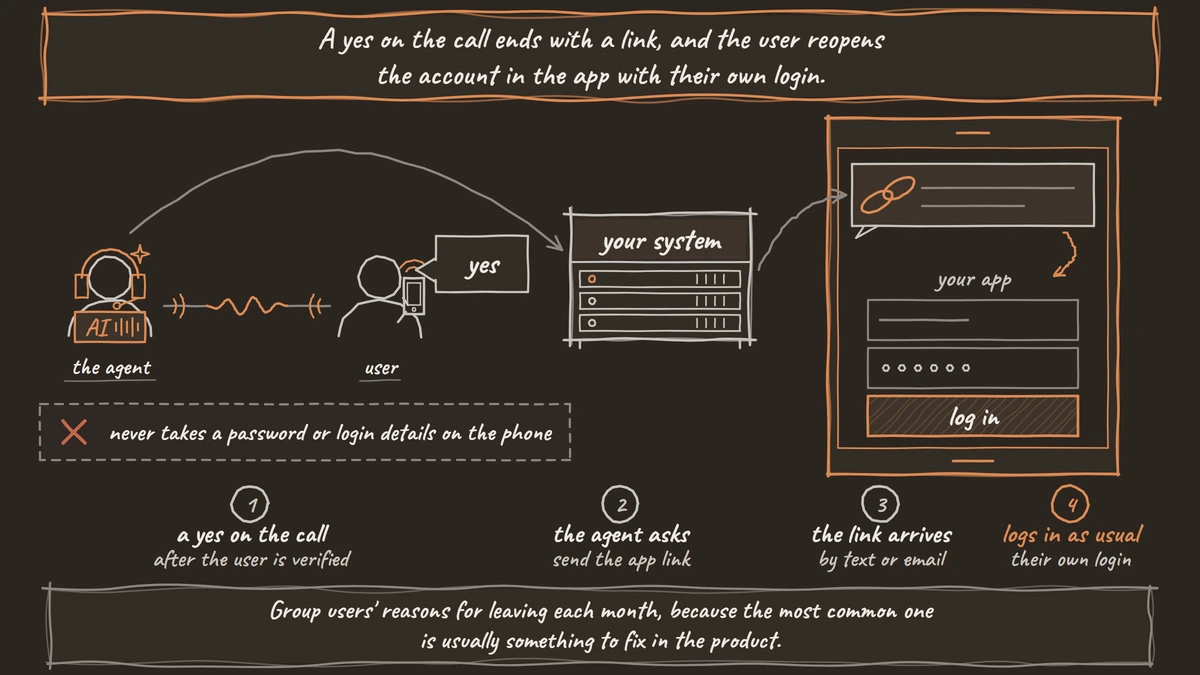
A Webhook node at the end of the call sends the reason, the offer and the outcome to your system. Group the reasons each month, because the most common one is usually something to fix in the product.
Join the Dograh Community
Dograh is an OSS alternative to Vapi. Join our Slack community for queries, releases, best practices & community interactions.
Where the call data sits
Win-back calls carry account history, so decide where the audio and transcripts live before the first call. You can self-host Dograh or run it on Dograh Cloud. Run it on your own servers with open-weight models, and the call audio stays in-house. Change one setting on day one. Self-hosted installs send anonymous usage telemetry by default, and setting ENABLE_TELEMETRY=false with POSTHOG_API_KEY removed turns it off.
A self-hosted setup adds no per-minute platform fee to each win-back call, while the servers, model keys and phone minutes still show up on your bill. Dograh Cloud bills a 1¢-a-minute platform fee instead. Start with a short list of users who left over one reason you can already fix. Test the agent on a real phone line first, then read the early transcripts for any offer your system did not return.
Glossary
- Service call
- A call that only tells a user something about their account, with nothing offered. It generally needs prior express consent, and adding any offer turns it into a sales call.
- Prior express written consent
- A signed agreement, electronic signatures included, that names a phone number and allows sales calls with an artificial or AI voice to it. A fintech win-back call that makes an offer needs it first.
- Variable extraction
- A Dograh Agent node setting that turns what the caller said, such as their reason for stopping, into named fields once the node finishes. It is an AI step, so the transcript and recording stay the exact record.
- Established business relationship
- A relationship based on a recent purchase or inquiry that matters for the do-not-call rules. It never replaces written consent for an AI-voice sales call to a former or inactive user.