
AI voice agents for KYC verification in BNPL handle two calls, confirming details a customer entered at sign-up, and checking an account the risk system has flagged. The risk system starts the call, the agent asks its questions, and the system returns pass, fail or review. Documents stay in the app, and payment talk stays off the call.
Key Takeaways
- Automated checks handle documents and selfies, and the call only confirms details.
- The agent never reads out why an account was flagged, so an intruder learns nothing.
- A flagged customer who is behind on payments goes to collections, never here.
A flagged BNPL customer may also be behind on payments, and an identity call can drift into collections. We cover the sign-up confirmation, checking a flagged account, the rules your checks follow and why we recommend self-hosting Dograh for this data. It is part of our guide to KYC and identity calls.
Two identity calls, after automated checks
A buy now, pay later lender already checks identity in the app, so the voice call does a narrower job. At sign-up, automated identity verification reads the ID document, matches a selfie to it and screens the name. A call adds nothing to that, and it should never try.
The call earns its place in two moments. The first is a sign-up the risk system wants confirmed before credit is extended, such as an address that does not match the device location. The second is an existing account the risk system has flagged, such as a login from a new device or a change of email just before a large order. Both point to the same two threats, synthetic identity at sign-up and account takeover later.
These calls reach a lot of people. The Federal Reserve's household survey found that 16% of adults used buy now, pay later in 2025. At that scale, a few seconds of confirmation by phone can stop a fraudulent order before the first instalment.
The sign-up confirmation call
The sign-up call confirms what the customer just entered and nothing more. The Greeting Text names the lender in fixed words, so the customer knows who is calling before anything else is said. A number finds the application, not the person, so the agent runs your check first, such as the date of birth they typed.
An HTTP API tool sends the caller's answers to your risk system, which compares them and replies pass, fail or review. The agent never sees the stored value, so build the endpoint to return only the result. If the check passes, the agent confirms the detail the risk system queried, such as the delivery address, and records any correction as the customer said it.
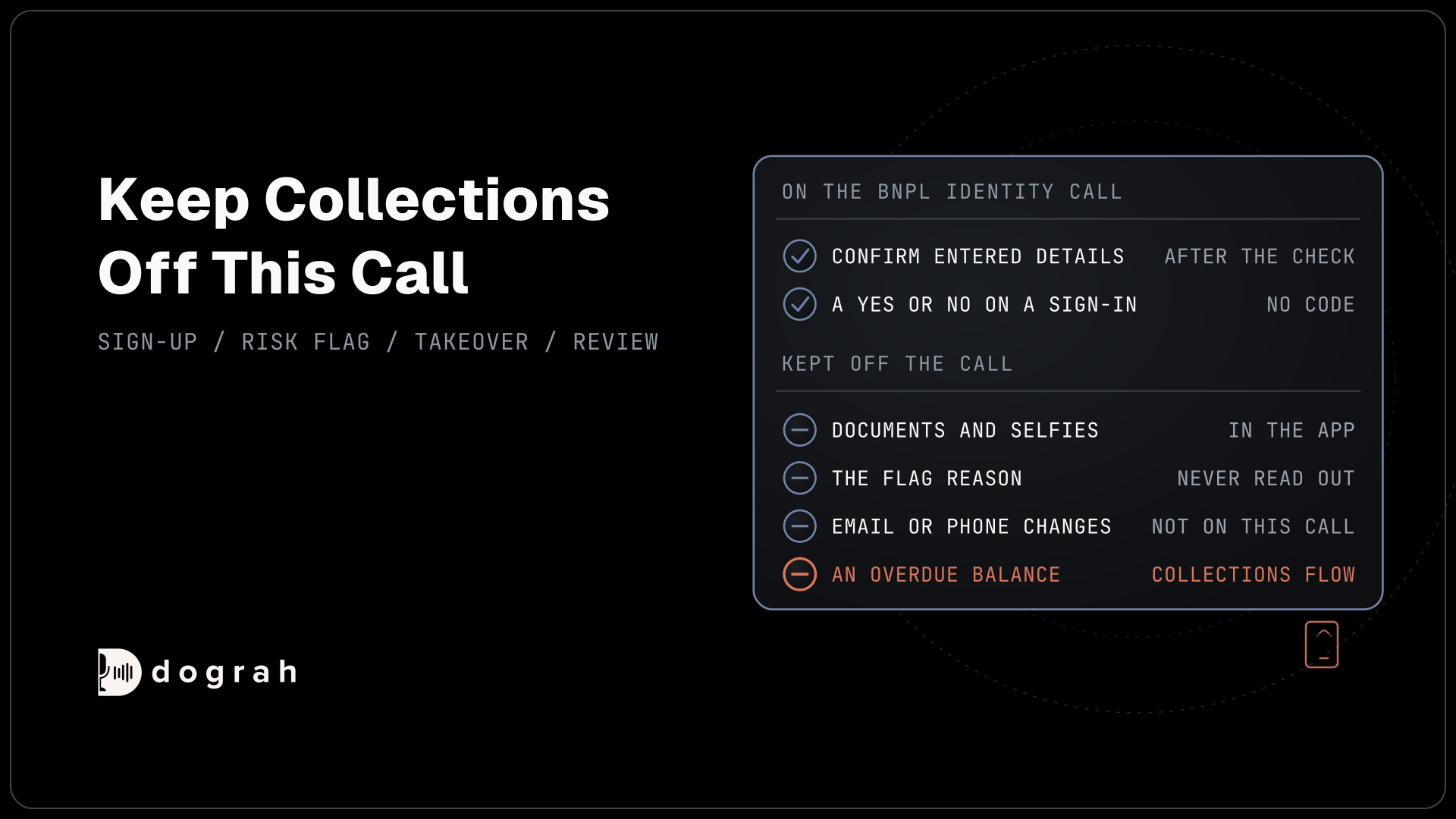
The agent never asks for a document number, a card number, a password or a code. Whatever is said lands in the transcript. If a document is needed, the agent asks your app to send a secure upload link during the call.

Open Source Alternative to Vapi / Retell
Self-hosted voice agent platform — no per-minute fees
dograh-hq/dograh
Star on GitHub
Checking a flagged account
A flagged-account call starts the moment a rule fires in your risk system. Your system calls the API Trigger with the customer's number and the flag reason in the context. The prompt reads the reason so the agent knows what to ask. It never says the reason out loud, because a person who took over the account could learn from it.
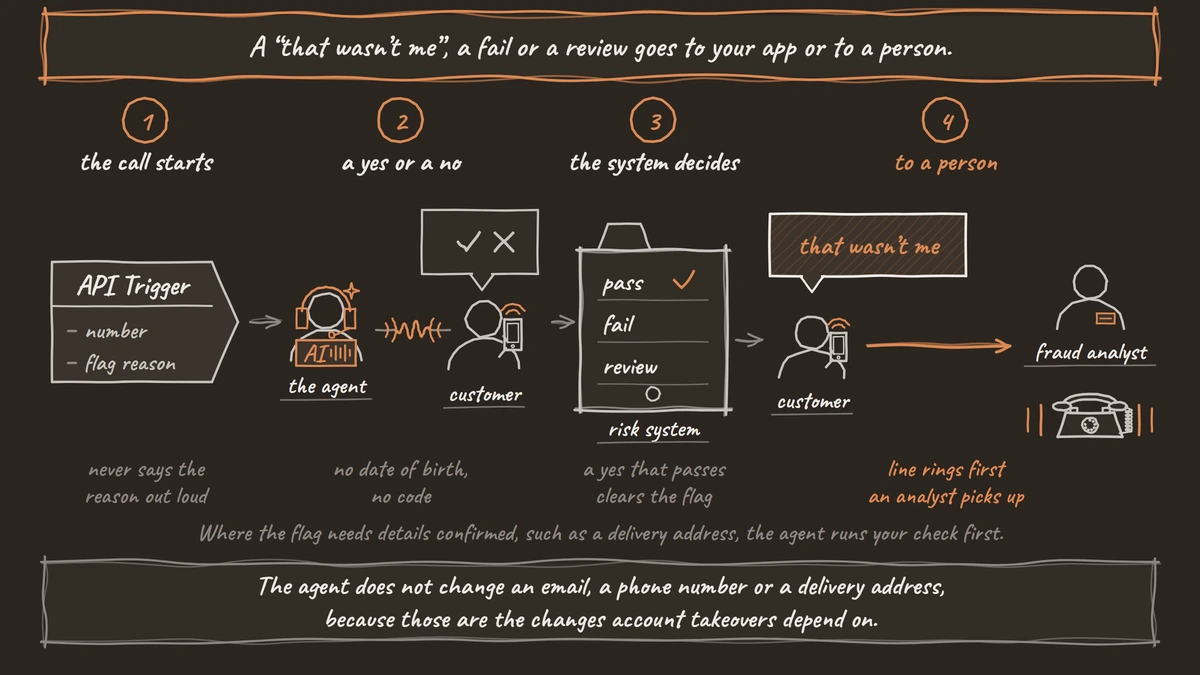
When the flag is a sign-in or a change to the account, the call reveals nothing and asks for nothing personal. The agent names the lender, says there is a sign-in it wants to confirm and asks for a yes or a no, with no date of birth and no code. The answer goes to your risk system, which returns pass, fail or review. Where the flag needs details confirmed, such as a delivery address, the agent runs your check first, just as on the sign-up call. A yes that passes clears the flag. A "that wasn't me", a fail or a review goes to your app or to a person. Transfer Call works on Twilio, Telnyx, Plivo, Cloudonix and Asterisk ARI. Your fraud team's line rings first, and the customer joins only after an analyst picks up, with the details written to your system before the transfer.
Some requests never happen on this call. The agent does not change an email, a phone number or a delivery address, because those are the changes account takeovers depend on. And it never treats the caller's voice as proof. Federal Reserve Governor Michael Barr warned that voice-based identity checks may become vulnerable to generative AI tools.
Keep collections off this call
The verification call never turns into a payment call, even when the account is behind. Late payment is common. In LendingTree's survey of BNPL users, 47% said they had paid late in the past year. So many flagged customers will also have an open balance.
Your risk system decides which call goes first. If a customer is both flagged and behind, the identity check runs on its own, and the balance goes to your collections flow with its own opening line and rules. Our post on missed-payment recovery in BNPL covers that call. Mixing the two would put a balance in front of someone who has not passed the check.
The rules your checks follow
Which checks a BNPL lender must run depends on where it lends and how it is set up. In the US, your checks follow your partner bank's program, your state licences and your own fraud rules, and the agent asks only the questions those set. In the UK, the FCA regulates buy now, pay later from 15 July 2026. Lenders need authorisation, must check that customers can afford to repay and must support customers in difficulty.
The call is a service call with no offer. It asks about the account the customer already holds. Confirm with counsel which rules apply to your product and markets before the first call.
Join the Dograh Community
Dograh is an OSS alternative to Vapi. Join our Slack community for queries, releases, best practices & community interactions.
Where the call data sits
Identity answers and spending history meet on this call, so it belongs on infrastructure you control. A BNPL record shows what someone bought and when, and the call adds their date of birth and address. We recommend self-hosting Dograh with open-source models for these calls, so that data stays inside your own boundary.
For these calls Dograh runs the call flow, the risk-system tools and the telephony, and the speech and language models sit in a separate layer the lender chooses. A lender that brings its own model keys changes whose contract covers the models, yet the customer's audio still goes to that provider. Audio stays in-house only with open-weight models on your own servers. Telemetry is the last thing to close, since a self-hosted install sends anonymous usage data by default until you set ENABLE_TELEMETRY=false and remove POSTHOG_API_KEY. The self-hosting guide covers the install, and why voice data needs to stay local covers the risk in full.
Glossary
- Synthetic identity
- A made-up identity built from real and fake details, such as a real date of birth with a false name. Automated checks at sign-up are the main defence, and a call only confirms what the risk system queried.
- Account takeover
- Someone other than the customer gaining control of an account, often after changing its email or phone number. That is why the agent never changes contact details on a flagged-account call.
- Risk flag
- A rule in the lender's risk system that marks an account for review, such as a new device or an address mismatch. The flag reason guides the agent's questions but is never read out before the check.
- Deferred Payment Credit
- The UK regulator's name for buy now, pay later. Lenders offering it need FCA authorisation from 15 July 2026 and must run affordability checks.