
AI voice agents for hospitals and health systems in Canada go live through a privacy impact assessment and an agreement with the supplier. Both ask where call data sits and who can train on it. Self-hosting in the hospital's data centre or a Canadian region, with open-weight models beside the agent, answers both before scheduling or follow-up calls start.
Key Takeaways
- A hospital voice agent passes the privacy impact assessment before it takes calls.
- Self-hosting with open-weight models keeps patient audio out of any vendor's training.
- Self-hosted lines start at 10 concurrent calls, which a hospital will raise.
A Canadian hospital rarely tries software on patients, so a voice agent must clear review first. We cover the privacy impact assessment, where call data sits, who can train on it, which calls an agent takes and sizing the hospital line on self-hosted Dograh. It is part of our guide to voice AI in healthcare.
How a Canadian hospital buys a voice agent
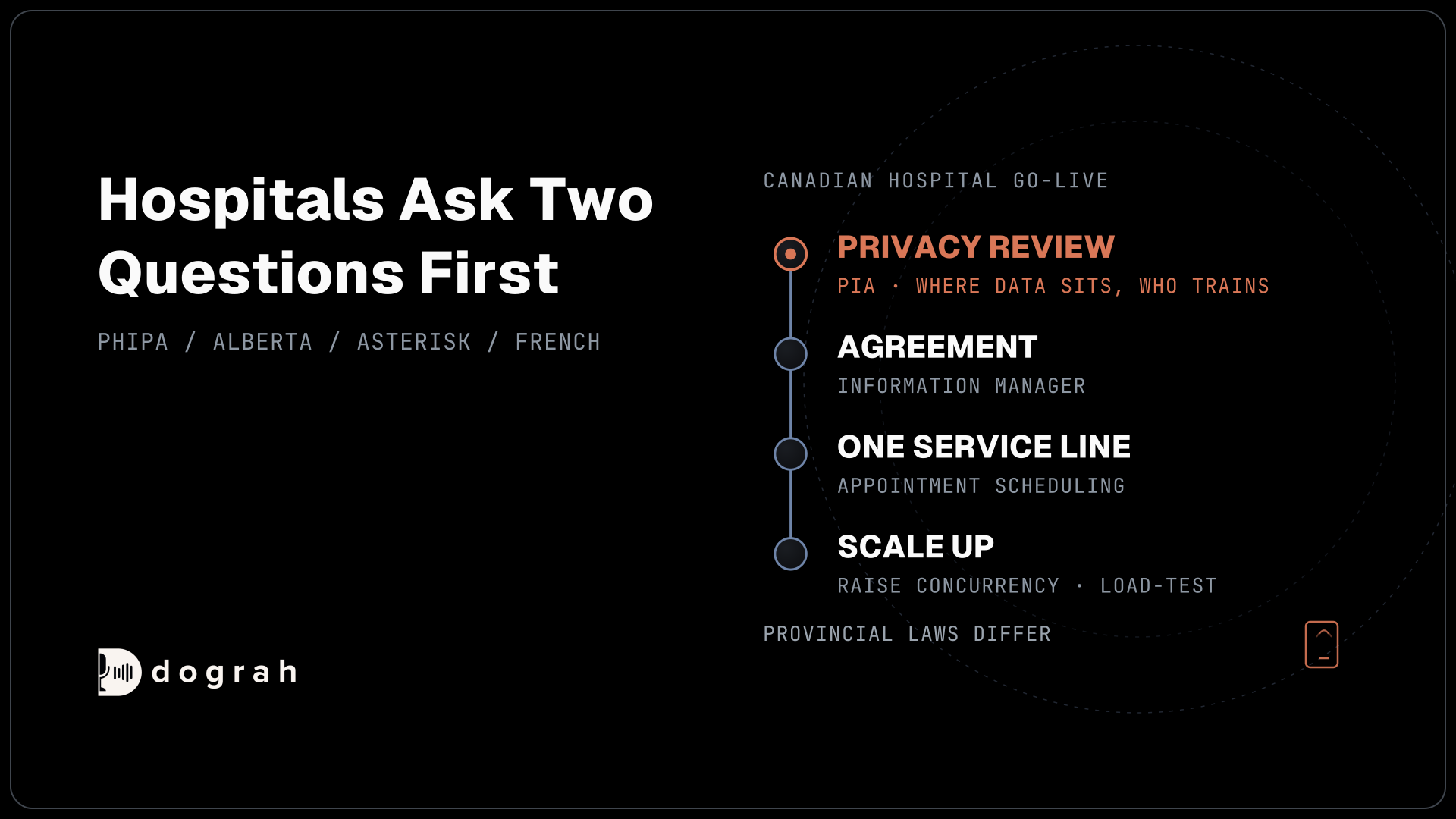
A Canadian hospital rarely buys software by trying it on patients first. The federal privacy commissioner's summary of privacy laws shows hospitals are generally covered by provincial laws, such as Ontario's Personal Health Information Protection Act (PHIPA) and Alberta's Health Information Act (HIA). Under those laws the hospital is the custodian of patient information, and the supplier running a voice agent handles that information for it under a written agreement, often called an information manager agreement.
Before go-live, the privacy office runs a privacy impact assessment (PIA), and two questions come first. The office wants to know where the call data will sit and whether anyone can train a model on it, and the rest of the review follows from those answers.
The calls themselves are covered elsewhere. AI voice agents for hospitals and health systems maps every hospital call type, and the UK version shows how NHS assurance shapes the same build. Here the focus is the Canadian review.
Where the call data sits
Self-hosted, the voice agent runs where the hospital chooses, in its own data centre or a Canadian cloud region. Each call leaves three recordings and a transcript in object storage and a call record in Postgres, all inside that environment. A hospital with its own phone system can connect it through Asterisk ARI, so patient calls move from the PBX to the agent without leaving the hospital network.
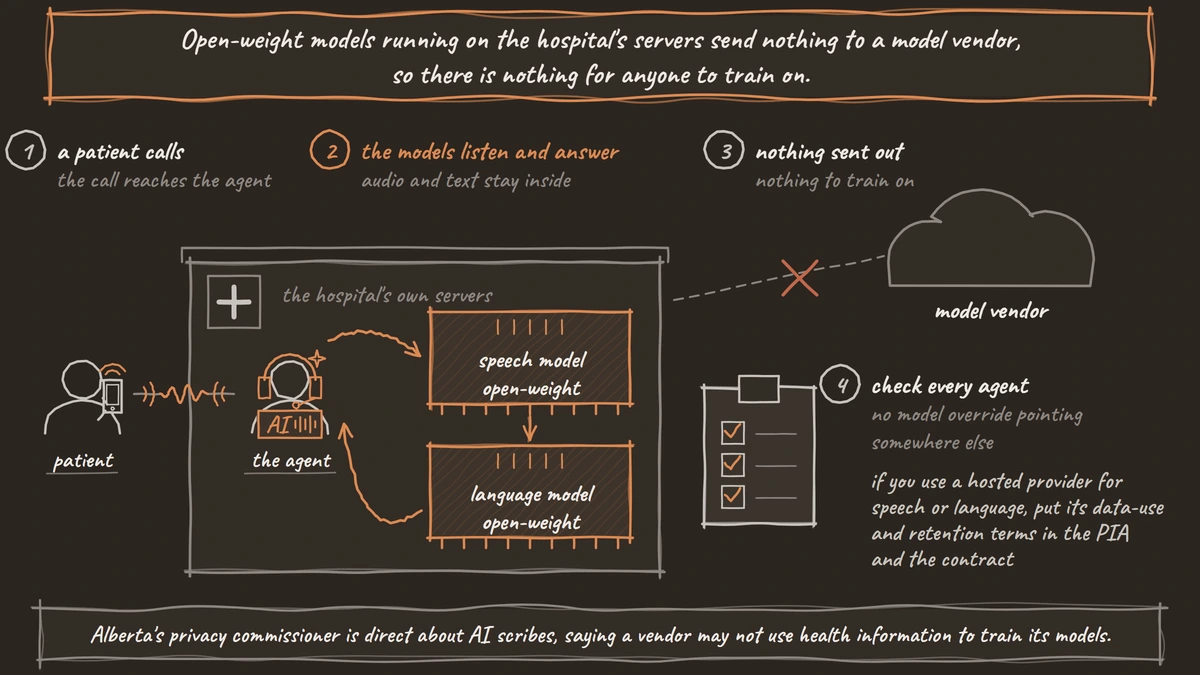
The live audio needs its own answer. The speech and language models form a separate layer from the agent platform. A hosted model provider receives the audio and text it processes, wherever it runs. Patient audio stays in Canada only when those models run on Canadian servers too. AI voice agents for telehealth in Canada covers the same question for clinics.
Who can train on the call data
Alberta's privacy commissioner is direct about AI scribes, saying a vendor may not use health information to train its models. Ontario's guidance, as Borden Ladner Gervais summarized it, expects vendor contracts with use limits, security terms, breach reporting and audit rights. Both were written for scribes, but a hospital privacy office will ask a voice agent supplier the same things.
Open-weight models running on the hospital's servers send nothing to a model vendor, so there is nothing for anyone to train on. If you use a hosted provider for speech or language, put its data-use and retention terms in the PIA and the contract, and check that no agent has a model override pointing somewhere else.

Open Source Alternative to Vapi / Retell
Self-hosted voice agent platform — no per-minute fees
dograh-hq/dograh
Star on GitHub
The hospital calls an agent can take
Hospital phone lines carry plenty of calls an agent can take, such as appointment scheduling and pre-registration before a procedure. Check-in calls after discharge fit too, with the answers collected for a nurse to review. Each starts with verification against the hospital's system, a date of birth plus one more item, before any appointment detail. Our identity verification guide covers how that check works.
Where a hospital serves patients in French, write the Greeting Text in both languages and set speech recognition to Multilingual (Auto-detect) with English and French ticked under Language Hints. If the greeting carries a notice that patients are talking to an automated assistant, switch off Allow Greeting Interruption on the Start Call node, since it is on by default and lets a caller cut the notice short.
Departments are one transfer away. Transfer Call works on Twilio, Telnyx, Plivo, Cloudonix and Asterisk ARI. Dograh calls the department first and connects the patient only when someone answers. It waits 30 seconds by default, and if nobody picks up, the patient stays with the agent, which takes a call-back request. For emergencies, the pathway's fixed Transition Speech says: "If this is a medical emergency, please call 911 now."
Sizing and running a hospital line
A self-hosted install runs 10 concurrent calls by default. A hospital line needs more, so raise DEFAULT_ORG_CONCURRENCY_LIMIT and add API workers and model capacity to match, then load-test before the first busy Monday. Every extra concurrent call also needs speech and language model capacity, which is where most of the hardware goes when the models run on hospital servers.
Nothing is deleted on a schedule, because there is no retention setting. The hospital's records schedule decides how long recordings and transcripts stay, and its own process deletes them from its database and storage. Turn off the anonymous usage telemetry a self-hosted install sends by default by setting ENABLE_TELEMETRY=false and removing POSTHOG_API_KEY.
Join the Dograh Community
Dograh is an OSS alternative to Vapi. Join our Slack community for queries, releases, best practices & community interactions.
A hospital that self-hosts pays Dograh no per-minute platform fee, but servers, model keys and phone minutes still cost money. Dograh Cloud charges a 1¢-a-minute platform fee. Provincial laws differ and the regulators' guidance was written for scribes, so confirm the PIA and the supplier agreement with your privacy office and counsel before go-live.
Start with appointment scheduling on one service line. It gives the privacy office one data flow to review and shows the concurrency the full hospital will need.
Glossary
- Custodian
- The organization responsible for personal health information under a provincial law such as PHIPA or the HIA. For a hospital's patient line, that is the hospital or health authority.
- Information manager agreement
- The written agreement under which a supplier processes or stores health information for a custodian. It sets use limits, security duties, breach reporting and audit rights.
- Privacy impact assessment (PIA)
- A documented review of a new system's data flows and risks, done before go-live. Alberta custodians submit one to the commissioner, and other provinces expect one in practice.
- Concurrent calls
- The number of calls the agent handles at the same moment. Self-hosted Dograh starts at 10 and is raised with DEFAULT_ORG_CONCURRENCY_LIMIT plus server and model capacity.