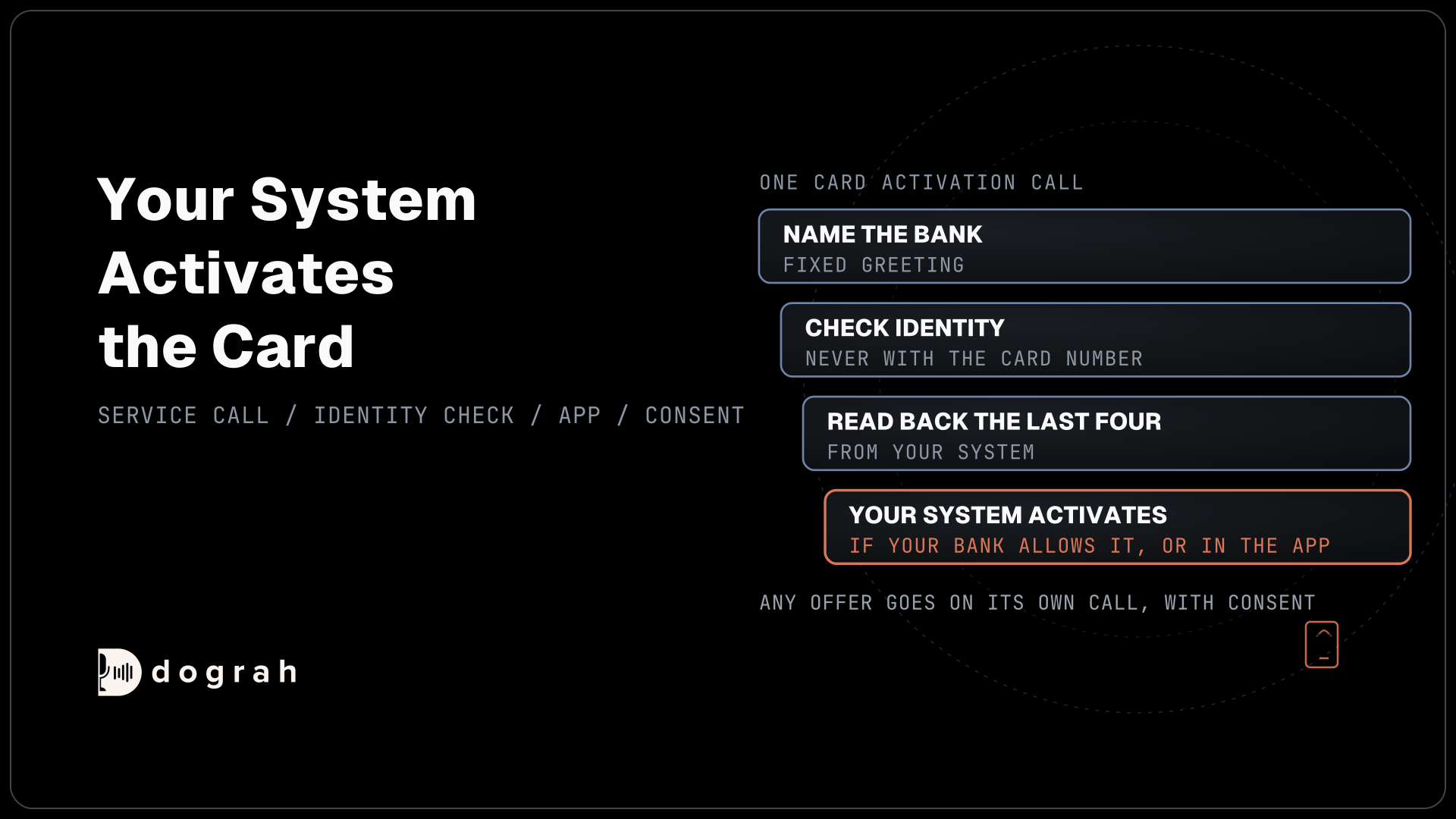

AI voice agents for card activation call customers whose card has arrived, or answer when they call to activate it. The agent names the bank, checks identity with your questions and never asks for the card number. If your bank allows activation by phone, your system activates the card on its reply. Otherwise, the customer finishes in the app.
Key Takeaways
- Activation is a service call about a card the customer asked for.
- The agent reads the last four digits back only after the identity check passes.
- Any offer, such as a higher limit, belongs on a separate call with consent.
A new card in the post is exactly when a scammer would phone, so a real activation call must sound different. We cover outbound and inbound calls, checking identity without the card number, and activating through your system or app in Dograh, with no offers. It sits under our guide to KYC and identity calls.
Activation is a service call
An activation call is about a card the customer already has, and the rules around card issuing keep it that way. In the US, Regulation Z's rule on issuing credit cards allows a new credit card only when the customer asked for it, or as a renewal or replacement of a card they already accepted. So an activation call always follows a request or a renewal. It never offers a card.
Debit cards have their own rule. Under Regulation E, a debit card the customer did not ask for must arrive not yet usable, with a clear note saying so. The bank makes it usable only when the customer asks, and only after verifying the customer's identity by a reasonable means. For that card, the identity check before activation is the rule itself. Confirm with counsel how these rules apply to your card programs.
The call is outbound to a mobile in most cases, so consent matters too. Under the Telephone Consumer Protection Act (TCPA), the FCC's 2024 ruling on AI-generated voices treats an AI voice as an artificial voice, so the call needs the customer's prior express consent. A call about the customer's own card with nothing offered is generally a service call. Add an offer, and it needs prior express written consent.
Two calls, one card
Activation comes up in two calls. The outbound call goes to customers whose card was delivered a few days ago and is still inactive. The inbound call is a customer phoning to say "I want to activate my new card". Both run the same steps after the greeting.
For the outbound call, your card system builds the list from delivery records and starts each call. For the inbound call, Pre-Call Data Fetch can look up the caller's number as the call connects and load the card's delivery status and the last four digits on file. The prompt keeps all of it unspoken until the check passes. A number finds the account, but it does not prove who is calling.
If you set voicemail handling to leave a message, that message names the bank and asks the customer to call the number on the back of their new card. It says nothing about the card itself.

Open Source Alternative to Vapi / Retell
Self-hosted voice agent platform — no per-minute fees
dograh-hq/dograh
Star on GitHub
Check identity, never with the card number
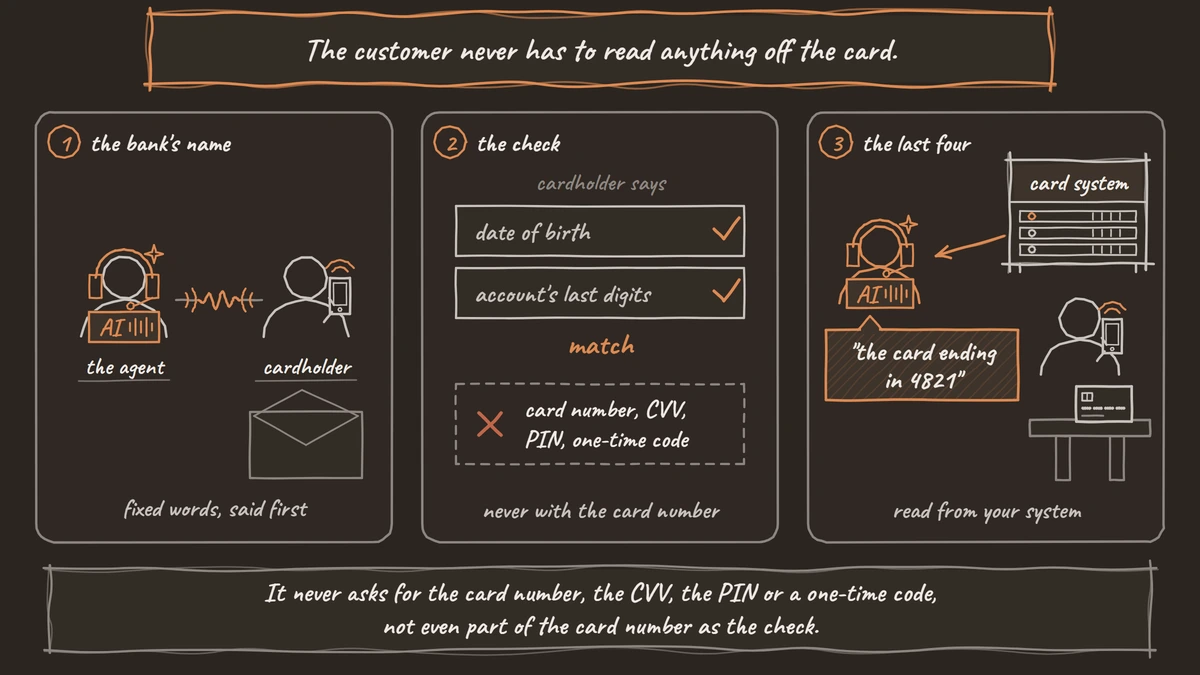
The Greeting Text names the bank in fixed words, and then the agent runs your approved check, such as the date of birth plus the last digits of the account number. It never asks for the card number, the CVV, the PIN or a one-time code, not even part of the card number as the check. The FTC's advice to consumers is that a real bank caller never asks for a verification code, and an activation call is exactly the moment a scammer would ask.
The stakes are real. The Federal Reserve's household survey found that 16% of adults experienced fraud involving their credit card in 2025. A new card in the post is an obvious target.
After the check passes, the agent can confirm which card it means by reading the last four digits from your system, as in "the card ending in 4821". The customer never has to read anything off the card. If a customer starts reading the full number anyway, the prompt tells the agent to stop them politely. Whatever was said is already in the transcript, so your team deletes it from your own storage. Our post on handling payment-sensitive (PCI) calls in a voice agent explains why that cleanup matters.
Activate through your system, or finish in the app
Whether the card can be activated on the call is your bank's decision, and your system carries it out. If your bank allows activation by phone, the agent uses an HTTP API tool to ask your card system to activate the card once the check passes. Your system replies active, or with a reason it can't. The agent tells the customer exactly what the system said, and nothing more.
If your bank wants activation in the app, the agent says so and walks the customer through where to tap. Setting a PIN always happens in the app or at an ATM, never on the call. Callers answer by voice throughout, so every step the agent asks for is one the customer can say out loud safely.
A customer who says the card never arrived goes to the card team. Transfer Call works on Twilio, Telnyx, Plivo, Cloudonix and Asterisk ARI. The card team's line rings first, and the customer is connected once a team member answers. An HTTP API tool writes the report to your system before the transfer, so the team can block the old card straight away.
Join the Dograh Community
Dograh is an OSS alternative to Vapi. Join our Slack community for queries, releases, best practices & community interactions.
Keep offers off the activation call
The activation call ends when the card works. It does not offer a higher limit or a second card, however natural that feels while the customer is on the line. Any of those turns a service call into a sales call, which needs written consent most card files do not hold.
If you want to promote card features, run that as a separate campaign to customers with written consent on file, with its own script. AI voice agents for product cross-sell in banking covers that call. Keeping the two apart also helps trust. A customer who hears only "your card is active" learns what a real call from the bank sounds like.
Glossary
- Unsolicited debit card
- A debit card the bank sends without the customer asking for it. Regulation E says it must arrive not yet usable, and the bank makes it usable only on request after verifying identity.
- Card validation
- The step that makes a new card usable, often called activation. On a voice call, the agent asks the bank's system to do it after the identity check, and the system's reply decides.
- Service call
- A call about something the customer already has, such as their new card, with nothing offered. An offer on the same call turns it into a sales call that needs written consent.
- Last four digits
- The end of the card number, read back by the agent from the bank's system after the check passes. It confirms which card the call is about without the customer reading anything aloud.