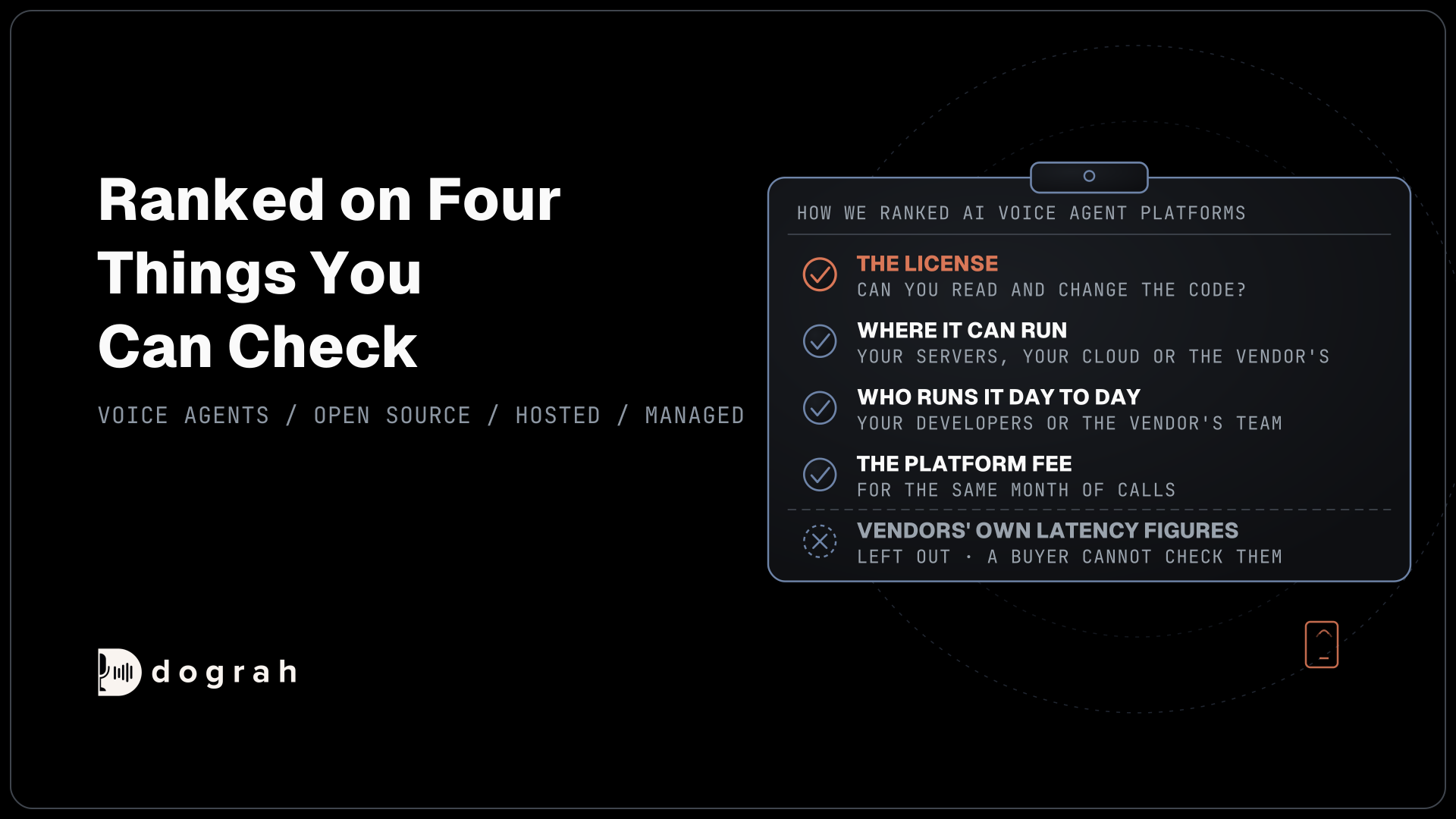

Telnyx suits teams that want a carrier and a hosted AI agent from one account, with 500 calls at once on pay as you go. Its network and latency figures are its own claims, so test them on your calls. Dograh, the open-source AI voice agent platform, can use Telnyx as its carrier, self-hosted or on Dograh Cloud.
Key Takeaways
- Telnyx is two products, a carrier and a hosted voice agent.
- Pay as you go allows 500 calls at once with no monthly minimum.
- "HIPAA included in every plan" is Telnyx's wording. Get the BAA in writing.
Telnyx sells the phone line and, if you want it, a hosted agent on top, so a fair review judges each part on its own. We table its prices, then cover the carrier, its AI products, plans and HIPAA, checks before signing and fit, with Dograh last.
Telnyx for voice AI in one table
Telnyx prices each part of a call on its own, and its agent product adds one more line. The rows below come from Telnyx's Voice AI pricing and its Voice API price list.
| Area | What Telnyx offers | What to know |
|---|---|---|
| Voice API | $0.002 a minute | Plus SIP trunking for each call |
| SIP trunking | Inbound from $0.0032, outbound $0.005 | Starting rates on Telnyx's page |
| Numbers | $1.00 a month, local or toll-free | Bought in your Telnyx account |
| Audio to an outside agent | Media streaming over WebSockets, $0.0035 a minute | Used when another platform runs the agent |
| Telnyx's own agent | Voice engine $0.05 a minute | Language model tokens and telephony on top |
| Billing increment | 60 seconds per call | A 15-second call bills as a full minute |
| Calls at once | 500 on pay as you go | No monthly minimum |
| Larger plans | Growth from $2,000 a month, Enterprise from $5,000 | Minimum spend, not a fee on top |
| HIPAA | "HIPAA included in every plan" | Ask for the BAA in writing |
The carrier side of Telnyx
As a carrier, Telnyx covers what a voice agent needs to make and take calls. The Call Control API handles each call, SIP trunking connects it, and media streaming sends the live audio to whichever platform runs the agent. Recording and answering machine detection come as extras, and recording storage carries no charge. Answering machine detection costs $0.002 on the standard tier and $0.0065 on the premium one.
The network is the part Telnyx leans on most. Telnyx says it owns a private global MPLS network and runs its own licensed carrier network. Those are Telnyx's own claims, and they only matter if they hold for your callers, so test call quality from the countries your callers ring from.
Telnyx's own voice AI agents
Telnyx also sells the agent, so one account can hold both layers. Its voice engine runs turn-taking, speech-to-text and the voice for one per-minute rate, and the language model is billed by token on top. For models Telnyx runs on its own GPUs, it estimates Kimi at about $0.006 a minute, while Anthropic and OpenAI models bill at their list rates on the same invoice.
Agents are built in the AI Assistant Builder, a no-code interface inside Telnyx's Mission Control Portal, with more than 30 pre-built integrations. You can choose from the open-source models Telnyx hosts or bring your own language model. On the speech side, the engine uses Deepgram models or Telnyx's own speech-to-text. Voices include Telnyx's own and providers such as Rime, Inworld, Resemble and Murf, so a team that already likes one of those voices can keep it on Telnyx's bill.
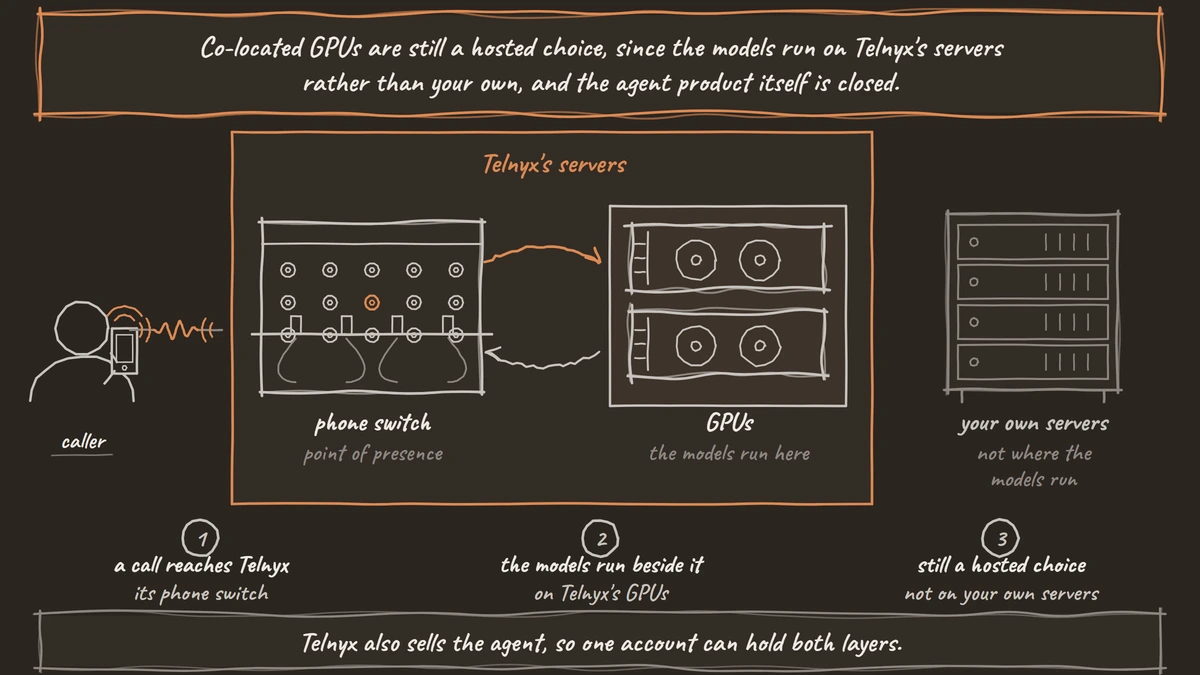
The speed pitch rests on co-location. Telnyx says its GPUs sit next to its telephony points of presence, removing hops between providers, and claims latency under 200 ms. Treat that as Telnyx's figure until your own calls confirm it. Co-located GPUs are still a hosted choice, since the models run on Telnyx's servers rather than your own, and the agent product itself is closed. For how the engine, tokens and phone line add up on a real call, see Telnyx voice AI pricing.

Open Source Alternative to Vapi / Retell
Self-hosted voice agent platform — no per-minute fees
dograh-hq/dograh
Star on GitHub
Plans, limits and the HIPAA wording
Most teams can start on pay as you go and stay there a long time. It has no minimum, and it allows 500 calls at once and 100 API requests a second. Growth suits a team already spending $2,000 a month, since its 15% discount applies to voice, messaging and numbers and it adds round-the-clock chat or call support. Enterprise brings dedicated infrastructure and a private network connection.
Read the 500 carefully. It is Telnyx's limit on calls through its own platform. If another platform runs your agent, that platform's own call limit still applies. Billing also rounds each call up to 60 seconds, so a campaign of very short calls costs more than its minute total suggests.
For healthcare, Telnyx advertises "HIPAA included in every plan" and says it is SOC 2 Type II certified. Before patient calls go through Telnyx, ask for its business associate agreement (BAA) under the Health Insurance Portability and Accountability Act (HIPAA) in writing, and check which products it covers.
What to check before you sign
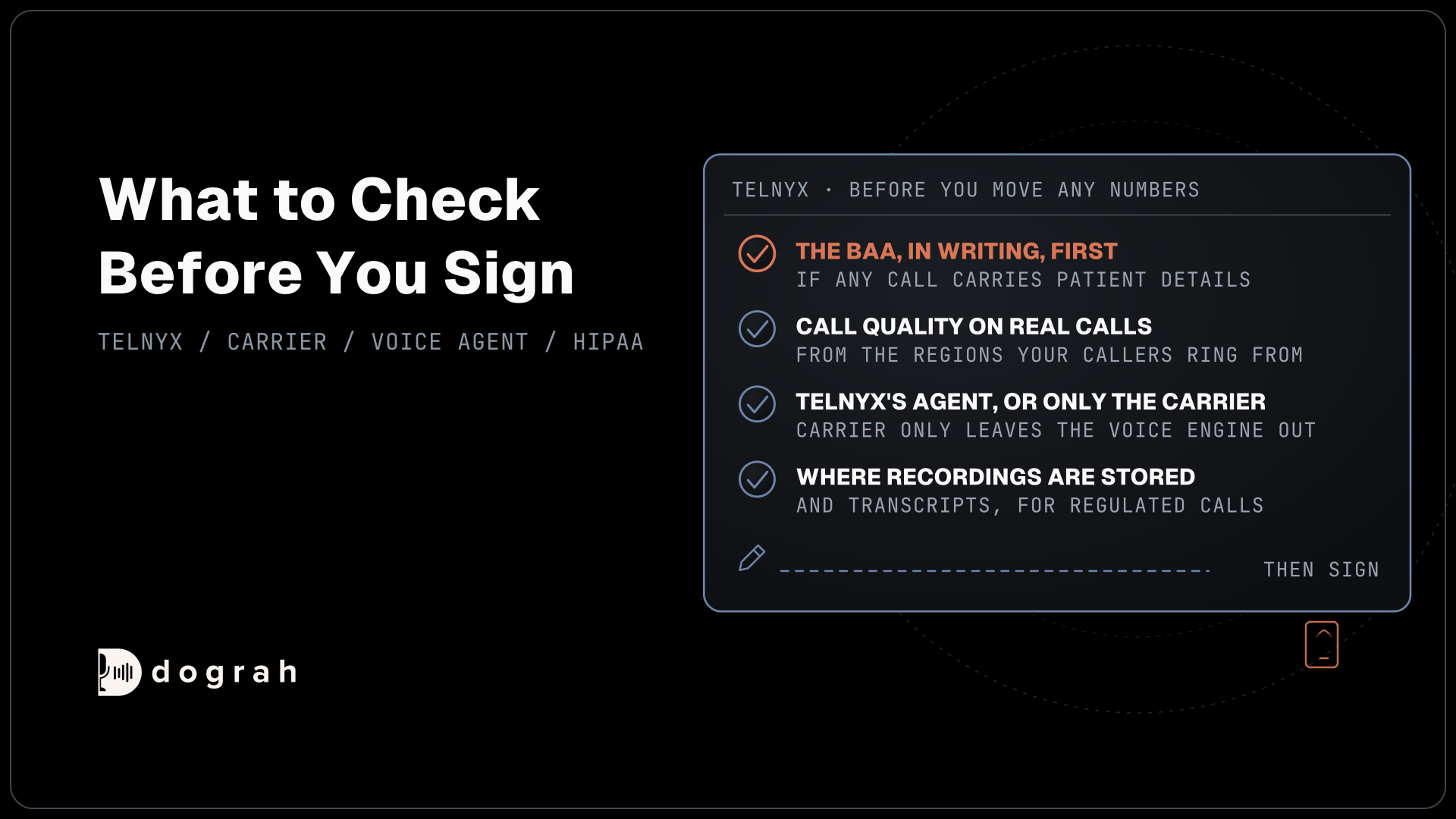
A few answers decide whether Telnyx fits, so get them before you move any numbers. The BAA comes first if any call carries patient details. Then test call quality from your callers' regions on real phone calls. Most phone calls still reach an agent as 8 kHz audio, while a browser test runs at 16 kHz, so judge the agent on the phone, not in the dashboard.
Next, decide whether you want Telnyx's agent at all. If you only need a carrier, you pay the Voice API, SIP and streaming rates and leave the voice engine out. If you want the hosted agent, budget the engine, the tokens and the telephony as separate lines. Finally, ask where recordings and transcripts are stored for your account, since data location matters for regulated calls.
Who Telnyx fits
Telnyx fits a team that wants the carrier and the agent from one account, or high concurrency without a contract. A team that wants a hosted agent close to the phone network, on one invoice, gets that here. A team running its own agent platform gets a carrier with a high self-serve ceiling.
It fits less well a team that needs to read or run the agent's code, since the AI product is closed and hosted. It also fits less well a healthcare team that needs its BAA settled before signing anything. For a line-by-line look at Telnyx against the other big carrier, see Twilio vs Telnyx, and our Twilio review judges Twilio the same way.
Join the Dograh Community
Dograh is an OSS alternative to Vapi. Join our Slack community for queries, releases, best practices & community interactions.
Where Dograh fits
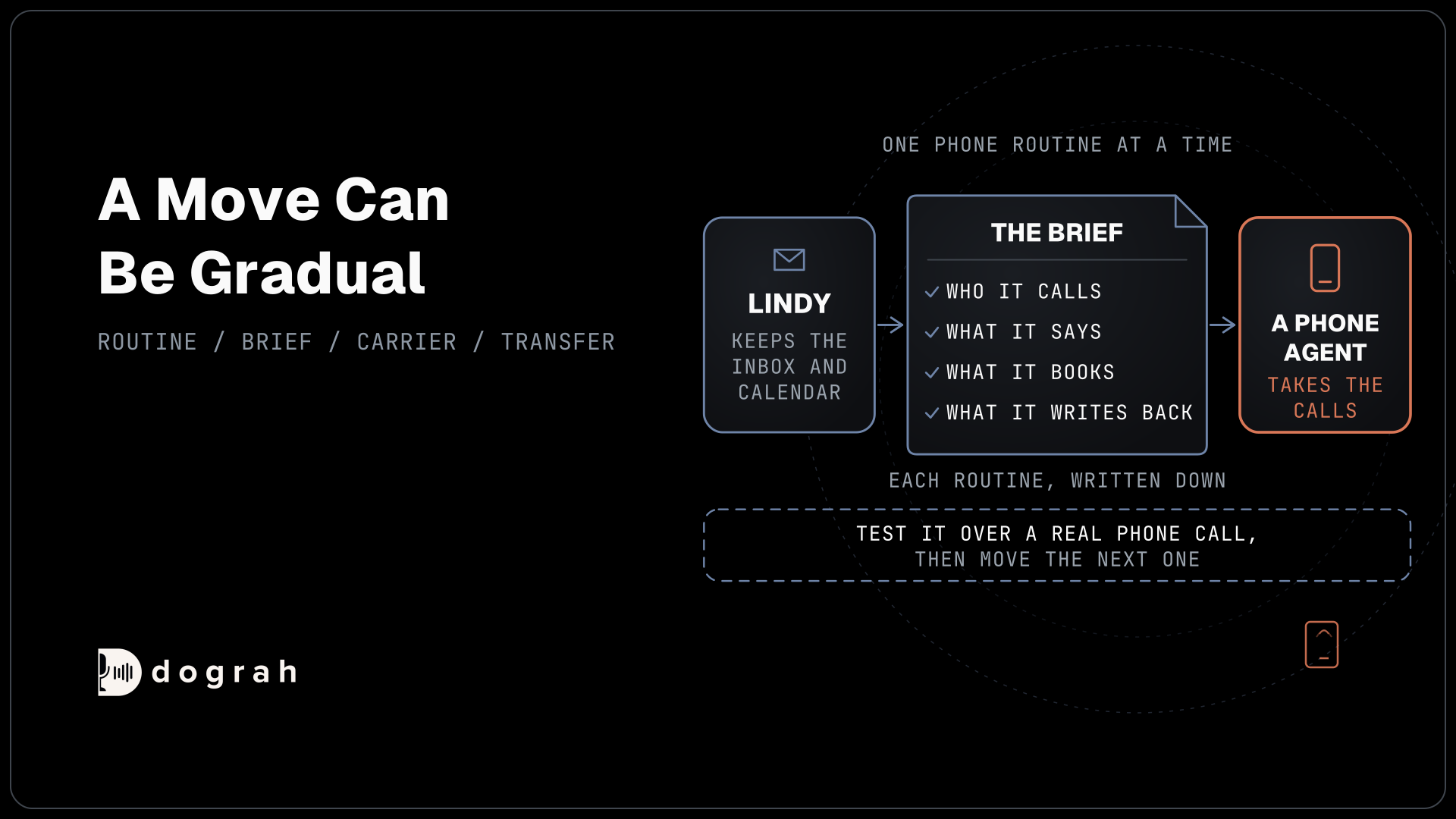
Telnyx is one of the phone providers Dograh connects to, as the carrier under the agent. You connect Telnyx with an API key, and Dograh creates the Call Control application for you when you save, so the step left in Telnyx's portal is assigning your numbers to it. Saving an inbound workflow on a number then sends the webhook address to that application. Changing carriers later leaves the agent as it is. Dograh also connects to Twilio, Plivo, Vonage, Exotel, Vobiz, Cloudonix and Asterisk ARI, so a number can move and the same agent still answers it.
Under Dograh, Telnyx carries the call and the agent runs on Dograh, so the voice engine line drops off the Telnyx bill. The voice, speech-to-text and language model come from providers you choose on your own keys, Rime, Inworld and Murf voices among them, or from open models on your own servers. Transfer Call works on Telnyx numbers. The agent places a call to the person first and joins the caller through a Telnyx conference only after someone answers, so conference minutes apply and Telnyx's $0.10 transfer command is not used. If the line is busy, unanswered or fails, the caller stays with the agent and the call goes on.
The platform shows up as its own line next to the Telnyx bill. Self-hosted, Dograh adds no per-minute platform fee, but the servers, model keys and phone minutes are still paid for. Dograh Cloud bills a 1¢-a-minute platform fee. The trade for running it yourself is upkeep. Your team owns the server, the database and every upgrade, with community help on Slack and GitHub for the open-source version and custom SLAs on Enterprise.
For patient calls, a self-hosted install needs no BAA with Dograh, since the calls never reach us. Telnyx may need one, depending on what it stores, which is one more reason to get its BAA in writing. Each call also leaves a trace and a QA score. The QA step scores every step of test and live calls, and the trace shows the speech-to-text, AI and voice time for each turn, so you can tell whether a slow reply came from the model or the line.
Glossary
- Call Control application
- The Telnyx object that receives a number's call events and tells Telnyx where to send them. Dograh creates one on save, and each Telnyx number that should reach the agent is assigned to it.
- MPLS network
- Multiprotocol Label Switching, a way of sending traffic along set paths across a private network rather than the open internet. Telnyx says it runs its own private global MPLS network.
- Co-located GPUs
- GPUs placed in the same site as the phone switches, so call audio reaches the models with fewer hops. On Telnyx this is still a hosted setup, since the models run on Telnyx's hardware.
- Minimum spend
- A monthly amount a plan commits you to use, rather than a fee added on top. Telnyx's Growth plan starts at $2,000 a month and Enterprise at $5,000.