
Speechmatics alternatives are divided into hosted speech-to-text providers and open models. Dograh is the open-source AI voice agent platform where each agent switches speech-to-text with one setting, self-hosted or on Dograh Cloud. Deepgram, Soniox and Gladia are the hosted providers, and Whisper and Parakeet are open models that run on your own GPU.
Key Takeaways
- Linden 1's $0.30 an hour is introductory, listed at $0.40 before.
- Speechmatics' voice-agent model runs on its cloud only, not in its on-prem containers.
- In Dograh, speech-to-text is one setting per agent, so you can test two providers.
Speechmatics is a strong speech-to-text vendor, and its own pricing and docs explain most of the reasons voice teams look elsewhere. We compare the options in one table, then show how Dograh switches speech-to-text, each alternative by reason, one priced month, accuracy and what switching takes.
Why voice teams look past Speechmatics
Most teams leave Speechmatics over how it fits a live phone agent, and its accuracy is rarely the problem. The reasons come from Speechmatics' own published rates and limits and its docs.
Linden 1, the model built for voice agents, costs $0.30 an hour for live audio, and Speechmatics labels that rate introductory, noting it was originally $0.40. Self-serve Pro allows 50 real-time sessions, so 50 live calls is the ceiling before an Enterprise contract. On-prem containers exist on Enterprise, but the voice-agent endpoint runs only on Speechmatics' cloud. And Speechmatics sells the speech layer, now with text-to-speech beside it, while the call flow, the phone line and the tools are left for a team to build or buy elsewhere.
Speechmatics alternatives in one table
Each alternative answers a different one of those reasons, so the table names its strongest point beside its live-audio price. Speechmatics is the first row.
| Option | Live audio price | Strongest point | Where it runs |
|---|---|---|---|
| Speechmatics (baseline) | $0.30 an hour for Linden 1 (introductory, $0.40 before) to $0.80 for Enhanced | 55+ languages, a medical model, HIPAA and SOC 2 on self-serve | Speechmatics' cloud. Containers and appliances on Enterprise, Agent STT on SaaS only |
| Dograh | Runs any row here, Speechmatics included, on your key | Speech-to-text is one setting per agent | Your servers, or Dograh Cloud |
| Deepgram | $0.0077 a minute for Nova-3 in English, $0.0092 multilingual | Per-second billing, 150 streams at once on pay as you go | Deepgram's cloud, containers on your hardware on Enterprise |
| Soniox | $0.12 an hour, plus context and output tokens | 60+ languages and the top score on Pipecat's streaming benchmark | Soniox's cloud |
| Gladia | 0.68 EUR an hour | 100+ languages on Solaria-1 | Gladia's cloud, custom hosting on Enterprise |
| Open models (Whisper, Parakeet) | No hourly bill, a GPU instead | Call audio stays on your servers | Your own GPU |
Dograh: change speech-to-text without a rebuild
Speechmatics turns a caller's speech into text, and everything after that is still a voice agent someone has to run. Dograh is that agent layer, released under the BSD 2-Clause license. It holds the call flow, telephony, call transfer, call history and QA that scores every step of a call, and it leaves the speech models to you.
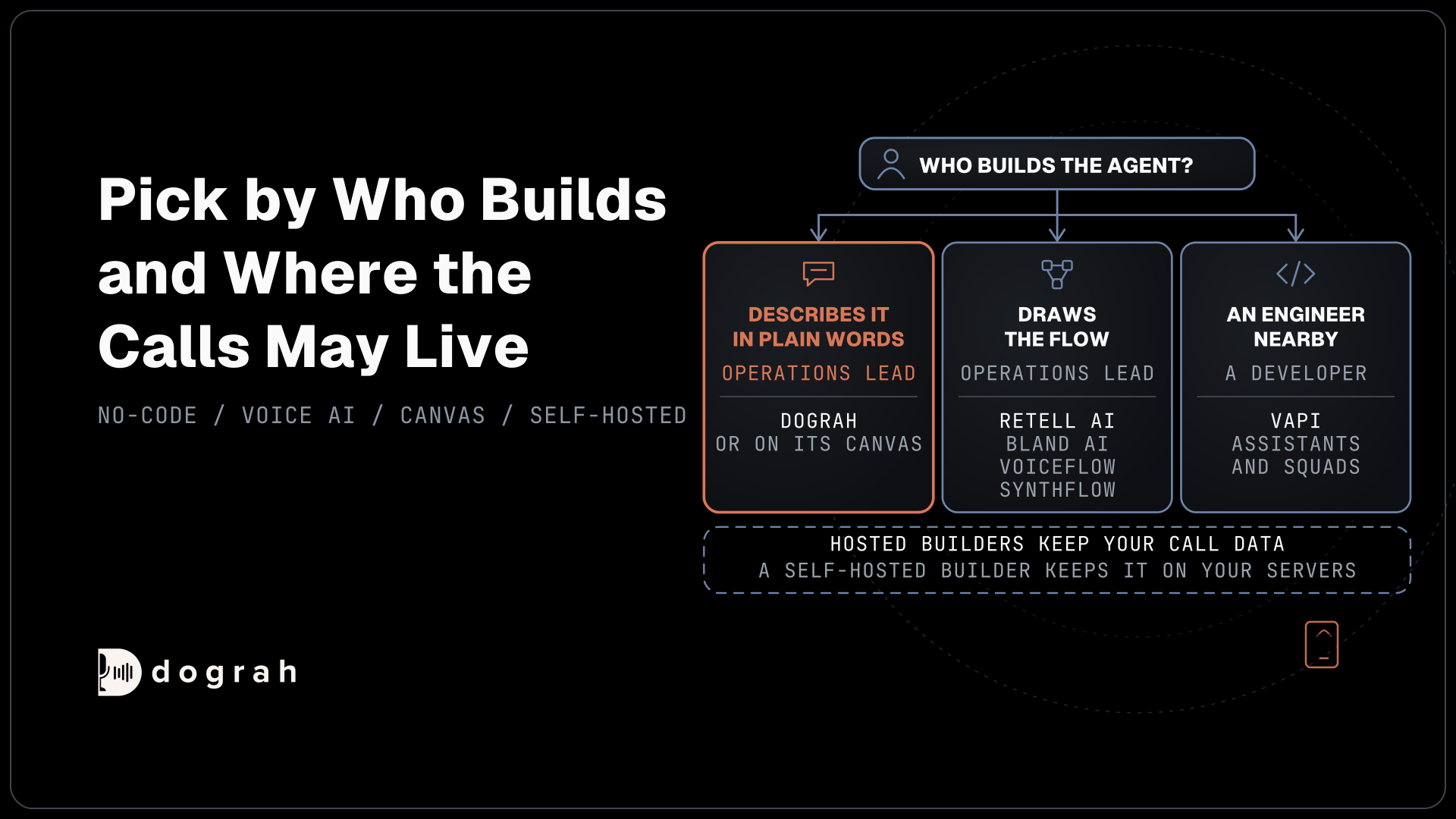
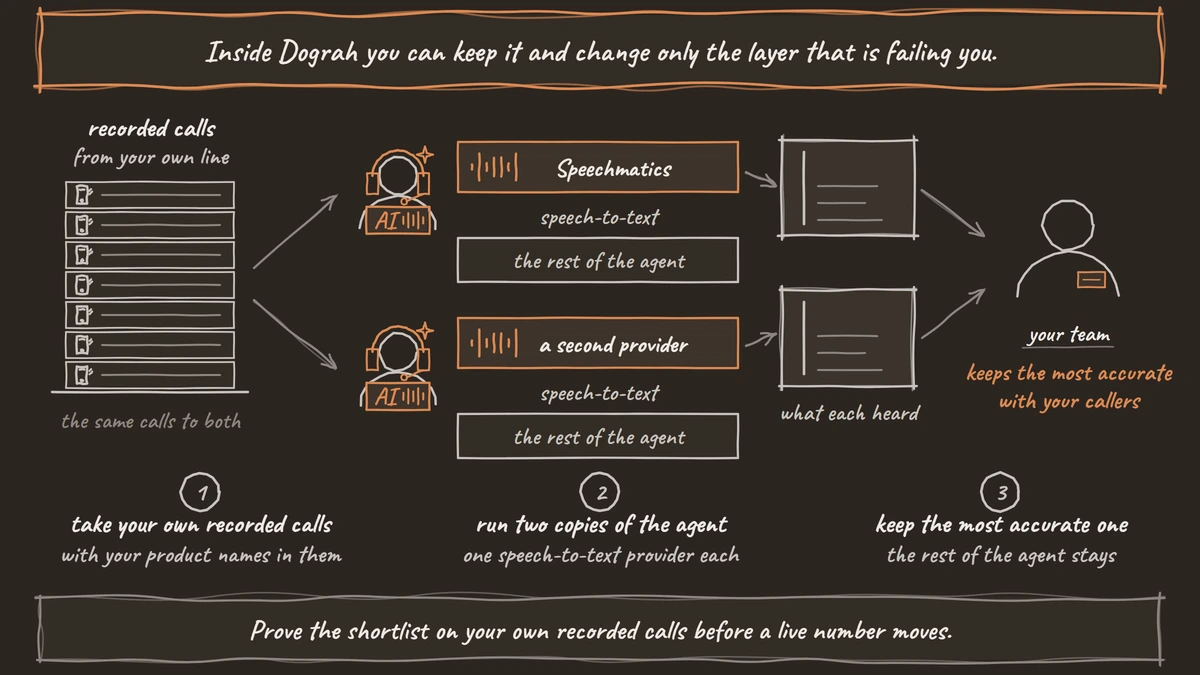
The agent's speech-to-text setting is one choice in its Model tab. It offers Speechmatics, Deepgram, Soniox, Gladia, AssemblyAI, ElevenLabs, Azure, Google, OpenAI, Cartesia, Sarvam, Smallest AI, Hugging Face and Dograh's own models. Change it and the rest of the agent stays as it was, so two copies of one agent can run two providers on the same recorded calls.
A few details matter for this switch. The Speechmatics option runs Linden 1 through Speechmatics' hosted Agent STT on your own key, and older saved setups that name Standard or Enhanced also run as Linden 1. Words in the agent's Dictionary reach Speechmatics as additional vocabulary. The Soniox option defaults to stt-rt-v5 and takes a typed model name, so stt-rt-v6 works too. Each provider field also holds more than one API key and spreads calls across them.
As the orchestration layer, Dograh handles the call flow, tools and telephony, and the speech and language models sit in a separate layer of your choosing. Open models such as Whisper connect through Speaches, an OpenAI-compatible server you run, and only that local route keeps call audio off a provider's servers.
Self-hosted Dograh has no per-minute platform fee, but the servers, the model keys and the phone minutes still cost money. Dograh Cloud adds a 1¢-a-minute platform fee, and your speech-to-text provider bills you separately at its own rate. A self-hosted install runs 10 calls at once by default, raised with one setting, and Cloud's pay as you go includes 10.
Hosting it yourself puts the server, the database and the upgrades in your team's hands, with community support on the open-source version and custom SLAs on Enterprise. Our post on AssemblyAI alternatives runs the same switch from AssemblyAI's side, with its own reasons and a 50,000-minute month.
When the Linden 1 price may move
A budget built on $0.30 an hour rests on a rate Speechmatics itself calls introductory. If it returns to $0.40, the speech line for a busy agent rises by a third. Two other Speechmatics prices sit nearby, Melia 1 at $0.40 and Enhanced at $0.80 for live audio.
Speechmatics offers a way to lower the rate. Opting in to model training takes 33% off speech-to-text, and in exchange Speechmatics may use your audio and transcripts to improve its models. Teams with health or payment details on their calls usually leave that off. Our breakdown of Speechmatics pricing prices every model per call minute.
The rivals bill in different ways. Deepgram charges per second with no rounding, at $0.0077 a minute for Nova-3 in English. Soniox lists $0.12 an hour for live audio, plus a small charge for context and output tokens.
When 50 live sessions is not enough
Self-serve Speechmatics caps live audio at 50 sessions, and for a voice agent one session is one call. An outbound campaign that dials 60 numbers at once leaves 10 of them waiting on the speech provider, however many lines the agent and carrier allow. Enterprise lifts the fixed number, and Speechmatics says its limit then adjusts to demand.
Deepgram allows 150 streams at once on pay as you go and 225 on its Growth plan. Gladia allows 30 live sessions on self-serve and unlimited concurrency on Enterprise.
The speech cap is one link in a chain. Your voice agent platform, your language model's rate limits and your phone carrier each set a ceiling too, and the lowest one decides how many calls run.

Open Source Alternative to Vapi / Retell
Self-hosted voice agent platform — no per-minute fees
dograh-hq/dograh
Star on GitHub
When audio has to stay on your servers
Speechmatics does run on your own hardware, on Enterprise. Its on-prem containers cover batch and real-time transcription, GPU inference servers are needed for the most accurate models, and each container needs a license token from Speechmatics support.
The catch for voice agents is the endpoint. Agent STT is available on SaaS only, so Linden 1 stays a hosted service even on an Enterprise contract. You can pin a region for data residency, but the live audio still leaves your network. Deepgram has the same kind of route, with self-hosted containers on NVIDIA GPUs under an Enterprise deal, and its code is closed too.
Open models keep the audio inside with no contract at all. Whisper is MIT licensed, and NVIDIA's Parakeet TDT 0.6B and Canary-Qwen 2.5B are published under CC-BY-4.0, which allows commercial use with attribution. Your team then runs the GPU and the upgrades. Our guide to open-source speech-to-text models covers licenses and which model fits which card.
What 20,000 minutes of live audio costs
One month on every meter shows the size of the speech line. Take an example of 20,000 call minutes, about 333.3 hours of live audio.
| Option | Sum | Example month |
|---|---|---|
| Speechmatics Linden 1, introductory rate | 333.3 hours x $0.30 | $100 |
| Speechmatics Linden 1, original rate | 333.3 hours x $0.40 | $133.33 |
| Speechmatics Linden 1 with the training discount | 333.3 hours x $0.30 x 0.67 | about $67 |
| Deepgram Nova-3, English | 20,000 minutes x $0.0077 | $154 |
| Deepgram Nova-3, multilingual | 20,000 minutes x $0.0092 | $184 |
| Soniox real-time | 333.3 hours x $0.12 | $40, plus context and output tokens |
| Gladia real-time | 333.3 hours x 0.68 EUR | 226.67 EUR |
| Open model on your own GPU | Server time | The GPU bill, whatever the minutes |
Every row is small next to the language model, the voice and the phone minutes for the same 20,000 minutes. Choose on accuracy with your callers, your languages and the session cap you will hit, and let price settle a tie.
Accuracy on Pipecat's streaming benchmark
An independent test is a better start than any vendor's claim, a rival's list included. Pipecat's streaming STT benchmark runs 1,000 conversational clips through each model and reports pooled word error rate and the median time to the final segment.
On it, Soniox stt-rt-v6 scores 0.71% in 266 ms, AssemblyAI's universal-3-6-pro 0.80% in 307 ms, and Speechmatics linden-1 0.96% in 369 ms. Soniox stt-rt-v5 scores 1.09% in 260 ms and Deepgram nova-3-general 1.37% in 247 ms. Gladia is not in the table. The benchmark notes that gaps under about 0.25 points sit inside the confidence interval, so Linden 1 is close to the top two and ahead of Nova-3 on accuracy, while Nova-3 returns text sooner.
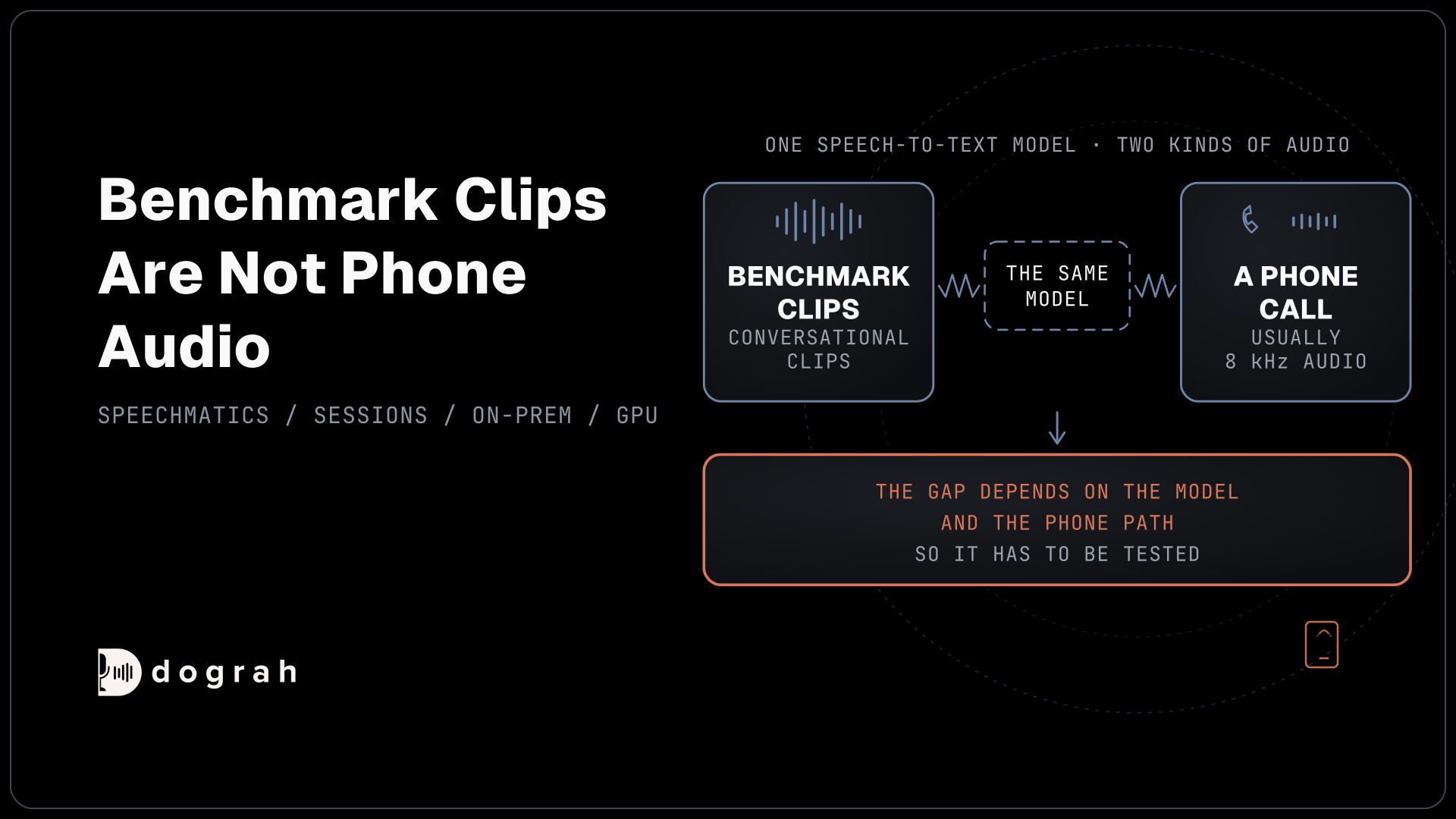
These clips are not phone audio. A phone call usually arrives as 8 kHz audio, half the 16 kHz a browser demo gets. In our experience the error rate on a phone call can be up to three times higher than on a web call, though the gap depends on the model and the phone path, so it has to be tested. Our review of the best speech-to-text APIs, tested on voice agent calls shows how phone codecs move each model.
When staying on Speechmatics makes sense
Speechmatics still fits many live agents. If your callers speak languages it covers well, your peak sits under 50 calls or you are on Enterprise, and region pinning meets your data rules, the case for moving is weak. Linden 1 sits near the top of an independent benchmark, and Speechmatics offers HIPAA and SOC 2 Type II on self-serve plans. Inside Dograh you can keep it and change only the layer that is failing you.
What moving off Speechmatics takes
Switching speech-to-text in Dograh means changing one setting. Add keys for two candidates, point one copy of the agent at each, and run the same 50 or so recorded calls from your own line through both, with your product names and account numbers in them. The Dictionary carries over, though how much it helps depends on each provider.
When a call goes wrong after the switch, each call's trace shows the speech-to-text, AI and voice time for every turn. That tells you whether the new provider is slower or simply mishearing.
Join the Dograh Community
Dograh is an OSS alternative to Vapi. Join our Slack community for queries, releases, best practices & community interactions.
Picking your Speechmatics alternative
Start with where the agent runs. If you want to change speech-to-text without rebuilding the call each time, Dograh fits, as an open-source platform you self-host or run on Dograh Cloud, with the provider as one setting per agent. Then pick the provider by your reason for leaving. Deepgram suits per-second billing and 150 open streams, and Soniox or Gladia suit callers across many languages. When the audio must stay inside your network, an open model such as Whisper or Parakeet is the route. Prove the shortlist on your own recorded calls before a live number moves.
Glossary
- Agent STT
- Speechmatics' streaming endpoint for voice agents, which runs the Linden 1 model and returns speaker-labeled turns. It is available on Speechmatics' cloud only, not in its on-prem containers.
- Real-time session
- One open stream of live audio to a speech-to-text provider, which for a voice agent means one call. Speechmatics allows 50 at once on self-serve Pro.
- Additional vocabulary
- A list of words sent to Speechmatics so it recognizes product names and jargon. Words in a Dograh agent's Dictionary reach Speechmatics this way.
- Pooled word error rate
- Word errors counted across every clip in a test set together, rather than averaged clip by clip. Pipecat's streaming benchmark reports it for each speech-to-text model.